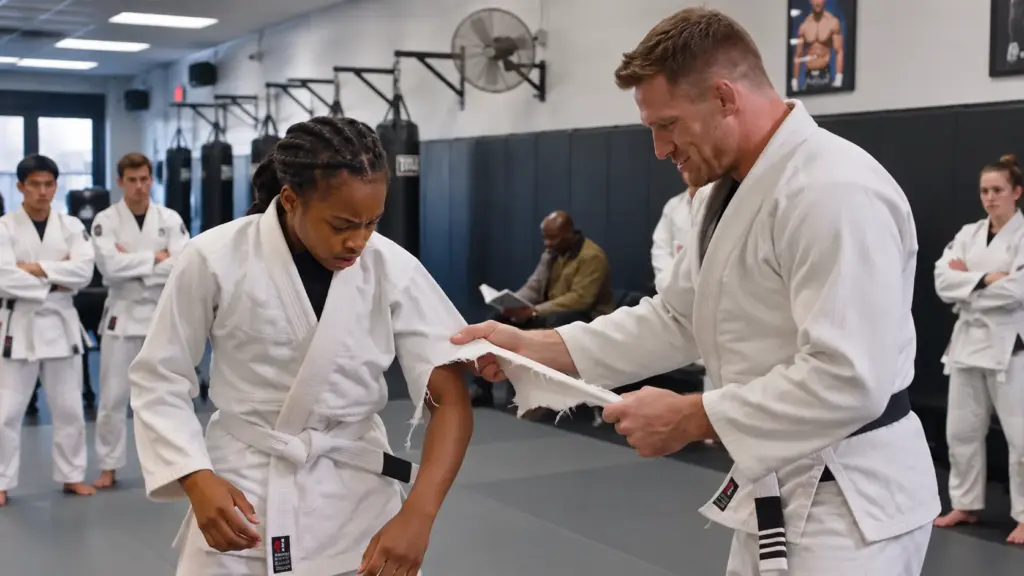
“My mother wore it when she trained.”
“Where is she?”
Amara’s eyes lowered.
“She died two years ago.”
Daniel went still.
For the first time that afternoon, his expression changed.
“I’m sorry.”
Amara touched the damaged fabric.
“She taught me everything I know. I wanted to wear it for my first competition.”
Daniel looked at the faded embroidery near the collar.
A name had been stitched there in dark blue thread.
N. ELLIS.
His breathing changed.
He looked at Amara.
“Your mother’s name was Naomi?”
Amara nodded.
“Naomi Ellis.”
Daniel stared at the uniform.
Then he slowly sat down on the edge of the mat.
Reed noticed immediately.
“Daniel?”
But Daniel was looking at Amara.
“Your mother trained in Baltimore?”
“Yes.”
“At Eastside Grappling?”
Amara’s eyes widened.
“How do you know that?”
Daniel swallowed.
“Because I knew your mother.”
The room fell completely silent.
Amara took a small step forward.
“You did?”
Daniel nodded.
“She was one of my first students.”
Amara stared at him.
“Mom never told me about you.”
Daniel smiled sadly.
“She probably had more important stories.”
He looked down at the uniform.
“She was seventeen when she first walked into my gym. Didn’t have money for lessons. Worked evenings at a grocery store.”
Amara listened without moving.
“She asked whether she could clean the mats in exchange for training.”
Daniel paused.
“I told her yes.”
Reed lowered his head.
He remembered Naomi.
Everyone who had trained at Eastside remembered her.
Daniel continued.
“Your mother was stubborn. Determined. Never complained. She became one of the best students I ever taught.”
Amara’s eyes filled with tears.
“She told me martial arts wasn’t about hurting people.”
Daniel nodded.
“That’s exactly what she used to say.”
He looked toward Brock.
“She understood something that some people spend their entire lives trying to learn.”
Brock lowered his gaze.
Daniel turned back toward Amara.
“Why did you come here?”
She hesitated.
“I wanted to compete. Mom always said I should keep training.”
“Then you should.”
Amara looked at her torn uniform.
“But now—”
“We’ll repair it.”
She shook her head.
“It’s ruined.”
Daniel examined the seam again.
“No. It’s torn. Those aren’t the same thing.”
He stood.
“There’s a woman named Mrs. Alvarez who runs a tailoring shop two blocks from here. She repaired my uniforms for years. If anyone can restore this, she can.”
Amara smiled through her tears.
“Really?”
“Really.”
Then Daniel looked toward Keith.
“I want the incident report completed before we leave. And I want the security footage preserved.”
Keith nodded quickly.
“Of course.”
Brock finally spoke.
“Look, I didn’t know the uniform belonged to her mother.”
Daniel turned.
“Would it have been acceptable if it didn’t?”
Brock opened his mouth.
Then closed it.
“No.”
Daniel waited.
Brock looked toward Amara.
“I’m sorry.”
She said nothing.
He continued.
“I was trying to make people laugh. I didn’t think about what I was doing.”
Amara looked at him.
“You thought about it enough to film me.”
Brock lowered his eyes.
“You’re right.”
For once, he had no clever answer.
Daniel placed a hand on Amara’s shoulder.
“You don’t owe him forgiveness.”
She nodded.
The police arrived several minutes later.
Statements were taken.
The footage was preserved.
Keith informed Brock, Julian, and Mason that their memberships were suspended pending a formal investigation.
For the first time, the academy’s owner seemed to understand that protecting his business meant protecting the people who trained there.
Three weeks later, Amara entered her first regional grappling tournament.
Her white gi had been repaired.
The stitching across the shoulder was slightly darker than the original fabric, but the embroidered name remained untouched.
N. ELLIS.
Daniel stood beside the competition area.
He had agreed to help prepare her.
Not because he wanted to return to professional coaching.
But because he had made a promise to himself long ago that he would never turn away someone who genuinely wanted to learn.
Amara lost her first match.
She was disappointed.
For several minutes, she sat silently on the bench, staring at the floor.
Daniel sat beside her.
“Do you know what your mother did after losing her first tournament?”
Amara shook her head.
“She cried in the parking lot.”
Amara looked surprised.
“Really?”
“Absolutely.”
“What did you say?”
Daniel smiled.
“I told her she could either quit or come back Monday.”
“What did she do?”
“She was waiting outside the gym before I arrived.”
Amara laughed.
Then she wiped her eyes.
“I’ll come back Monday.”
Daniel nodded.
“I know.”
Across the tournament hall, competitors celebrated victories, coaches shouted instructions, and families gathered around the mats.
But Daniel wasn’t watching the winners.
He was watching a sixteen-year-old girl carefully fold her repaired uniform into her gym bag.
And for the first time in many years, he felt that returning to the mat had given him something more meaningful than another championship.
It had given him a chance to continue a promise that began decades earlier.
Because the greatest martial artists aren’t remembered only for the opponents they defeat. They’re remembered for the people they protect, the confidence they restore, and the courage they help others discover.





