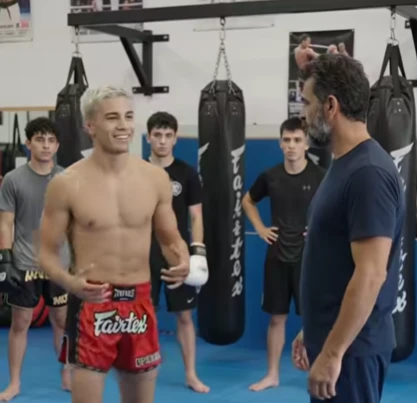
The first thing people noticed about Victor Kane was never the frayed, sweat-stained black belt wrapped securely around his waist.
It was not the heavy gold medals hanging around his neck in framed photographs, nor the massive, gleaming trophies displayed beneath the buzzing fluorescent lights of Iron Ridge Combat Gym. It was not the cauliflower ear he had somehow managed to avoid, nor the rugged, terrifying scars that most veteran fighters wore like badges of honor.
It was the silence.
It was a strange, heavy, almost suffocating stillness that followed him the moment he stepped through the glass front doors. The gym was usually a symphony of controlled violence. On any given Tuesday evening, Iron Ridge was deafening. The air would be filled with the rhythmic thwap-thwap-thwap of speed bags, the heavy, bone-rattling thuds of shins striking dense leather Thai pads, the sharp exhalations of breath, and the gruff barks of instructors correcting forms.
But when Victor arrived, the volume simply dropped. The tempo died.
Beginners who had been slouching against the chain-link walls would hurriedly sit up straight, crossing their legs in perfect posture. Teenagers who had been laughing and gossiping by the dented metal lockers would fall dead silent, suddenly looking intensely focused on re-tying their belts. Even seasoned, battle-scarred fighters—men who had bled on mats across the country—would pause their grueling drilling rounds, looking up from the canvas just to nod respectfully in his direction.
Victor Kane knew that silence intimately. More importantly, he had learned to crave it like oxygen. He fed on it.
At twenty-eight years old, he was the undisputed king of Iron Ridge, the uncrowned monarch of the county’s fight scene. Standing six feet two inches tall, he possessed impossibly broad shoulders and a physique sculpted by tens of thousands of grueling, agonizing hours. His dark hair was always meticulously styled, seemingly unaffected by the oppressive humidity of the gym. His jaw was sharp enough to cut glass, his dark eyes were perpetually cold, and his movements carried the absolute, terrifying certainty of a man who never, ever doubted his own supremacy.
For three long, blood-soaked years, Victor had been completely undefeated on the regional grappling and mixed martial arts circuits.
He had broken the spirits of hardened, Division I collegiate wrestlers who thought their conditioning could outlast him. He had choked out visiting Brazilian Jiu-Jitsu black belts who thought they could walk into his town, teach a seminar, and claim easy victories. He had humiliated former professional fighters who were desperately trying to cling to their fading glory.
Some opponents, fueled by foolish pride and adrenaline, managed to last a few excruciating minutes. They would survive just long enough to realize they were drowning in deep water. Others panicked immediately, tapping out in less than thirty seconds before their ligaments were completely severed.
Victor remembered every single victory. He remembered the smell of the canvas, the heat of the stadium lights, and the exact, intoxicating moment the will to fight evaporated from his opponents’ eyes. He could feel it every time—a subtle relaxation of their muscles, a frantic tap of their fingers, a quiet gasp of submission.
Seven elegantly framed photographs covered the wall of honor beside the main training mats.
The first showed him biting a gold medal, a smear of an opponent’s blood painted across his cheek. The second captured him holding a silver cup, while a defeated rival wept openly in the blurred background, face buried in taped hands. The fourth photo was a gruesome close-up of a devastating armbar; the sheer, unadulterated agony captured perfectly on the other man’s face as his elbow was bent past its natural limit.
But it was the seventh photograph—the largest one, placed dead center under a dedicated spotlight—that mattered most.
It was taken mere seconds after he had won the Northern State Grappling Championship. The match had been a brutal, twenty-minute war of attrition against a Russian sambo specialist. But Victor had won. The photograph showed him staring straight through the camera lens, eyes like icy daggers, both heavily taped fists raised in absolute authority. Beneath it was a heavy, polished brass plate, engraved with sharp block letters: VICTOR KANE — THREE-TIME REGIONAL CHAMPION.
Victor passed that wall every single morning. He always stopped to look. Sometimes he stood there for three seconds; sometimes he stood there for three minutes.
It reminded him of an absolute, undeniable truth: He was the apex predator. He was the standard. He was the exact mold every sweating, bleeding body in this gym was desperately trying to become. And in his mind, that singular greatness granted him the right to stand infinitely far above them all.
That Saturday morning, Iron Ridge Combat Gym was unusually packed, practically bursting at the seams.
The annual open-mat fundraiser had drawn families, rival academies, local politicians, and curious residents from across the county. The cracked asphalt parking lot was overflowing, cars parked on the grass and down the street.
Brightly colored banners hung above the entrance, flapping aggressively in the autumn wind. A large, hand-painted sign near the front desk—decorated with messy handprints of the junior class—read: IRON RIDGE YOUTH SCHOLARSHIP FUNDRAISER — EVERY CHILD DESERVES A CHANCE TO TRAIN.
Outside, enthusiastic volunteers were flipping hamburgers on portable charcoal grills. The rich smell of roasted meat, grilled onions, and fresh coffee drifted through the air, mixing with the crisp, cloudless autumn sky. Children chased each other across the grass, their faces painted with tigers and dragons, while parents chatted amiably, holding paper plates.
Inside, the atmosphere was a stark contrast to the wholesome carnival outside. The air was thick and heavy with the gym’s signature, intoxicating scent: clean rubber mats, industrial-strength disinfectant, chalk dust, and the sharp, metallic tang of sweat.
Head Coach Frank Wallace stood near the entrance, his massive, calloused hands gripping a worn plastic clipboard.





