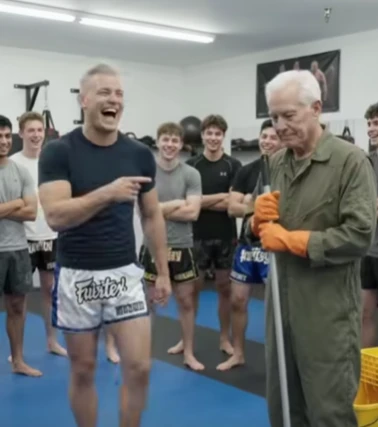
The young fighter tried to roll.
He couldn’t.
He attempted to push away.
Walter adjusted.
A tiny movement.
Less than an inch.
Dylan froze.
His shoulder was trapped.
He could feel the pressure increasing.
Walter leaned closer.
“Don’t struggle.”
Dylan gritted his teeth.
“Get off me.”
Walter loosened the hold slightly.
“Say stop.”
Dylan tried to twist free.
Pain flashed through his shoulder.
“Stop!”
Walter released immediately.
Marcus hit the timer.
Twenty-three seconds.
Nobody spoke.
Dylan remained on the mat, staring at the ceiling.
Walter rose carefully.
His left knee trembled.
He steadied himself.
Then extended a hand.
Dylan stared at it.
For a moment, Marcus thought the young man might strike him.
Instead, Dylan accepted the help.
Walter pulled him upright.
“Are you hurt?” he asked.
Dylan shook his head.
“No.”
“Good.”
Walter turned toward Marcus.
“Twenty-three seconds?”
Marcus nodded.
“Twenty-three.”
Walter looked toward the donation table.
“Then I suppose the children get their five hundred dollars.”
Nobody laughed.
Dylan looked toward the floor.
Then, slowly, he reached for his phone.
He opened his banking application.
Transferred the money.
And showed Marcus the confirmation.
“Done.”
Walter nodded.
“Thank you.”
Then he walked off the mat, put on his mismatched socks and work shoes, retrieved his keys, and returned to the orange stain.
The crowd remained silent.
Finally, a teenage girl near the front raised her hand.
“Mr. Bell?”
Walter looked up.
“Yes?”
“Where did you learn to do that?”
Walter paused.
“At school.”
The girl frowned.
“What school?”
Walter smiled.
“A very old one.”
Marcus approached.
“Walter.”
The janitor looked toward him.
“Yes?”
Marcus hesitated.
“What’s your full name?”
“Walter James Bell.”
Marcus stared.
Then something clicked.
He turned toward the equipment table, pulled out his phone, and searched an old wrestling archive.
Walter continued mopping.
Marcus scrolled.
Stopped.
Then looked up.
“No.”
Walter glanced toward him.
Marcus enlarged a photograph.
It showed a young Black wrestler standing on a podium in a packed arena.
He wore a dark singlet.
A medal hung around his neck.
The caption beneath the photograph read:
WALTER J. BELL — NATIONAL GRECO-ROMAN WRESTLING CHAMPION, 1982.
Marcus looked toward the janitor.
“You’re Walter Bell?”
Walter sighed.
“Apparently.”
Marcus stared.
“You won three national titles.”
Walter nodded.
“A long time ago.”
“You coached at the Olympic training center.”
“Briefly.”
“You trained Raymond Foster.”
Walter smiled.
“Raymond was a good kid.”
Marcus almost dropped his phone.
Raymond Foster was one of the most respected wrestling coaches in the country.
He had trained national champions.
He had written instructional books.
And he had once credited an older mentor named Walter Bell with teaching him everything he understood about balance.
Marcus looked around the room.
“Does anybody here understand who this man is?”
The spectators remained silent.
Marcus turned toward Dylan.
“You just challenged one of the finest technical wrestlers this state ever produced.”
Dylan stared at Walter.
The old man continued cleaning.
As though nothing extraordinary had happened.
Marcus approached him.
“Why didn’t you tell anyone?”
Walter stopped.
He looked toward the mat.
Then toward the children.
“Because I wasn’t asked.”
Marcus shook his head.
“You’ve been working here for eleven years.”
Walter nodded.
“Yes.”
“And nobody knew?”
Walter smiled faintly.
“People know what they need to know.”
Marcus studied him.
“Why did you leave wrestling?”
The question changed Walter’s expression.
He rested both hands on the mop handle.
For several seconds, he said nothing.
Then he looked toward the windows.
“My wife.”
The room quieted again.
“She got sick.”
Walter swallowed.
“At first, I thought I’d take a year away from coaching. Then one year became three. Medical bills came. I took whatever work I could find.”
He paused.
“She passed away twelve years ago.”
Marcus lowered his eyes.
“I’m sorry.”
Walter nodded.
“Thank you.”
He looked toward the children.
“After that, I didn’t have much interest in competitions.”
Dylan approached slowly.
“Mr. Bell?”
Walter turned.
“Yes?”
The young fighter hesitated.
“I’m sorry.”
Walter waited.
Dylan continued.
“For making you the joke.”
Walter studied him.
Then nodded.
“Thank you.”
Dylan looked toward the mat.
“I thought you were just…”
He stopped.
Walter raised an eyebrow.
“Just what?”
Dylan swallowed.
“Just the janitor.”
Walter smiled sadly.
“There’s nothing wrong with being a janitor.”
Dylan nodded.
“I know.”
“No,” Walter replied gently. “I don’t think you did.”
The words stayed with him.
Marcus looked toward the donation table.
Then toward the crowd.
He picked up the microphone.
“Everyone, before we move on, I want to say something.”
The room turned toward him.
“Today was supposed to be about raising money for young athletes. Somewhere along the way, we started treating people like props.”
He glanced toward Dylan.
“And I let it happen.”
The admission surprised everyone.
Marcus continued.
“Mr. Bell didn’t owe us a demonstration. He didn’t owe us his history. He didn’t owe us anything except the work he was hired to do.”
He paused.
“But he gave us a lesson anyway.”
Marcus looked toward Walter.
“Not about fighting.”
“About respect.”
The crowd applauded.
Walter looked uncomfortable.
He raised one hand.
“Please.”
The applause slowly faded.
He cleared his throat.
“If you want to thank me, put something in the donation box.”
A few people laughed.
This time, Walter smiled too.
By the end of the afternoon, the fundraiser had exceeded its goal.
Dylan donated another five hundred dollars.
Several parents contributed extra money.
A local business owner offered to sponsor equipment for the youth wrestling program.
And Marcus made a decision that would change Eastbrook Sports Pavilion.
The following Monday, he approached Walter in the maintenance office.
“Can I ask you something?”
Walter looked up from a broken door hinge.
“Of course.”
“Would you consider teaching wrestling again?”
Walter shook his head.
“My knees won’t survive demonstrations.”
“You wouldn’t have to demonstrate everything.”
Walter smiled.
“I don’t know.”
Marcus sat down.
“We have kids here who can’t afford private coaching. Some of them are talented. Some just need somewhere safe to spend their afternoons.”





