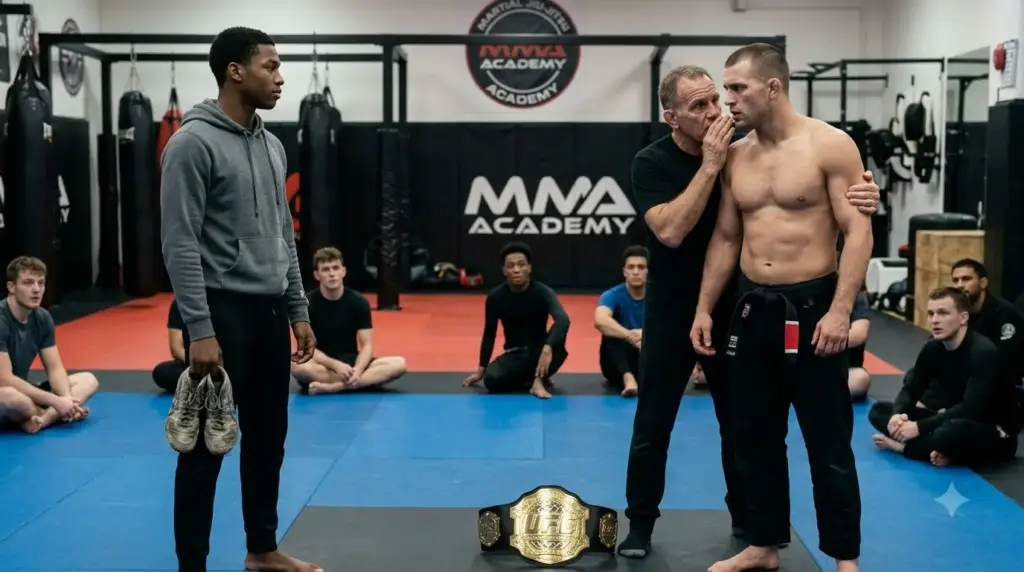
Samuel checked the clock.
One minute and forty-three seconds.
That was all it had taken.
Dylan sat on the mat, breathing heavily.
Caleb stood and offered his hand.
“Good round.”
Dylan stared at it.
He had expected applause.
Instead, he heard nothing.
The silence was unbearable.
He slapped Caleb’s hand away.
“Again.”
Richard stepped forward.
“No.”
Dylan stood.
“He caught me once.”
“He submitted you cleanly.”
“I want another round.”
Caleb looked at him.
“Why?”
Dylan’s jaw tightened.
“Because I’m better than that.”
Caleb nodded.
“Then train like it.”
The words landed harder than an insult.
Dylan stared at the teenager.
“What did you say?”
Caleb’s expression remained calm.
“If you’re better than that, you don’t need another round to prove it. You need to figure out why it happened.”
For several seconds, nobody moved.
Then Richard spoke.
“That’s enough.”
He picked up Dylan’s championship belt and handed it back.
“Take your belt.”
Dylan looked down at the gold plate.
An hour earlier, it had felt like proof that he was untouchable.
Now it felt strangely heavy.
Later that evening, Dylan found Caleb sitting alone near the lockers.
The teenager was tying his shoes.
Dylan stopped beside him.
“Can I ask you something?”
Caleb looked up.
“Sure.”
“Why didn’t you tell everyone who you were?”
Caleb shrugged.
“You didn’t ask.”
“I asked your rank.”
“And I told you.”
Dylan sat down.
“Richard said you’ve trained with world champions.”
“Some.”
“He said you’ve won major junior tournaments.”
“A few.”
“And your father?”
Caleb’s expression softened.
“He taught me most of what I know.”
Dylan hesitated.
“Why haven’t I heard of him?”
Caleb looked at his hands.
“He stopped competing before I was born. He runs a small gym. Mostly teaches kids.”
“That’s it?”
Caleb smiled.
“That’s enough for him.”
Dylan was quiet.
Then he asked the question that had been bothering him.
“Why didn’t you take the belt?”
Caleb looked confused.
“Because it’s yours.”
“But you beat me.”
“In training.”
“You submitted me.”
“That doesn’t mean I earned your championship.”
Dylan stared at him.
For the first time that evening, he had no argument.
Caleb continued.
“You won that belt in competition. You worked for it. One round with me doesn’t erase that.”
Dylan looked down.
“I was trying to embarrass you.”
“I know.”
“And you still respected me.”
Caleb finished tying his shoes.
“My dad says you learn more about someone after a round than during it.”
Dylan swallowed.
“What did you learn about me?”
Caleb considered the question.
“You’re really good.”
Dylan blinked.
“That’s it?”
“No.”
Caleb stood.
“You’re also scared of people finding out you’re not the best at everything.”
Dylan felt his face burn.
The teenager wasn’t mocking him.
That made the words harder to dismiss.
Caleb picked up his bag.
“Everybody loses in training. That’s why we train.”
Then he walked toward the exit.
Dylan remained on the bench.
Alone with his championship belt.
The following morning, Dylan arrived at Riverstone before sunrise.
Richard was already there.
The coach looked surprised.
“Early.”
Dylan placed his belt on a shelf.
“I need to work on my guard passing.”
Richard smiled faintly.
“That’s a good place to start.”
Dylan hesitated.
“And I owe Caleb an apology.”
Richard nodded.
“Yes, you do.”
For the next two hours, they drilled the exact sequence that had led to the submission.
No audience.
No cameras.
No championship announcements.
Just repetition.
Mistakes.
Corrections.
And progress.
Two weeks later, Caleb returned to Riverstone with his father.
Dylan approached them before training began.
He looked at David Brooks.
Then at Caleb.
“I owe you an apology,” he said.
Caleb nodded.
Dylan continued.
“I treated you like you were beneath me because you didn’t look impressive. And when you beat me, I acted like a child.”
Caleb smiled slightly.
“It’s okay.”
“No,” Dylan said. “It wasn’t. But I’m working on it.”
David Brooks studied him.
Then extended his hand.
“That’s all any coach can ask.”
Dylan shook it.
That afternoon, Dylan and Caleb trained together.
They exchanged techniques.
They drilled escapes.
They laughed when things went wrong.
And when Caleb caught Dylan in another submission, Dylan tapped immediately.
Then asked:
“Show me how you set that up.”
Caleb grinned.
“Thought you’d never ask.”
Months later, Dylan defended his championship belt in front of a packed arena.
The match was difficult.
His opponent was younger, faster, and relentless.
But Dylan remained composed.
He defended patiently, adjusted his strategy, and eventually secured a submission in the final minute.
The crowd erupted.
Reporters surrounded him afterward.
One asked:
“Dylan, what’s changed most about your game this year?”
Dylan looked at the championship belt resting on his shoulder.
Then toward the crowd.
Caleb stood beside David and Richard near the front row.
Dylan smiled.
“I learned how to lose.”
The reporter looked confused.
“You’re on a winning streak.”
Dylan nodded.
“That’s exactly why I needed the lesson.”
He explained that a quiet teenager had submitted him during an open-mat session.
That he had reacted badly.
That his coach had warned him to walk away, but he had refused.
“And what did that teach you?” the reporter asked.
Dylan looked directly into the camera.
“That being a champion doesn’t mean you’re better than everyone in the room. It means you’re responsible for how you behave when someone proves you’re not.”
Years later, people still told the story of the champion who wagered his belt against an unknown teenager.
They remembered the coach’s warning.
They remembered the armbar.
They remembered the stunned silence.
But Dylan remembered something different.
A quiet eighteen-year-old who refused to take a belt he hadn’t earned.
A teenager who had every opportunity to humiliate him but chose not to.
And a simple lesson that changed the way he trained, competed, and treated people.
The strongest fighter isn’t always the one who wins every round. Sometimes, it’s the one who can lose, admit it, learn from it, and return to the mat without needing to prove anything.





