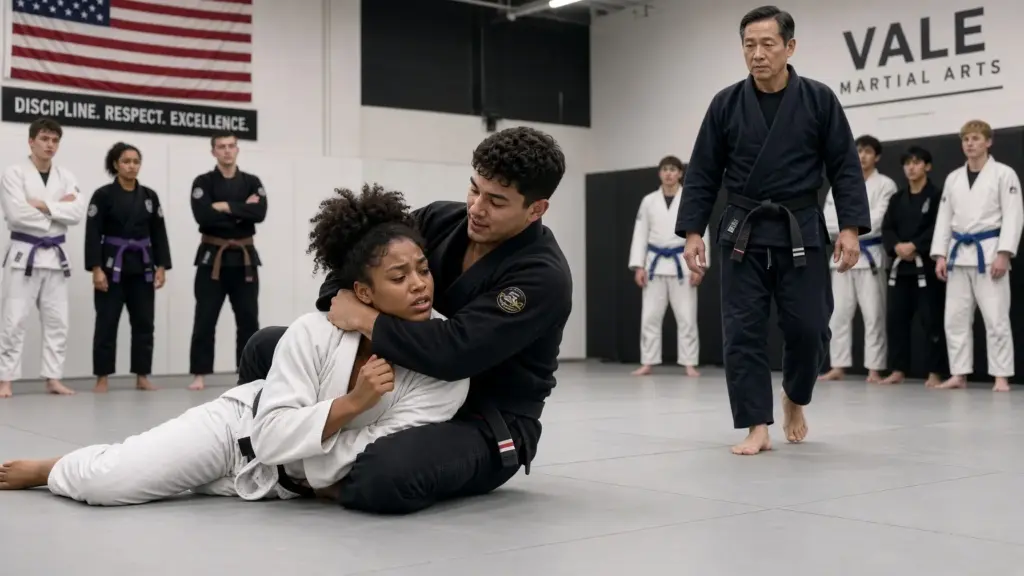
Adrian nodded.
“That’s a long time.”
“And suddenly somebody walks in, and everyone acts like she’s special.”
Adrian looked toward the mat.
Lena was helping a younger student adjust her stance.
“Marcus, has anything Lena done taken away from what you’ve accomplished?”
Marcus didn’t answer.
Adrian continued.
“Your medals are still yours. Your experience is still yours.”
He paused.
“So why does her presence bother you?”
Marcus stared at him.
Then walked away.
The next two rounds were uneventful.
Lena trained with different partners.
She made mistakes.
Accepted corrections.
Offered suggestions when asked.
By the end of the session, most students had stopped thinking about her belt.
But Marcus hadn’t.
As everyone began packing their equipment, he approached Raymond.
“I want a formal assessment.”
Raymond looked up from his clipboard.
“For whom?”
“Lena.”
“She’s already being assessed.”
“Not properly.”
Raymond sighed.
“Marcus.”
“I want her tested under competition conditions.”
Adrian, standing nearby, turned.
“Why?”
Marcus looked at him.
“Because I want to know whether she’s actually good.”
Adrian nodded.
“Then ask Raymond.”
“I am asking Raymond.”
Raymond closed his clipboard.
“All right.”
Marcus looked surprised.
“All right?”
“Yes. We’ll hold an assessment next Saturday.”
Marcus smiled.
“Good.”
Raymond continued.
“But you won’t be conducting it.”
The smile disappeared.
“What?”
“You’re not impartial.”
Marcus stared at him.
“You’re kidding.”
“No.”
“I’ve coached here for years.”
“And right now, you’re treating a new student like an opponent.”
Marcus looked away.
Raymond’s voice softened.
“That’s not what I need from an instructor.”
Saturday arrived.
Northbridge’s assessment room was smaller than the main training hall.
There were no spectators except instructors and a few invited senior students.
Lena arrived wearing her borrowed white gi.
Marcus sat near the wall.
He had insisted on attending.
Raymond allowed it on one condition.
He would observe silently.
The assessment began with basic movements.
Then positional drills.
Then controlled sparring.
Lena performed well.
Not perfectly.
She made several errors during the striking portion.
Her timing was slightly off against an experienced kickboxer.
She admitted afterward that she needed more work in that area.
But during grappling rounds, her experience became unmistakable.
She moved with patience.
Maintained balance under pressure.
Recognized transitions quickly.
And never used unnecessary force.
One of the senior instructors, a fourth-degree black belt named Victor Han, watched closely.
After the final round, he approached Raymond.
“How long has she trained?”
“Eight years.”
Victor nodded.
“That makes sense.”
Marcus leaned forward.
“What does?”
Victor looked at him.
“Her movement.”
Marcus crossed his arms.
“She made mistakes.”
Victor smiled.
“So did everyone else.”
Marcus said nothing.
Victor continued.
“That’s why we train.”
After the assessment, Raymond invited Lena into his office.
Adrian joined them.
Marcus remained outside.
Inside, Raymond placed the evaluation sheet on the desk.
“Lena, your grappling is excellent.”
“Thank you.”
“Your striking needs adjustment to our system.”
“I know.”
“But your overall experience is well beyond beginner level.”
Lena nodded.
Raymond smiled.
“I’d like you to continue training with the advanced group.”
“Okay.”
“And we’ll establish a formal progression plan for your ranking.”
“Thank you.”
Adrian looked proud.
Raymond turned toward him.
“Evelyn would be pleased.”
Adrian’s expression softened.
“She would.”
Lena looked down.
For a moment, the mention of her former coach made her emotional.
Then she smiled.
“I wish she could see this.”
Raymond nodded.
“So do I.”
Outside, Marcus waited.
When Lena emerged, he stood.
“Well?”
She looked at him.
“Well what?”
“Did you pass?”
“Yes.”
Marcus frowned.
“What rank?”
“Raymond’s working that out.”
He laughed.
“So you’re still a white belt.”
Lena nodded.
“For now.”
Marcus shook his head.
“Unbelievable.”
Lena looked at him for several seconds.
Then asked a question he hadn’t expected.
“Why does it matter so much to you?”
Marcus stared.
“What?”
“My belt.”
He looked uncomfortable.
“It doesn’t.”
“Then why do you keep asking?”
Marcus said nothing.
Lena continued.
“I came here because I wanted somewhere to train. I didn’t ask for your position. I didn’t ask for your students. I didn’t ask for your attention.”
He looked away.
She paused.
“But every time I walk into this room, you act like I’m taking something from you.”
Marcus’s face reddened.
“That’s not fair.”
Lena nodded.
“Maybe not.”
Then she walked away.
That evening, Marcus returned to Northbridge after everyone had left.
Raymond was cleaning the mats.
Marcus stood near the doorway.
“Coach?”
Raymond looked up.
“Yeah?”
“Can we talk?”
Raymond set down the mop.
“Of course.”
Marcus sat on a bench.
For several minutes, he said nothing.
Then he asked, “Do you think I’m a bad instructor?”
Raymond considered the question.
“I think you’re a talented fighter.”
Marcus looked down.
“That’s not what I asked.”
Raymond nodded.
“No.”
He sat beside him.
“Marcus, when you first came here, you were sixteen.”
“I remember.”
“You were angry all the time.”
Marcus smiled faintly.
“Yeah.”
“You wanted to fight everybody.”
“Pretty much.”
Raymond continued.
“But you worked hard. You listened. You improved.”
Marcus nodded.
“And somewhere along the way, you became very successful.”
He looked toward the championship photographs.
“Maybe too successful.”
Marcus frowned.
“What does that mean?”
“It means people stopped correcting you.”
The words landed heavily.
Raymond continued.
“Students admire you. Parents praise you. Sponsors want photographs with you.”
He paused.
“But admiration can become dangerous when you start needing it.”
Marcus stared at the floor.
Raymond placed a hand on his shoulder.
“You don’t have to be the best person in every room.”
Marcus swallowed.
“I know.”
“Do you?”
For a long time, Marcus didn’t answer.
Then he whispered, “I’m trying.”
Over the next month, Marcus began making small changes.
He stopped interrupting other instructors.
He asked students what they wanted to improve.
He allowed beginners to make mistakes without turning every correction into a public lesson.
And he stopped treating Lena like a problem.
At first, their interactions were awkward.
Then ordinary.
One afternoon, Marcus approached her after class.
“Lena?”
She looked up.
“Yeah?”
“I owe you an apology.”
She waited.





