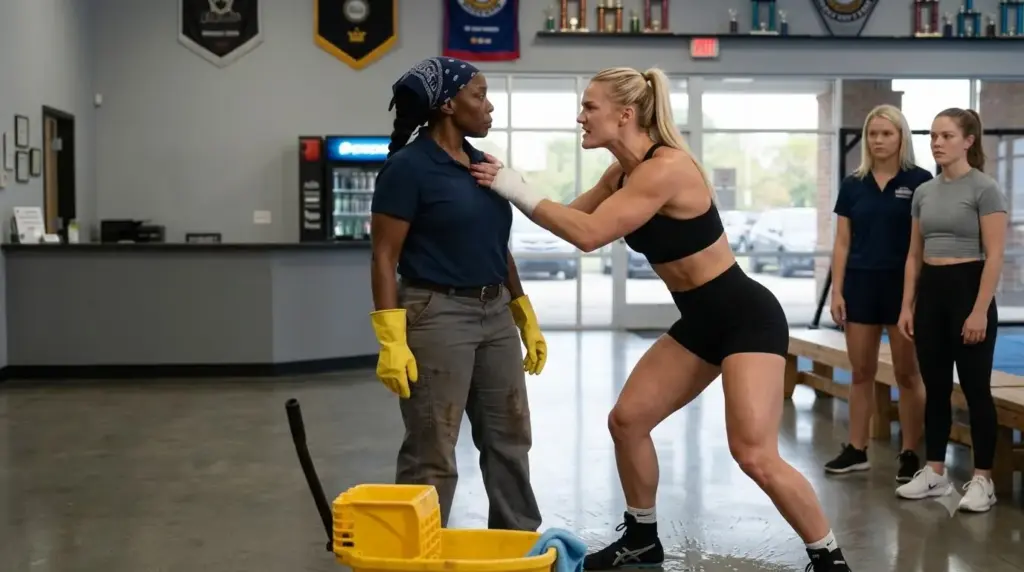
The Champion Pushed the Cleaning Lady Aside — Unaware She Had Never Lost a Fight
Chapter 1: The Woman Behind the Yellow Mop Bucket
The laughter was what Miriam Cade remembered most.
Not the shove. Not the sharp pain shooting through her left knee. Not even the humiliation of landing against the edge of a boxing platform while more than a hundred people watched.
It was the laughter.
At fifty-seven, Miriam had learned that some people laughed because something was funny, while others laughed because they were relieved not to be the person being humiliated.
On that rainy Friday afternoon in Milwaukee, Wisconsin, she heard both kinds.
The East Harbor Athletic Pavilion was hosting one of its biggest promotional events of the year. Television crews, sponsors, journalists, and invited guests had gathered to watch Silas Creed, the undefeated regional light-heavyweight boxing champion, demonstrate the skills that had made him one of the Midwest’s most promising fighters.
Silas was thirty-one, handsome, wealthy, and exceptionally talented.
He had won nineteen professional fights without a loss. Eleven victories had come by knockout. His management team was negotiating an exhibition series worth more money than most of the pavilion’s employees would earn in a decade.
Everywhere he went, people wanted photographs.
Everywhere he spoke, people listened.
And somewhere along the way, Silas had begun believing that being admired meant he could treat others however he pleased.
Miriam knew almost nothing about his record.
She had worked at the pavilion for four years, arriving before sunrise, cleaning locker rooms, repairing small maintenance problems, and making sure the training areas remained safe.
Her navy work trousers were faded. Her silver hair was pulled into a practical bun, and her left knee had troubled her for years.
She wasn’t interested in cameras.
She was interested in finishing her shift.
That afternoon, someone had spilled a large sports drink near the edge of the training platform.
Miriam placed a yellow caution sign beside the wet patch and began cleaning.
Then Silas arrived.
“Move it, sweetheart,” he said.
Miriam looked up.
He was walking toward her with his trainer, a photographer, and two members of the production crew.
“The floor’s wet,” she replied. “Give me another minute.”
Silas glanced at the cameras.
“They’re filming me.”
“The floor is wet either way.”
Someone nearby laughed.
Silas stopped.
He had expected an apology.
Instead, a cleaning woman had corrected him in front of his audience.
His smile tightened.
“Did you hear what I said?”
“Yes.”
“Then move.”
Miriam pulled her bucket closer to the wall.
“You can walk around. There’s plenty of room.”
Another chuckle came from the spectators.
Silas looked toward the sound.
Then back at Miriam.
“You’re making this difficult.”
“I’m trying to keep somebody from slipping.”
He kicked the caution sign aside.
Miriam bent to retrieve it.
And Silas shoved her.
Hard.
Her heel slid across the wet floor. Her injured knee buckled, and she struck the padded platform with her hip before catching herself.
The mop clattered across the tiles.
Water spilled from the bucket.
A few spectators laughed, believing the moment was part of a staged comedy routine.
Silas grinned.
“Guess she was right about the floor.”
But near the front row, a young girl in a green sweatshirt lowered her phone.
“You pushed her!”
Silas glanced toward the child.
“Barely touched her.”
Miriam remained still for several seconds.
Pain traveled from her knee into her lower back.
She tested her hand, then slowly rose with the help of the platform.
She didn’t shout.
Didn’t threaten him.
Didn’t even ask for an apology.
Instead, she looked toward the spreading water.
“Please keep people back until I clean this.”
Silas stared at her.
Something about her composure irritated him.
Most people would have been embarrassed.
Some would have cried.
Others would have shouted.
But Miriam behaved as though his arrogance were simply another mess that needed cleaning.
“You got something to say to me?” he demanded.
Miriam met his eyes.
“I just did.”
A few people laughed again.
Silas’s face darkened.
“Do you know who I am?”
Miriam glanced at the enormous promotional banner behind him.
His photograph occupied nearly half the wall.
“I can read.”
The laughter became louder.
Silas stopped smiling.
His trainer, Malcolm Price, stepped forward.
“Silas. Enough.”
But the champion ignored him.
“You’re pretty disrespectful for someone pushing a mop.”
Miriam bent carefully to retrieve the caution sign.
“And you’re making it harder for me to do my job.”
Silas looked toward the photographer.
“Are you recording this?”
The photographer hesitated.
“Some of it.”
“Good.”
Silas pointed toward Miriam.
“Maybe we should teach her a little respect.”
Malcolm’s expression changed.
“Don’t.”
Silas laughed.
“Relax. I’m joking.”
Miriam looked at him.
“No, you’re not.”
The words were quiet.
But they landed with unexpected force.
For a moment, the champion seemed unsure what to say.
Then he grinned.
“All right, Grandma. You think you’re so tough?”
Miriam sighed.
“I’m trying to clean the floor.”
“Come on. Step into the ring.”
The nearest spectators turned.
Malcolm shook his head.
“Silas, stop embarrassing yourself.”
But Silas was already enjoying the attention.
“One round,” he announced. “Thirty seconds. No punches. Just see if she can stay standing.”
A few guests laughed nervously.
Miriam looked at the boxing platform.
Then at Silas.
“No.”
Silas spread his arms.
“Scared?”
“No.”
“Then what’s the problem?”
Miriam looked down at her injured knee.
“I’m fifty-seven years old, and you just pushed me onto a wet floor.”
For a moment, the crowd fell silent.
The young girl in green spoke again.
“She doesn’t have to fight you!”
Her mother gently pulled her backward.
Silas ignored them.
“Come on. I’ll give you five thousand dollars if you last thirty seconds.”
Miriam looked at him.
“Keep your money.”
Silas laughed.
“Five thousand dollars? You probably make that in three months.”
Miriam’s expression changed.
Not into anger.
Into disappointment.
“Money doesn’t make you important, son.”
Silas stepped closer.
“Maybe not. But winning does.”
Miriam studied him.





