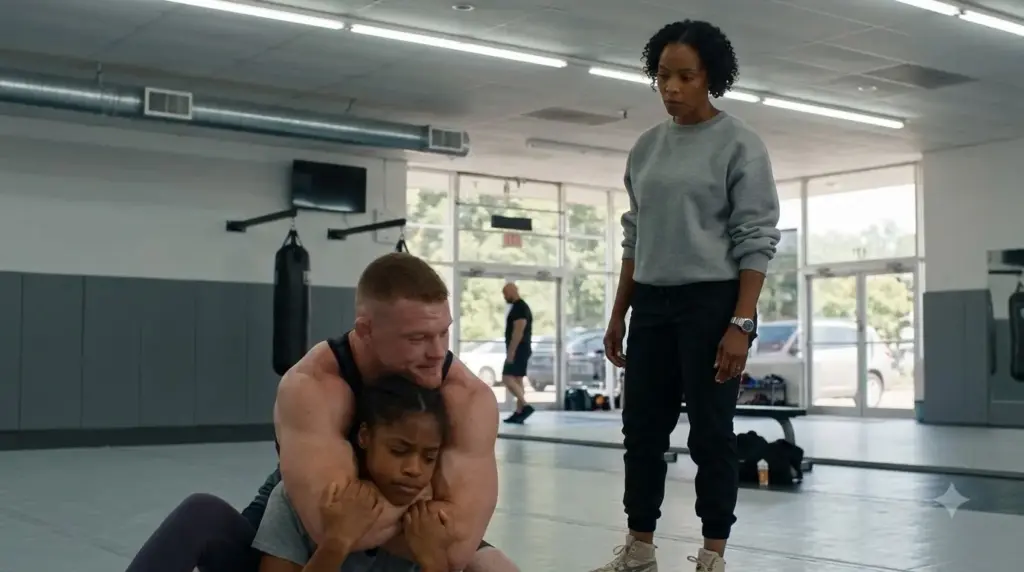
“Grant said I embarrassed the academy.”
Evelyn felt something tighten in her chest.
“When did he say that?”
“Before the exhibition.”
Caroline turned sharply.
“Tessa, you never told me that.”
Tessa’s eyes filled with tears.
“He said if I couldn’t handle the demonstration, I didn’t deserve to compete.”
Evelyn waited.
Tessa continued.
“I’ve trained there for four years. I thought if I worked hard enough, he’d finally respect me.”
She wiped her face.
“Then he asked me to participate in the exhibition. I thought it meant he believed in me.”
Evelyn leaned forward.
“Did you know he was going to apply that hold?”
“Yes.”
“Did you agree that he could continue after you tapped?”
Tessa looked horrified.
“No.”
“Did anyone tell you that was part of the demonstration?”
“No.”
Evelyn nodded.
“Then you did nothing wrong by surrendering.”
Tessa looked toward her mother.
For several seconds, she said nothing.
Then she whispered, “I thought I was supposed to be tougher.”
Caroline sat beside her daughter.
“You were supposed to be safe.”
Tessa began to cry.
And Evelyn understood that the physical injury was only part of what had happened.
Three days later, the commission began its formal review.
The first person interviewed was Paul Mercer, the referee.
He arrived carrying a folder.
His hands trembled slightly.
Evelyn sat across from him.
“Paul, how long have you been officiating?”
“Eleven years.”
“How many events have you refereed?”
“Hundreds.”
“Have you ever seen a fighter tap?”
“Of course.”
“What are you required to do?”
“Stop the action.”
“Did Tessa Marlow tap?”
Paul lowered his eyes.
“Yes.”
“Did you recognize it?”
“Yes.”
“Did you order Grant Voss to release?”
“Yes.”
Evelyn paused.
“Then why wasn’t the hold stopped immediately?”
Paul rubbed his forehead.
“Because Grant wouldn’t let go.”
“Did you attempt to intervene?”
“Yes.”
“Did you call for assistance?”
“No.”
“Why?”
Paul was silent.
Then he opened his folder.
Inside were copies of emails.
He pushed them across the table.
Evelyn read the first.
It was from Leonard Price.
The message instructed officials to avoid unnecessary interruptions during Grant’s exhibition demonstrations.
Another email warned that referees who interfered with the event’s presentation could lose future assignments.
Evelyn looked up.
“Did you interpret these messages as pressure not to stop Grant?”
Paul nodded.
“Yes.”
“Did you report that concern?”
“No.”
“Why not?”
He stared at his hands.
“Because I needed the work.”
Evelyn considered his answer.
Then said, “I understand the pressure. But Tessa needed you to protect her.”
Paul’s eyes filled with tears.
“I know.”
He looked toward the window.
“I keep seeing her hand tapping.”
The investigation uncovered more than a single incident.
Over the previous eighteen months, Grant had participated in several demonstrations where less experienced fighters reported being pressured to continue after signaling discomfort.
Some described being mocked for stopping.
Others said they were threatened with losing opportunities to compete.
One former athlete, nineteen-year-old Maya Ellis, provided a statement about an exhibition in which she had been injured.
She had complained to management.
Nothing happened.
Instead, she was removed from the academy’s competitive team.
Evelyn reviewed the records.
The pattern was becoming clear.
Grant wasn’t simply an aggressive competitor.
He had been allowed to treat safety rules as optional whenever they interfered with his performance.
And Leonard Price had helped create an environment where officials were reluctant to challenge him.
But the most disturbing discovery came from an unexpected source.
Marcus Pell.
The security officer who had tried to stop Evelyn from entering the mat.
He requested a private meeting.
When Evelyn arrived, Marcus was waiting with a small external drive.
“I think you need to see this.”
Evelyn sat down.
“What is it?”
“Security footage.”
“From the exhibition?”
“Yes. But not from the cameras everyone knows about.”
Marcus connected the drive to a computer.
A recording appeared.
It showed the backstage corridor fifteen minutes before the demonstration.
Grant stood beside Leonard.
They were speaking quietly.
The audio was faint but understandable.
Leonard pointed toward the training floor.
“Make it memorable.”
Grant laughed.
“She’ll tap.”
Leonard shrugged.
“Then give the audience a few seconds.”
Evelyn watched without moving.
Grant smiled.
“They’ll love it.”
The recording ended.
Marcus looked at her.
“I didn’t know what they meant until I saw what happened.”
Evelyn remained silent for several seconds.
Then asked, “Is this the original recording?”
Marcus nodded.
“The system automatically saves a backup.”
“Has anyone altered it?”
“No.”
“Are you willing to provide a statement about how it was obtained?”
Marcus swallowed.
“Yes.”
Evelyn looked at the screen.
The incident had no longer been merely a failure to stop an unsafe hold.
The recording suggested that the people responsible for the exhibition had anticipated a delayed release and treated it as entertainment.
She closed the laptop.
“Thank you, Marcus.”
He looked uncomfortable.
“I should’ve done something sooner.”
Evelyn nodded.
“Yes.”
Then she added, “You can still help by telling the truth.”
The commission scheduled a hearing.
Grant arrived wearing an expensive suit and a confident smile.
Leonard sat beside his attorney.
Several reporters waited outside.
Evelyn presented the evidence.
Medical documentation.
Witness statements.
Referee testimony.
And the backstage recording.
When the footage played, Grant’s expression changed.
Leonard leaned toward his attorney.
The room remained silent.
Afterward, the hearing officer turned toward Grant.
“Mr. Voss, did you understand that Ms. Marlow had surrendered?”
Grant shifted in his chair.
“Yes.”
“Did you hear the referee order you to release?”
“Yes.”
“Why did you continue?”
Grant looked toward Leonard.
Then back at the hearing officer.
“I was trying to make the demonstration realistic.”
The officer studied him.
“Realistic for whom?”
Grant said nothing.
“Ms. Marlow had withdrawn her participation in that hold. What justified continuing?”
Grant lowered his eyes.
For the first time, he had no audience cheering for him.
No music.
No championship belt.
Just a room full of people waiting for an answer.
He couldn’t provide one.





