The Baseball Legend Laughed at His Old Glove — Then the Boy Made a $100,000 Promise
Chapter 1: Three Pitches for a Dream
One hundred thousand dollars.
I had never seen that much money in my life.
The largest amount I’d ever held was six hundred and twelve dollars, collected in a coffee can during a fundraiser for our neighborhood baseball field.
We needed twelve thousand to repair the lights, replace the broken fencing, and keep the program running another summer.
We raised six hundred and twelve.
Then the city posted a notice on the gate.
FIELD CLOSED UNTIL FURTHER NOTICE.
That was three weeks before I arrived at Arlington Ballpark.
And now Tom Reynolds, one of the most famous baseball players in history, was offering enough money to save our field nearly ten times over.
All I had to do was throw three strikes.
Against a professional hitter.
In front of thirty thousand people.
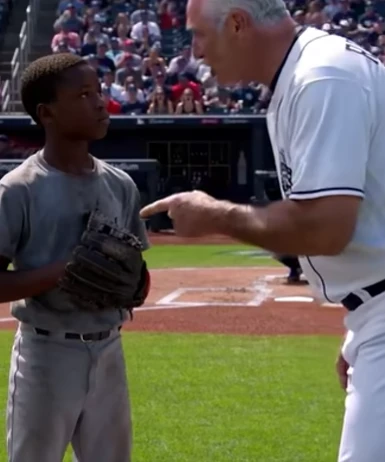
Tom grinned down at me.
“Well, kid? What do you say?”
The television host, Melissa Grant, pushed her microphone toward my face.
I looked at the baseball in my hand.
Then at the old glove hanging from my left wrist.
My father had stitched that glove together at our kitchen table.
I could still remember the way he held it beneath the lamp, squinting at the fishing line as he worked.
“Don’t throw something away just because it needs fixing,” he’d told me.
That had been eight months before he died.
I swallowed.
“Can I choose any youth baseball program?”
Tom laughed.
“Absolutely.”
“Even one nobody’s heard of?”
“Sure, kid.”
I nodded.
“Then I’ll do it.”
The stadium erupted.
Tom raised both hands.
“There you have it! Three pitches, three strikes, and one hundred thousand dollars!”
Melissa turned toward the camera.
“Folks, I think we just found the bravest eleven-year-old in Texas!”
People cheered.
Some laughed.
Others pointed their phones toward the field.
But I wasn’t looking at them anymore.
I was thinking about a chain-link fence covered in rust.
A crooked home plate.
And twelve kids who had nowhere left to play baseball.
My father used to say that baseball was a game of small things.
The way your fingers rested against the seams.
The angle of your shoulders.
The distance between your feet.
He said people loved home runs because they were loud, but games were often decided by moments nobody noticed.
My father noticed everything.
His name was Samuel Brooks.
He worked as a mechanic at a small repair shop outside Fort Worth.
He wasn’t famous.
He never played in the Major Leagues.
But every evening after work, he drove me to a dusty public baseball field behind an abandoned warehouse.
We practiced until the streetlights came on.
Sometimes longer.
He taught me to throw with control before he taught me to throw hard.
“Anybody can throw a ball at a wall,” he’d say. “The trick is knowing exactly where you want it to go.”
He would place an empty plastic bottle on a fence post.
Then he’d step back.
“Hit the bottle.”
At first, I missed.
A lot.
I threw high.
Low.
Left.
Right.
Sometimes the ball bounced into the weeds and took ten minutes to find.
But my father never laughed.
He simply picked up the bottle, set it back in place, and said, “Again.”
Eventually, I could hit it from twenty feet.
Then thirty.
Then forty.
By the time I turned ten, I could throw a baseball through a hanging tire from the distance of a regulation pitcher’s mound.
My father made the target smaller.
A paper cup.
Then a bottle cap taped to a board.
I didn’t always hit it.
But I learned how to aim.
And more importantly, I learned how to stay calm when I missed.
Then, one November morning, my father suffered a heart attack at work.
He never came home.
For weeks afterward, I couldn’t touch a baseball.
My mother tried to help.
She took me to the field.
Bought me a new ball.
Asked whether I wanted to join another team.
But every time I looked at the empty pitcher’s mound, I saw my father standing behind home plate.
Waiting.
Smiling.
Telling me to try again.
So I stayed away.
Until one evening, my mother found me sitting on the back steps with his old glove.
“Your dad loved that thing,” she said.
I nodded.
She sat beside me.
“You know what he’d say if he saw you now?”
I shook my head.
She smiled sadly.
“He’d tell you that baseball doesn’t stop being yours just because he’s gone.”
I cried that night.
Then the next morning, I returned to the field.
Alone.
And started throwing again.
Back at Arlington Ballpark, the organizers hurried to arrange the challenge.
A professional hitter named Jason Cole stepped toward home plate.
He was thirty-four, broad-shouldered, and known for his powerful swing.
He had agreed to participate in the youth showcase, but he hadn’t expected to face an eleven-year-old pitcher.
He crouched beside me before walking to the batter’s box.
“Hey, Elijah.”
“Yes, sir?”
“You know you don’t have to do this, right?”
I nodded.
“Yes, sir.”
“Thirty thousand people can make anybody nervous.”
“I know.”
Jason looked at my glove.
Then at my mismatched cleats.
“Those shoes comfortable?”
I nodded.
“They’re okay.”
He smiled.
“Good.”
Then his expression became serious.
“Listen. Whatever happens, don’t let the crowd get inside your head.”
I looked toward the stands.
“They’re pretty loud.”
Jason chuckled.
“They are.”
He stood.
“But the ball doesn’t care who’s watching.”
I smiled.
That sounded like something my father would have said.
Jason walked toward home plate.
Tom Reynolds approached me again.
“Ready, kid?”
I nodded.
Tom pointed toward the giant screen.
“Remember, three straight strikes. No second chances.”
“Yes, sir.”
“And no excuses.”
I looked at him.
“I wasn’t planning on making any.”
A few nearby players laughed.
Tom’s smile tightened.
He stepped away.
An umpire took his position behind the catcher.





