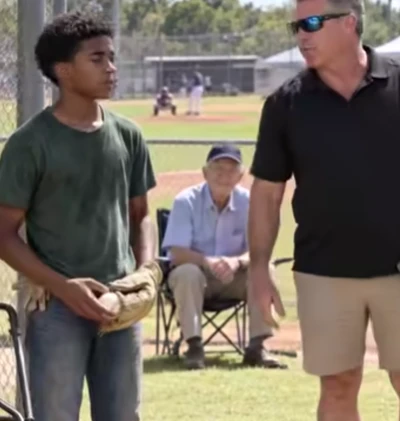
The first thing Franklin Hayes recognized was the throw.
The second was the name on the clipboard—and that was when the seventy-year-old scout realized somebody had lied to him.
But fourteen-year-old Caleb Turner knew nothing about that yet.
He was beyond the left-field fence, pushing a rattling lawn mower through grass thick enough to swallow his dusty sneakers.
Sweat darkened his faded green T-shirt.
His oversized work gloves slipped whenever he tightened his grip.
Inside the fence, summer tryouts had begun.
Gulf Coast Premier Baseball occupied the prettiest field in that peaceful Florida suburb.
White chalk gleamed against reddish dirt.
Wealthy parents watched beneath expensive tents while their sons warmed up with spotless uniforms and gloves that cost more than Caleb’s mother earned in a shift.
Caleb studied the players between passes of the mower.
The pitcher opened his front shoulder too early.
The shortstop moved before every outside pitch.
The catcher dropped his target whenever he expected a breaking ball.
“Eyes on your row.”
Uncle Ray stood beside the equipment shed, favoring his injured knee.
His graying beard shone with sweat.
“I’m watching.”
“The grass or the boys?”
Caleb looked down.
Ray’s expression softened, but his voice remained firm.
“Finish your work.
Keep your head down.
We aren’t here for them.”
There was something folded in his shirt pocket.
Every few minutes, he touched it.
Caleb had noticed.
He had also noticed Ray checking the entrance since eight that morning.
“Are we waiting for somebody?”
“Maybe.”
“Who?”
Ray pulled a weed from beside the shed.
“Somebody who ought to know better than to be late.”
Ray Turner had helped raise Caleb since he was six, when his father disappeared and his mother began working nights as a nurse.
Ray repaired what broke, stretched groceries, and answered the questions Caleb stopped asking his exhausted mother.
He maintained baseball diamonds throughout the county.
Caleb grew up around the game, but always near its edges: equipment sheds, locked gates, empty bleachers.
After the teams left, though, Ray brought out an old baseball.
“Show me what your body remembers.”
They practiced until the lights switched off.
Some evenings Ray sat on an overturned bucket because his knee hurt too badly to stand.
Other evenings Caleb’s mother watched from her car before driving to work, smiling over a paper cup of coffee.
Those hours belonged to them.
Nobody charged admission.
“Hey, lawn boy!”
Caleb looked up.
Preston Weller leaned against the dugout railing, blond hair beneath his cap and a silver chain bright against his collar.
His father sponsored two tournament teams.
Other boys rarely disagreed with Preston.
“You mowing grass or taking baseball lessons through the fence?”
Laughter broke out.
Caleb pushed the mower forward.
“Maybe he’s scouting us,” another player said.
Preston raised his phone.
“Watch out, guys.
He might tell the grass about us!”
More laughter.
Caleb’s face burned.
Near the dugout, Coach Darren Pike turned toward the noise.
His mirrored sunglasses reflected the fence, the mower, the boy standing outside it.
For one foolish second, Caleb expected him to intervene.
Pike looked away.
The silence from the adult hurt worse than the laughter from the boys.
Caleb lowered his head.
Across the field, Ray had stopped unloading fertilizer.
His rough hands rested on the truck’s tailgate.
He did not come over.
Caleb understood why.
Ray’s maintenance contract came up for renewal next month.
Hospital bills and rent did not disappear because somebody deserved a better uncle than a man who had to swallow his anger.
Practice continued.
A ground ball skipped toward third.
The fielder scooped it, hurried his feet, and threw.
The ball sailed beyond first base.
“Ball!”
It rolled through an opening beside the bullpen fence and stopped against Caleb’s sneaker.
He switched off the mower.
Without the engine, the laughter seemed closer.
Caleb removed his right glove, tucked it into his waistband, and picked up the baseball.
Pike gestured impatiently.
“Throw it back, kid.
And be careful.”
“Don’t hurt yourself!”
Preston called.
A few parents chuckled.
The catcher waited near home plate, glove hanging low.
It was a considerable distance.
Caleb could have walked closer.
Instead, his fingers settled across the seams.
He heard Ray’s voice as clearly as if his uncle stood beside him.
“Don’t throw angry.
Throw honest.”
Caleb turned his shoulders.
There was no theatrical windup.
Just a smooth gathering of weight, a compact step, and his right arm coming through.
The ball crossed the diamond on a startlingly low arc.
The catcher snatched his glove upward.
The leather cracked.
His hand dropped with the impact.
Every laugh stopped.
Pike lowered his clipboard.
Preston’s phone sank toward his chest.
Behind the parents, Franklin Hayes rose from his folding chair.
He had evaluated young pitchers for forty years.
Age had bent his shoulders and slowed his knees, but it had not changed his eyes.
“Boy,” he called.
Caleb’s stomach tightened.
Hayes walked toward the gate.
“What’s your name?”
“Caleb Turner, sir.”
The scout stopped.
“Turner?”
“Yes, sir.”
Hayes looked toward Pike.
Then back at Caleb.
“Who taught you that?”
“My uncle.”
“What’s his name?”
“Ray.”
Behind them, the equipment truck’s tailgate slammed.
Ray approached with a pronounced limp.
“He’s finished here,” he said.
Hayes studied him.
“Ray Turner?”
“That’s right.”
“I’ve been trying to reach you.”
Ray pulled the folded paper from his pocket.
“I’ve been trying to reach somebody who answers.”
Pike arrived before Hayes could respond.
“Franklin, we’re getting behind schedule.”
Hayes held out his hand toward Caleb.
“Let me see that grip.”
“Franklin—”
“The grip, Darren.”
Caleb demonstrated with an imaginary baseball.
Hayes watched his wrist, then the alignment of his shoulders.
“How often do you pitch?”
“Mostly we play catch.”
“Any organized team?”
Caleb shook his head.
Pike gave a small, relieved smile.
“There you are.
Strong arm, no experience.
We have registered athletes waiting.”
“Then register him.”
The coach’s smile disappeared.
“This is invitation-only.”
Ray unfolded his paper.
“He has an invitation.”
The sheet trembled slightly in his hand.





