They sat in the academy office.
Ryan leaned back in his chair.
“What’s this about?”
“Nia.”
Ryan sighed.
“Not again.”
Mateo placed a folder on the desk.
Inside were written observations from several beginner classes.
Mateo had begun documenting concerns after witnessing Ryan pressure students to continue exercises when they were uncomfortable.
Some incidents were minor.
Others were not.
Ryan opened the folder.
His expression darkened.
“You’ve been keeping records on me?”
“I’ve been recording safety concerns.”
“Behind my back?”
“I tried talking to you.”
Ryan slammed the folder shut.
“You think you can run this place better than I can?”
Mateo looked at him.
“I think the students deserve to know they’ll be safe when they say stop.”
Ryan stood.
“Get out.”
Mateo remained seated.
“Ryan—”
“You’re fired.”
For several seconds, Mateo didn’t move.
Then he stood slowly.
“Okay.”
He collected his belongings.
At the door, he turned.
“You’re a good grappler, Ryan.”
Ryan stared at him.
Mateo continued.
“But that doesn’t automatically make you a good teacher.”
Then he left.
The next Thursday, Northline’s beginner class was nearly empty.
Only six students arrived.
Parents had begun withdrawing their children.
Several adults canceled memberships.
Ryan blamed rumors.
He blamed Mateo.
He blamed Alana.
He blamed Nia’s mother.
But he never questioned the decision that had started everything.
Until an unexpected visitor arrived.
His former instructor, Thomas Varela, walked through the academy doors.
Thomas was sixty-two, a retired competitor who had trained Ryan when he was a teenager.
Ryan hadn’t seen him in almost five years.
“Coach?”
Thomas looked around the empty gym.
“Ryan.”
“What are you doing here?”
“I heard something happened.”
Ryan laughed bitterly.
“Everybody’s heard something.”
Thomas sat on a bench.
“Then tell me your version.”
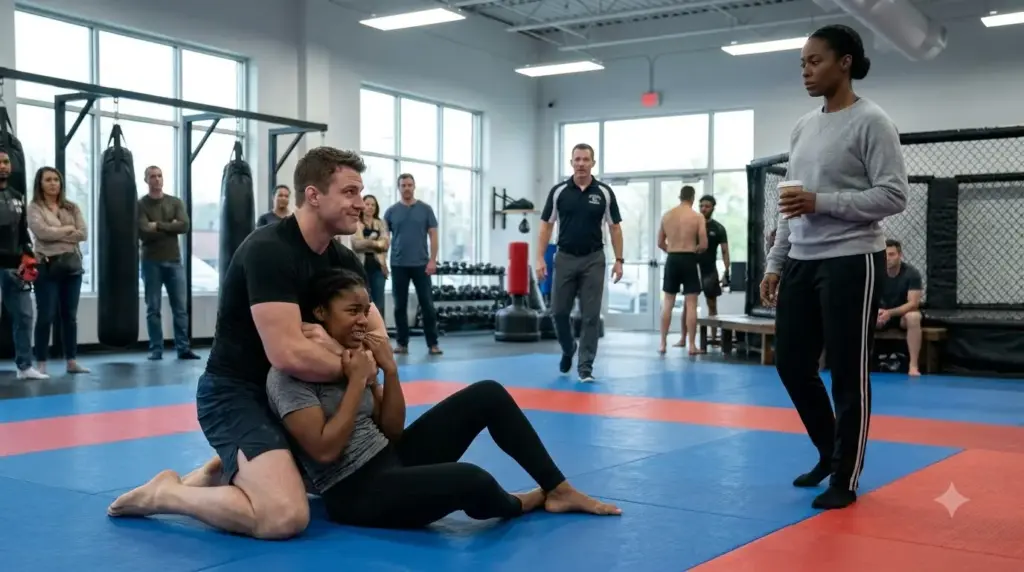
Ryan explained the demonstration.
He described Nia as inexperienced.
He called Alana intrusive.
He said Mateo had betrayed him.
Thomas listened quietly.
When Ryan finished, the older man asked one question.
“Did she tap?”
Ryan looked away.
Thomas waited.
Finally, Ryan said, “Yes.”
“Did you release immediately?”
Ryan remained silent.
Thomas nodded.
“Then there’s your answer.”
Ryan looked angry.
“You don’t understand.”
Thomas stood.
“I understand perfectly.”
He walked toward the mat.
“Do you remember your first competition?”
Ryan frowned.
“Of course.”
“You were fourteen.”
“Yes.”
“You got caught in an armbar.”
Ryan nodded.
“You tapped.”
“Yes.”
Thomas looked at him.
“And what did your opponent do?”
Ryan’s voice became quieter.
“He released.”
“Immediately?”
“Yes.”
Thomas nodded.
“That’s why you still have a healthy arm.”
Ryan stared at the floor.
For the first time, the memory seemed different.
Thomas continued.
“I taught you that tapping isn’t weakness. It’s communication.”
Ryan swallowed.
“And when someone trusts you enough to train with you, you have a responsibility to hear them.”
The older man picked up his bag.
“You’ve spent years teaching students how to control other people.”
He paused.
“Maybe it’s time you learned how to control yourself.”
Two weeks later, Ryan sent a written apology to Nia and Denise.
It acknowledged that he had continued the hold after Nia tapped.
It did not excuse his actions as a misunderstanding.
He also offered to cover reasonable expenses connected to the incident.
Denise read the letter carefully.
Then placed it on the kitchen table.
Nia looked at her.
“Are you going to answer?”
“Not today.”
“Why?”
“Because we don’t owe him an immediate response.”
Nia nodded.
Then asked, “Do you think he’s actually sorry?”
Denise considered the question.
“I don’t know.”
Nia looked toward the window.
“I don’t think I want to go back.”
Her mother took her hand.
“Then you don’t have to.”
A month later, Nia visited the physical-therapy clinic beside Northline.
She had an appointment with Alana.
Not for treatment.
For a conversation.
Alana welcomed her into a small office overlooking the parking lot.
“How are you doing?”
“Better.”
“I’m glad.”
Nia hesitated.
“Can I ask you something?”
“Of course.”
“Why did you help me?”
Alana looked surprised.
“Because you needed help.”
“But you didn’t know me.”
Alana smiled gently.
“I didn’t need to.”
Nia looked down.
“Everybody else seemed scared of him.”
Alana considered that.
“Sometimes people hesitate because they don’t know what to do. Sometimes they’re afraid of making things worse.”
“Why weren’t you afraid?”
Alana paused.
“I was concerned.”
“About him?”
“About you.”
Nia smiled faintly.
Then asked another question.
“Do you think I should quit jiu-jitsu?”
Alana leaned forward.
“Do you still enjoy learning?”
Nia nodded.
“I think so.”
“Then one instructor’s behavior doesn’t have to decide that for you.”
Nia looked thoughtful.
“But how do I know another gym will be safe?”
Alana smiled.
“That’s a very good question.”
She took out a sheet of paper.
Together, they wrote down questions Nia could ask before joining another academy.
How instructors responded to tapping.
Whether beginners could refuse demonstrations.
How injuries were handled.
Whether parents could observe classes.
And whether complaints were taken seriously.
When they finished, Nia looked at the page.
“Nobody ever told me I could ask these things.”
Alana nodded.
“You can.”
That summer, Nia joined a small community grappling program.
It wasn’t famous.
There were no framed championship belts.
No motivational slogans covering the walls.
The mats were older.
The uniforms were mismatched.
But the instructors introduced themselves.
They explained the rules.
They encouraged questions.
And when Nia tapped during her first practice, her partner released immediately.
Nia sat up.
For a moment, she couldn’t speak.
The instructor noticed.
“You okay?”
She nodded.
“Yeah.”
“Want to take a break?”
Nia smiled.
“Just a minute.”
“Take your time.”
It was such a simple exchange.
But it changed something inside her.
For weeks, she had associated tapping with fear.
Now, for the first time, it felt like what it was supposed to be.
A boundary.
One that mattered.
Meanwhile, Northline Jiu-Jitsu continued operating, but under increasing pressure.
Ryan enrolled in instructor-development training focused on safeguarding, communication, and athlete welfare.
He invited an independent consultant to review his teaching methods.
He also contacted Mateo.





