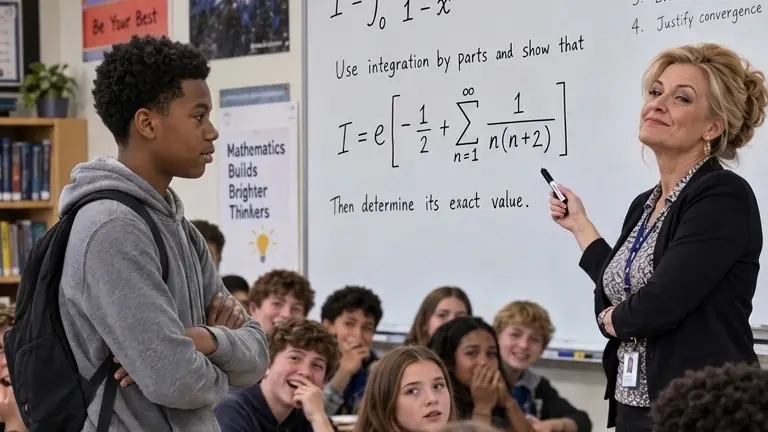
Teacher Told Black Student to Solve Higher Grade Math Problem as a Joke
“I can’t, Ms. Maxwell.”
The classroom fell deadly silent as thirteen-year-old Thompson refused to sit down. His hands trembled around the straps of his backpack, but he remained standing beside his desk.
What happened next would change Westside Middle School forever.
When his arrogant teacher wrote a complex calculus problem on the board to humiliate him, she had no idea she was about to reveal a mathematical genius who had been silently enduring her cruelty for months.
“This,” Veronica Maxwell announced with a cruel smile, “is a calculus problem from my eleventh-grade advanced placement class.”
She turned toward Thompson.
“Since you think you’re too special to follow simple instructions, why don’t you solve something students four years older than you can barely understand?”
Several classmates laughed.
Thompson stared at the equation, his expression unreadable.
But why was he really standing? And what secret was about to be exposed in front of the entire classroom?
The clock had already struck 9:15 when Thompson hurried into Ms. Maxwell’s mathematics class. His breathing was heavy, his backpack clutched tightly against his chest.
“Late again, Thompson.”
Veronica Maxwell’s voice cut through the classroom like ice. Her thin lips pressed together in disapproval as she gestured toward his empty seat.
“Sit down immediately.”
Thompson hesitated, his eyes darting nervously around the room.
“I’m sorry, Ms. Maxwell. Can I… can I stand for today’s lesson, please?”
Veronica’s eyebrows shot up.
“Absolutely not. You will sit like everyone else.”
“But, Ms. Maxwell, my back—”
“Your back?” Veronica repeated mockingly.
Several students snickered.
“Is that today’s excuse? Yesterday it was a family emergency. Now suddenly your back hurts?”
Thompson tightened his grip on his backpack.
The pain from last week’s punishment still lingered. Veronica had struck him with a wooden ruler after accusing him of disrespectful posture. Since then, sitting against the hard classroom chairs had become almost unbearable.
But who would believe him?
His mother worked two jobs and rarely made it home before midnight. His father had passed away three years earlier, leaving Thompson to navigate school and life with very little support.
Yet there was something nobody at Westside Middle School knew about him.
Every evening, after finishing his homework, Thompson spent hours studying advanced mathematics using old textbooks his father had collected. Numbers were the one place where he felt safe. Equations followed rules. They didn’t judge his clothes, his skin color, or his family’s income.
By eleven, he had mastered algebra. By twelve, he was solving trigonometry problems. Now, at thirteen, he had begun studying calculus entirely on his own.
He had never told Ms. Maxwell.
She had never bothered to ask.
“I said sit down!” Veronica shouted, slamming her palm against the desk.
Thompson flinched but remained standing.
“I can’t, Ms. Maxwell.”
The classroom fell silent.
Veronica’s eyes narrowed dangerously.
“Well, then,” she said, her voice suddenly calm, “since you’re so special today, perhaps you’d like to show us how special you truly are.”
She grabbed a marker and began writing an intimidating equation across the whiteboard.
When she finished, she stepped aside with a satisfied smile.
“Come on, Thompson. Solve it. If you get it right, I’ll give you an A for the entire semester.”
Laughter erupted.
One student whispered, “He doesn’t even know what calculus is.”
Another pulled out his phone beneath the desk.
Thompson slowly approached the board.
For several seconds, he studied the equation without speaking.
Then he picked up the marker.
His hand began moving.
One line became three. Three became six. He simplified the expression, corrected an overlooked assumption, and continued writing with astonishing confidence.
Veronica’s smile disappeared.
“Wait,” she interrupted. “What are you doing?”
“Solving it, ma’am.”
Two minutes later, Thompson stepped away from the board.
“There’s a mistake in the original problem,” he said quietly. “But if you correct this term, the answer becomes straightforward.”
Veronica stared at the solution.
She had copied that exact problem from a university mathematics examination, believing no middle-school student could possibly understand it.
But Thompson hadn’t merely solved it.
He had identified an error in the question itself.
At that moment, Principal Harris appeared at the classroom doorway, accompanied by the school counselor.
“Ms. Maxwell,” he said sternly, “we need to discuss the complaint filed about your treatment of this student.”
Veronica turned pale.
Thompson lowered his marker.
Because the principal wasn’t there by coincidence.
Someone had finally discovered what had been happening behind that classroom door.
And the evidence was far more serious than anyone expected.
Chapter 1 – Teacher Told Black Student to Solve Higher Grade Math Problem as a Joke – News