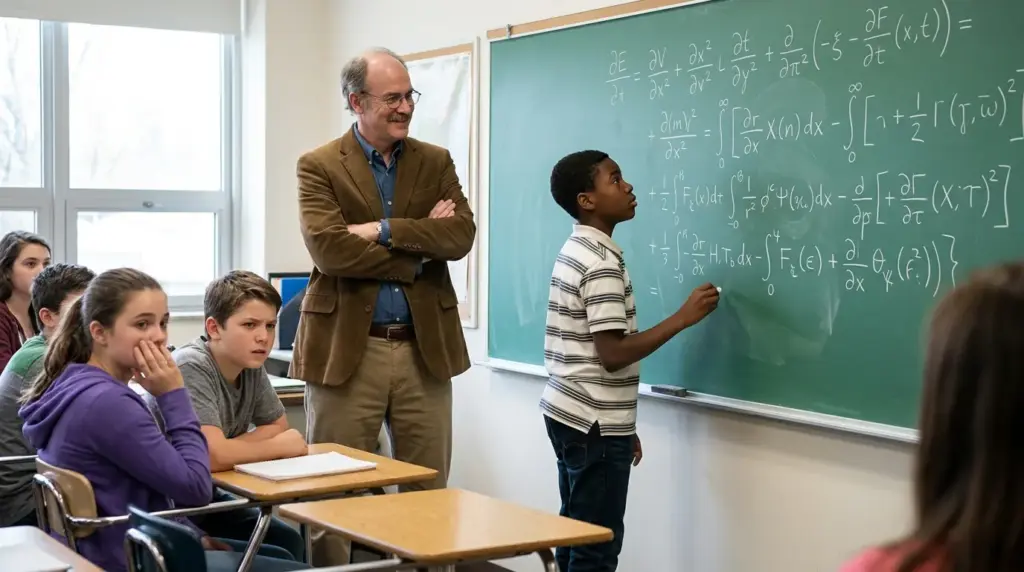
The classroom became tense.
Marcus remained standing.
“I’m not, sir.”
“You’re telling me a twelve-year-old independently learned differential equations?”
“Yes.”
“From what?”
“Books. Videos. Practice.”
Mr. Wittmann shook his head.
“Impossible.”
Sarah raised her hand again.
“But his answer is right.”
The teacher snapped.
“Sarah, be quiet.”
She lowered her hand.
Marcus looked at the signed conditions beneath the problem.
“Sir, you said I only needed to solve it correctly.”
Mr. Wittmann stared.
“Sit down.”
“But—”
“I said sit down!”
Marcus slowly returned to his desk.
And something inside him changed.
Not because he had solved the equation.
But because he finally understood that the teacher had never expected a fair contest.
He had expected a public humiliation.
And now he wanted to erase the result.
At the back of the classroom, a woman closed the notebook on her lap.
She had entered twenty minutes earlier with permission from the principal.
Her name was Dr. Eleanor Brooks.
She was sixty-one, a mathematics professor at a nearby university, and she had been invited to observe the school’s advanced mathematics curriculum.
She had spent most of the lesson taking notes.
Now she stood.
“Mr. Wittmann.”
The teacher turned.
“Yes?”
“I’d like to ask Marcus a question.”
Mr. Wittmann forced a smile.
“Of course, Doctor.”
Dr. Brooks approached the board.
“Marcus, would you mind coming up again?”
Marcus hesitated.
Then stood.
“Yes, ma’am.”
She smiled.
“First, excellent work.”
His expression changed.
It was such a simple compliment.
Yet he looked almost startled to hear it.
“Thank you.”
Dr. Brooks pointed toward the equation.
“Can you explain why you chose that integrating factor?”
Marcus nodded.
“Because the coefficient of \(y\) is \(2x\). Multiplying by \(e^{x^2}\) makes the left side a product derivative.”
Dr. Brooks smiled.
“Exactly.”
She studied him.
“Have you worked with differential equations before?”
“Yes.”
“How long?”
“About seven months.”
“Do you enjoy them?”
Marcus smiled shyly.
“Very much.”
“Why?”
He considered the question.
“Because sometimes something that looks complicated becomes simple when you find the right way to look at it.”
Dr. Brooks stared at him for a moment.
Then smiled more broadly.
“That’s a wonderful answer.”
Mr. Wittmann cleared his throat.
“Doctor, I should explain—”
She raised one hand.
“Just a moment.”
Then she turned toward Marcus.
“Would you be interested in visiting our university mathematics department?”
Marcus blinked.
“Me?”
“Yes.”
“Why?”
“Because I think you’d enjoy meeting people who ask the same kinds of questions you do.”
Marcus looked toward the floor.
“My mom works a lot. I don’t know if she could drive me.”
Dr. Brooks nodded.
“We can discuss transportation with her.”
His eyes widened.
“Really?”
“Really.”
For the first time that afternoon, Marcus smiled without trying to hide it.
Tommy began clapping.
Sarah joined him.
Then several other students.
Within seconds, the classroom filled with applause.
Mr. Wittmann stood beside the whiteboard, motionless.
The problem he had chosen to embarrass a child had revealed something extraordinary.
But the worst part for him was still coming.
After class, Marcus was packing his notebook when Mr. Wittmann approached.
“Marcus.”
The boy looked up.
“Yes, sir?”
“Stay a moment.”
Tommy hesitated near the door.
Marcus nodded toward him.
“It’s okay.”
Tommy left reluctantly.
Mr. Wittmann closed the classroom door.
His voice was quieter now.
“About what happened today.”
Marcus waited.
“I may have been a little harsh.”
Marcus said nothing.
“But you understand that I was trying to challenge you.”
Marcus looked at him.
“You said I couldn’t do arithmetic.”
Mr. Wittmann shifted uncomfortably.
“It was motivational.”
“You said I didn’t belong here.”
The teacher frowned.
“I don’t remember saying that.”
Marcus opened his notebook.
On the first page was a list of dates.
Beside each date, he had written a brief description.
September 8 — Asked if someone did my homework.
September 15 — Said my test score was a miracle.
September 21 — Told the class I was here by mistake.
Mr. Wittmann stared.
“What is that?”
Marcus looked down.
“My mom told me to write things down when they don’t feel right.”
The teacher’s expression changed.
“You’re keeping records of me?”
Marcus hesitated.
“Yes, sir.”
Mr. Wittmann took a slow breath.
“That’s unnecessary.”
Marcus looked at him.
“Then I hope I won’t have to write anything else.”
The teacher stared at the boy.
For the first time, he seemed to understand that Marcus wasn’t merely a quiet student who could be intimidated into silence.
He was observant.
Careful.
And far more resilient than Mr. Wittmann had imagined.
The teacher looked toward the whiteboard.
The signed challenge was still there.
Marcus followed his gaze.
“Sir?”
“What?”
“About the salary.”
Mr. Wittmann’s face tightened.
“Marcus, surely you understand that wasn’t a serious offer.”
Marcus nodded.
“I thought maybe.”
The teacher exhaled.
“Good.”
Marcus continued.
“But you wrote it down because I asked.”
Mr. Wittmann stared.
Marcus wasn’t smiling.
He wasn’t threatening.
He was simply stating a fact.
Then the classroom door opened.
Dr. Brooks stood outside with Principal Angela Foster.
“Marcus,” the principal said gently, “would you come with us?”
Mr. Wittmann stepped forward.
“Is something wrong?”
Principal Foster looked at him.
“We need to discuss what happened during your lesson.”
The teacher forced a laugh.
“It was an academic exercise.”
Dr. Brooks looked toward the whiteboard.
“An academic exercise that included a personal insult and an inappropriate financial wager with a child?”
Mr. Wittmann’s smile vanished.
Principal Foster turned toward Marcus.
“Your mother is on her way.”
Marcus felt his stomach tighten.
“Am I in trouble?”
The principal’s expression softened.
“No, Marcus.”
She looked at the equations.
“Not at all.”
That evening, Denise Johnson arrived at Roosevelt Middle School wearing her nursing home uniform.
She had come directly from work.
Her shoes were worn, and her eyes showed the exhaustion of a twelve-hour shift.
When she entered the principal’s office, Marcus immediately stood.
“Mom.”
She hurried toward him.
“Baby, are you okay?”
He nodded.
“I’m fine.”
She looked at the principal.
“What happened?”





