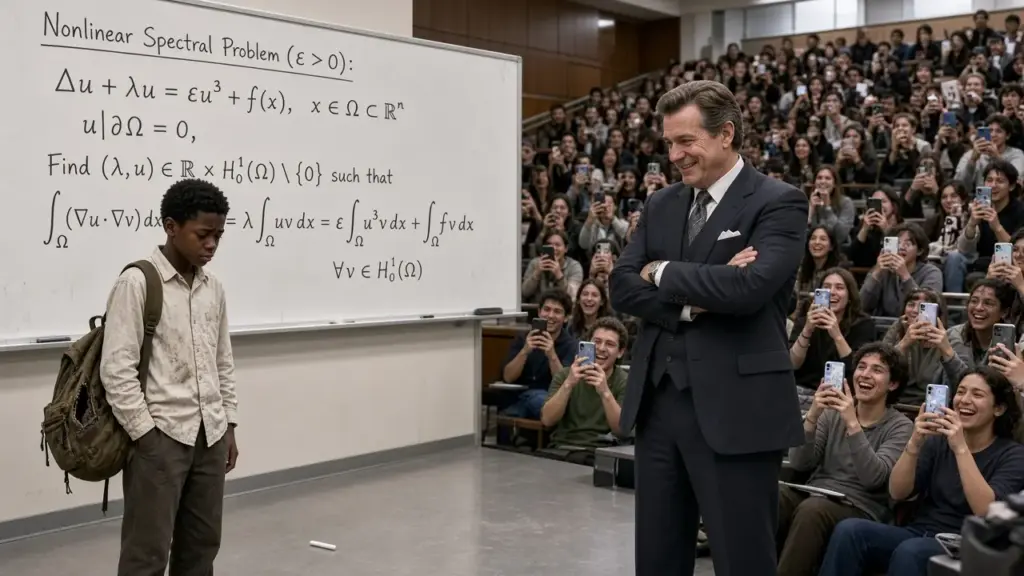
Professor Sinclair had challenged him to calculate its determinant.
The matrix followed a particular rule: the number in row \(i\), column \(j\), was the smaller of \(i\) and \(j\).
To the students, it looked monstrous.
A matrix with more than four million entries.
Solving it through direct expansion would be practically impossible within five minutes.
Sinclair knew that.
That was why he had chosen it.
“Four minutes and thirty seconds,” the professor announced, glancing at his watch.
Andre remained motionless.
“What’s wrong?” Sinclair sneered. “Can’t read the numbers?”
A wave of laughter rolled across the classroom.
Andre wasn’t confused.
He was thinking.
He had seen a similar mathematical structure years earlier in a discarded textbook. And he remembered an elegant property that could turn an enormous calculation into something remarkably simple.
He lifted the chalk.
Then he began writing.
First, he defined a lower triangular matrix whose entries were ones on and below the main diagonal and zeros everywhere else.
Next, he showed that multiplying this matrix by its transpose reproduced Sinclair’s enormous matrix exactly.
The students watched in confusion.
A young woman in the front row leaned forward.
“Wait,” she whispered. “Is he factoring the matrix?”
Andre continued.
Because the triangular matrix had only ones along its main diagonal, its determinant was one.
And because the determinant of a product equals the product of the determinants, the answer followed immediately.
Andre drew a box around the result.
Determinant = 1.
Then he placed the chalk down.
“Done, Professor.”
Sinclair looked at his watch.
Three minutes and forty-six seconds had passed.
The professor laughed.
“One? You’re telling me the determinant of a matrix containing more than four million entries is simply one?”
“Yes, sir.”
“Ridiculous!”
Andre turned back toward the board.
“You can verify it by subtracting each preceding row from the following row, working from the bottom upward. The matrix becomes triangular, with ones along the diagonal.”
A student in the second row quickly opened his laptop.
Another began copying Andre’s steps.
Then a third student whispered, “He’s right.”
Sinclair ignored him.
“Silence!”
But the whispers continued.
“That factorization works.”
“Every entry matches.”
“The determinant really is one.”
The professor grabbed the chalk and began checking the calculation himself.
He multiplied the matrices.
He examined the entries.
He looked for an error.
There wasn’t one.
His face slowly drained of color.
Andre had solved the problem correctly.
In less than four minutes.
A young woman named Emily raised her hand.
“Professor Sinclair?”
“What?”
“His proof is valid. I checked it independently.”
Another student spoke up.
“So did I.”
Then another.
“And me.”
The classroom fell into an extraordinary silence.
Sinclair stared at the blackboard.
For the first time in his twenty-seven-year teaching career, the man who had built his reputation on intimidating students had no immediate answer.
Andre reached for his backpack.
“Thank you for letting me try, sir.”
Sinclair suddenly slammed his hand against the desk.
“Not so fast!”
Andre stopped.
“You think solving one problem makes you a mathematician?”
“No, sir.”
“You think you can walk into my classroom wearing those filthy clothes and embarrass me?”
“I only answered the question you asked.”
Sinclair pointed toward the door.
“Get out before I call campus security!”
A voice rang out from the back of the room.
“Professor, you promised him an A.”
Everyone turned.
Emily was standing.
“You said if he solved the problem, you’d give him an A. He solved it.”
Sinclair glared at her.
“Sit down, Miss Parker.”
But Emily didn’t move.
“You made the bet in front of everyone.”
One by one, other students began nodding.
Then a tall young man near the aisle stood up.
“Professor, I recorded the entire thing.”
Sinclair froze.
The student held up his phone.
“Including what you said to him before the challenge.”
The professor’s expression changed.
“Turn that off immediately.”
“It’s already recorded.”
Andre looked around the room, visibly uncomfortable with the attention.
He hadn’t come to expose anyone.
He hadn’t come for revenge.
He had only wanted to discuss mathematics.
Then the classroom door opened.
An older woman in a navy maintenance uniform stood in the doorway, holding a bucket and a set of cleaning keys.
It was Denise Powell.
“Andre?”
Her eyes moved from her son to the crowded room.
“Baby, what’s happening?”
Before Andre could respond, Sinclair pointed toward her.
“Perfect. Take your son and leave. This building is for students and faculty, not janitorial staff and their children.”
Denise’s face tightened.
“I’m sorry, Professor. He wasn’t supposed to disturb your class.”
Andre turned toward her.
“Mom, I didn’t do anything wrong.”
Sinclair scoffed.
“Your son seems to believe he’s some kind of mathematical genius.”
Denise lowered her eyes.
“Come on, Andre. We need to go.”
Andre picked up his backpack.
But before he reached the door, a new voice interrupted.
“Nobody is going anywhere.”
Standing in the entrance was Dr. Eleanor Whitfield, the university’s dean of academic affairs.
She had been walking through the mathematics building when a student rushed into the hallway, urging her to come upstairs.
Now she stood staring at the blackboard.
“What happened here?”
Sinclair immediately straightened his jacket.
“Dean Whitfield, this is simply a misunderstanding involving an unauthorized visitor.”
Emily stepped forward.
“That’s not what happened.”
She explained the challenge, the insults, and the solution.
The dean listened without interrupting.
Then she approached the blackboard.
She studied Andre’s proof.
Her expression shifted from curiosity to astonishment.
“Who wrote this?”
Andre raised his hand.
“I did, ma’am.”
“How old are you?”
“Eighteen.”
“And where did you study linear algebra?”
Andre hesitated.
“Here, mostly.”
Whitfield frowned.
“Are you enrolled at Whitmore?”
“No, ma’am.”
“Then what do you mean, here?”
Andre looked toward his mother.
“I read the books people throw away.”
The dean stared at him.
“You taught yourself?”
“Yes, ma’am.”
“Who supervised your work?”
“Nobody.”
A long silence followed.
Whitfield looked again at the board.
Then she asked Andre to explain why his factorization worked.





