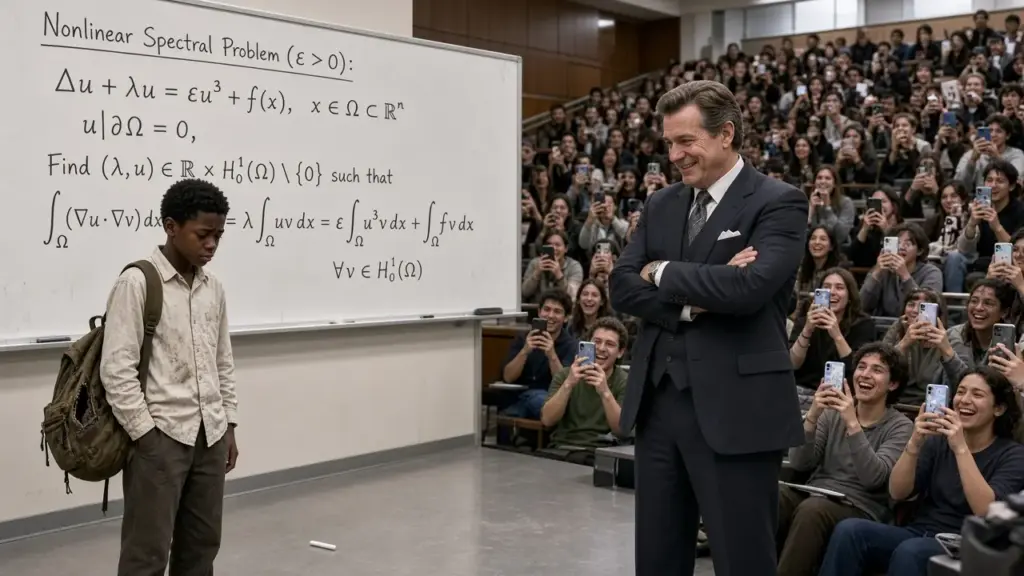
“My name is Samuel Whitaker. I used to teach mathematics here.”
Denise instinctively tightened her grip on Andre’s hand.
“If this is about the classroom, we’ve already apologized for him being there.”
Whitaker shook his head.
“I’m not here for an apology.”
He looked at Andre.
“Young man, where did you learn that substitution?”
Andre hesitated.
“From a book.”
“Which book?”
Andre thought for a moment.
“I don’t remember the title. It had a green cover, and some pages were missing.”
Whitaker smiled.
“Do you remember the author?”
Andre nodded.
He named a mathematician whose work was usually studied by graduate students.
Whitaker’s eyebrows rose.
“And you understood it?”
“Some of it.”
“What did you do with the parts you didn’t understand?”
Andre shrugged.
“I kept reading until they made sense.”
Whitaker was silent.
Then he asked, “Would you mind showing me your notebook?”
Andre opened his purple folder.
Inside were dozens of pages filled with equations, diagrams, and carefully written explanations.
Whitaker examined them.
His expression changed.
On one page, Andre had written a question about a mathematical model.
Below it were six different attempts to solve the problem.
Four were crossed out.
The fifth contained a mistake.
The sixth worked.
Whitaker looked at the boy.
“How long did this take you?”
“Three nights.”
“Why so long?”
Andre seemed confused.
“Because I kept getting it wrong.”
Whitaker smiled.
“That’s usually how mathematics works.”
For the first time that day, Andre smiled back.
The next morning, Whitaker requested a meeting with the university’s academic dean.
He brought Andre’s notebook.
He also brought the video.
Dean Margaret Ellis watched the recording in silence.
When it ended, she looked furious.
“Has Professor Sinclair responded?”
“He’s claiming the incident was taken out of context.”
Whitaker shook his head.
“The context makes it worse.”
Dean Ellis opened Andre’s notebook.
She turned several pages.
Then stopped.
“Samuel, are these calculations genuine?”
“As far as I can determine.”
“He’s eleven?”
“Yes.”
She looked toward the window.
“Extraordinary.”
Whitaker closed the notebook.
“Margaret, I don’t want this boy turned into a publicity campaign.”
She looked at him.
“Neither do I.”
“He needs proper educational support. And his mother needs assurance that her employment won’t be threatened because of what happened.”
Dean Ellis nodded.
“I’ll handle the employment issue. We should also arrange an independent academic assessment, with his mother’s permission.”
Whitaker stood.
“Good.”
As he reached the door, the dean asked, “Samuel?”
He turned.
“Do you think he’s a genius?”
Whitaker considered the question.
Then smiled.
“I think he’s a child who has been teaching himself advanced mathematics from discarded textbooks.”
He paused.
“That’s impressive enough without giving him a label.”
Three days later, Andre returned to Whitmore University.
This time, he entered through the front doors.
His mother walked beside him.
They were escorted to a quiet seminar room where three mathematics faculty members had prepared a series of problems.
There were no cameras.
No spectators.
No humiliating challenges.
Just pencils, paper, and a glass of water.
Whitaker sat across from Andre.
“Take your time.”
Andre nodded.
The first problem involved algebra.
He solved it quickly.
The second required calculus.
He worked carefully, explaining each step.
The third involved a mathematical proof.
He struggled.
For twenty minutes, he stared at the page.
Then he crossed out his work.
“I’m not sure.”
Whitaker leaned forward.
“That’s perfectly fine.”
Andre looked embarrassed.
“I thought I could do it.”
“You might still be able to.”
“But I don’t know how.”
Whitaker smiled.
“Then we’ve found something useful.”
Andre frowned.
“What?”
“Something you haven’t learned yet.”
The boy stared at him.
Then laughed.
It was the first time an adult had treated his uncertainty as an opportunity rather than a failure.
By the end of the assessment, the faculty members agreed that Andre demonstrated mathematical understanding far beyond his age.
They also identified gaps in his formal education.
He had learned advanced concepts without always encountering the foundational explanations that usually came first.
Whitaker recommended a structured mentorship program.
Not a sudden leap into full-time university classes.
Not a media spectacle.
A carefully designed educational plan that would challenge Andre while allowing him to remain a child.
Denise listened to every recommendation.
Then asked one question.
“Will he still be able to go to school with children his own age?”
Whitaker nodded.
“Absolutely.”
Denise exhaled.
“Then I’m willing to consider it.”
Two weeks later, Whitmore University announced that Professor Sinclair had been removed from classroom duties pending the outcome of a formal conduct review.
The administration also apologized to Andre and Denise.
The university confirmed that Denise’s employment would not be affected by her son’s complaint or participation in the review.
But the story had already changed something larger.
Students began speaking about the way campus workers were treated.
Several faculty members proposed opening educational enrichment programs to children of university employees.
The student government organized a meeting about discrimination and unequal access to academic resources.
And Vanessa Brooks, the graduate student who had first confirmed Andre’s solution, volunteered to help him with mathematics twice a week.
Their first meeting took place in the university library.
Vanessa placed a textbook on the table.
Andre looked at the cover.
“That’s the one.”
She frowned.
“What?”
“The book I found in the recycling bin.”
Vanessa opened it.
“Someone threw this away?”
Andre nodded.
“Pages seventy-three through ninety were missing.”
Vanessa smiled.
“Well, this copy has all the pages.”
Andre ran his fingers over the cover.
Then looked up.
“Can I borrow it?”
Vanessa laughed.
“That’s what libraries are for.”
Six months later, Andre stood on a small stage at a community mathematics exhibition.
He wasn’t competing against university students.
He wasn’t trying to embarrass a professor.
He was presenting a project about how mathematical models could help predict changes in city water usage.
His project wasn’t perfect.
One of his assumptions needed revision.
A judge pointed it out during the question-and-answer session.
Andre studied the criticism.
Then nodded.





