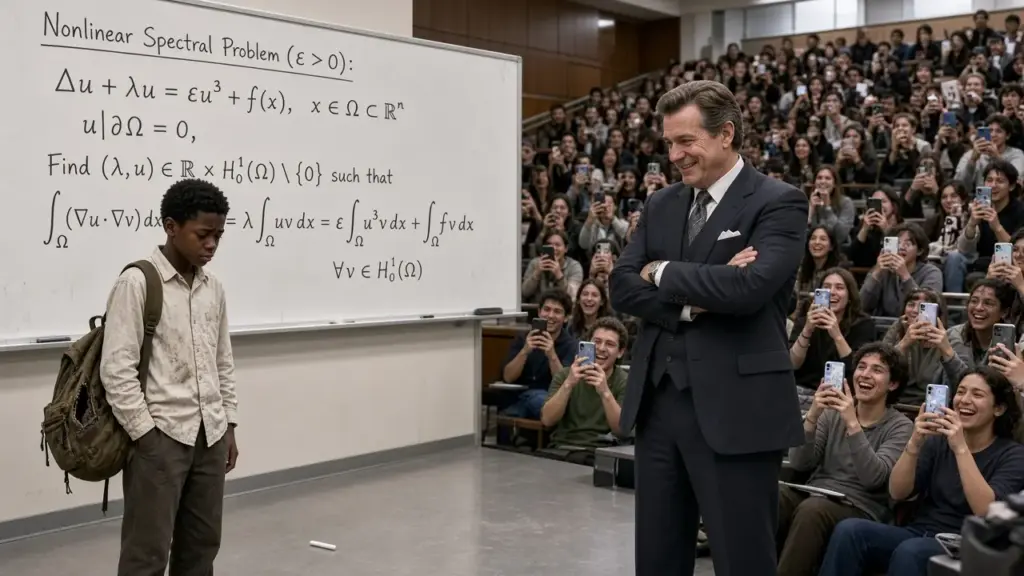
“Andre,” she asked, “who helped you with this?”
“Nobody.”
“Nobody at all?”
“My mom sometimes brings me extra pencils.”
A few students lowered their phones.
Maya examined the calculations for several more minutes.
Then she looked directly at Sinclair.
“Professor, we need an independent review of this immediately.”
Sinclair snatched the notebook from her hands.
“This is nonsense. A child couldn’t possibly understand this research.”
Andre’s voice remained calm.
“Then show me where I’m wrong.”
Those seven words changed everything.
Sinclair flipped through the notebook, desperately searching for an error.
But each page revealed another carefully constructed argument.
Finally, he slammed the notebook shut.
“Get out of my classroom.”
Andre reached for his work.
“Can I have my notebook back?”
Sinclair refused.
“That material belongs to this university.”
Maya stepped between them.
“No, Professor. It belongs to him.”
By lunchtime, the classroom recording had spread across campus.
Thousands of people watched Sinclair humiliate a thirteen-year-old boy before witnessing that same boy solve an advanced mathematical problem.
The university administration received hundreds of complaints.
But the most important development happened away from the cameras.
Maya contacted Dr. Evelyn Carter, a respected mathematics researcher at the University of Pennsylvania, and asked her to examine copies of Andre’s calculations.
Carter initially doubted the story.
Then she spent six hours reviewing his notebook.
At 11:30 that evening, she called Maya.
“Where is this child?”
“At home, I think.”
“Find him. And bring his mother. We need to talk.”
The following afternoon, Andre and Denise entered a conference room at Whitmore.
Denise wore her cleaning uniform because she had come directly from work.
She looked nervous.
“Is my son in trouble?”
Dr. Carter stood immediately.
“No, Mrs. Powell. Your son may have done something extraordinary.”
She explained that Andre’s proposed solution was not yet a verified mathematical breakthrough. Several parts required further examination, and independent experts would need to confirm the proof.
But his approach was original, sophisticated, and far beyond what anyone expected from a thirteen-year-old.
“He has an exceptional mathematical mind,” Carter said.
Denise covered her mouth.
Andre looked at his mother.
“Does that mean I can study here?”
Before Carter could answer, the university president entered the room.
He carried a formal letter.
“Andre, we’d like to offer you access to our advanced mathematics program, full academic support, and a scholarship pathway for your future education.”
Denise began crying.
Andre didn’t smile immediately.
Instead, he asked one question.
“Will my mom still have to clean the classrooms at night?”
The president hesitated.
Denise squeezed her son’s hand.
“Don’t worry about me, baby.”
But Andre shook his head.
“She’s the reason I learned everything. She kept bringing me here. She found the books. She believed in me when nobody else did.”
Dr. Carter looked at Denise.
“Mrs. Powell, your son deserves an opportunity. And you deserve to be treated with dignity.”
Within the following weeks, Whitmore launched an investigation into Sinclair’s conduct. Multiple students came forward with accounts of discriminatory remarks and intimidation.
Sinclair was placed on administrative leave while the investigation proceeded.
Meanwhile, Andre’s work underwent a rigorous independent review.
Three months later, researchers confirmed that his transformation provided a valid solution to a significant restricted case of the problem. It did not resolve the entire conjecture, but it represented a genuine mathematical contribution.
Andre’s name appeared as the lead author on a research paper prepared with academic mentors.
Denise received an offer for a better-paid university facilities position with regular daytime hours, which she accepted.
And Maya became one of Andre’s first formal mathematics mentors.
Six months after that unforgettable classroom confrontation, Andre returned to the same lecture hall.
This time, he wasn’t standing at the doorway.
He was standing at the podium.
The room was filled with professors, graduate students, journalists, and researchers who had come to hear him explain his work.
Denise sat in the front row, wearing a blue dress Andre had helped her choose.
Before beginning his presentation, Andre looked toward the blackboard.
He remembered the laughter.
The insults.
The phones recording his humiliation.
Then he looked at his mother.
“I used to think the hardest part of mathematics was finding the right answer,” he told the audience.
He paused.
“But sometimes the hardest part is getting someone to believe you’re capable of asking the question.”
The room remained silent.
Andre picked up the chalk.
And this time, nobody laughed.
Because the boy once told to leave the classroom was now teaching the very people who had believed he didn’t belong there.
And the most powerful lesson that day wasn’t written in any equation: intelligence has no race, dignity has no price, and opportunity should never depend on the job your parents do.





