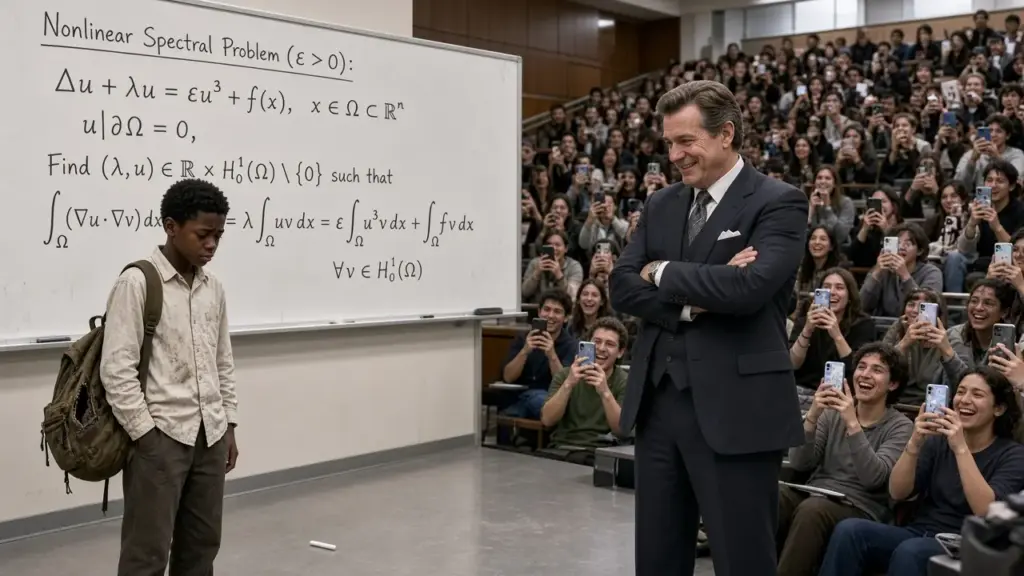
Andre didn’t lower his head. He didn’t shrink away. Years of watching his mother scrub floors while people walked past her like she was invisible had forged a spine of absolute steel inside him.
He looked directly into Sinclair’s eyes, his voice steady and calm. “I am officially registered for this class, Professor. And mathematics doesn’t discriminate.”
Sinclair’s face flushed a deep, violent shade of crimson. His lip curled into a vicious sneer. H
e stepped away from his wooden podium.
“Then prove it to me.”
The professor spun around, grabbed a piece of thick white chalk, and began violently attacking the blackboard. He scrawled a massive, sprawling, nightmarish equation across the slate. It was a notoriously complex variation of the Navier-Stokes exi
stence and smoothness problem—a millennium prize problem, laced with brutal partial differential equations meant to break graduate stude
nts in their final year.
Sinclair stepped back, tossing the chalk onto the metal tray. It clattered loudly in the dead-quiet room.
“Solve this,” Sinclair challenged, crossing his arms over his tweed chest. “I’ll give you an A for the entire semester right now, and you never have to come back. Go ahead. Show me what the janitor’s little son can do.”
More laughter rippled through the room. The glowing screens of dozens of recording phones were focused entirely on Andre.
“A bunch of stinking Black idiots,” Sinclair muttered, barely under his breath, though his lapel microphone caught the vile edge of his voice, amplifying it just enough to be heard by the front rows. “This is going to be hilarious.”
Sinclair folded his arms, grinning a predatory, wolfish smile. He expected the boy to stare blankly at the board, to cry, to apologize, or to run out of the room in absolute shame.
His name was Andre Powell. And he didn’t leave.
Andre unslung his battered backpack and let it drop to the floor with a heavy thud. He walked down the carpeted steps, his worn sneakers making no sound, until he stood face-to-face with the towering chalkboard. He picked up the piece of chalk.
He didn’t pause to think. He didn’t hesitate. The chalk met the slate, and the rhythmic, rapid-fire tap-tap-tap began to echo through the massive lecture hall.
Five minutes later, the Black boy would plunge the entire, two-hundred-seat classroom into a silence so thick you could choke on it.
Andre didn’t just attempt the problem; he deconstructed it. He saw the chaotic, sprawling equation not as a trap, but as a beautifu
lly intricate puzzle. He bypassed the deliberate dead-ends Sinclair had maliciously laid within the variables. He didn’t use the standard, clunky derivations taught in the textbooks; he used an elegant, streamlined Fourier transform he had developed himself while sitting on the cold floor of a janitor’s closet at 2:00 AM.
The chalk flew across the slate in a blur of white dust. His handwriting was crisp, perfect, and relentless.
Sinclair’s arrogant grin slowly began to melt away. He uncrossed his arms. He took a hesitant step forward, his pale eyes narrowing as he tried to find a flaw in the boy’s logic. He searched frantically for a mistake—a dropped negative sign, a missed boundary condition, a failed integration.
There was nothing. It was mathematically flawless.
Andre was moving faster now, integrating the final differential equation in his head and writing down the intermediate steps with a rapid, fluid grace that bordered on high art. The students holding their phones slowly lowered them, their mouths hanging slightly open as they watched the board fill with a beautiful, undeniable truth.
At exactly the five-minute mark, Andre reduced the chaotic nightmare of numbers into a single, elegant constant. He drew a sharp, firm box around the final answer.
He stopped writing. The fine white chalk dust settled in the air around him like snow. He gently placed the nub of chalk back onto the aluminum tray, wiped his dusty hands on his faded hoodie, and turned around to face the room.
Sinclair looked as though the floor had just vanished from beneath his polished leather shoes. The color had completely drained from his face, leaving him a sickly, ghostly white. A heavy bead of cold sweat formed at his temple, trickling down his jaw. His mouth opened and closed silently, like a fish pulled from the water. He stared at the board, his eyes wide with absolute horror, completely shattered by the towering monument of his own arrogant mistake. The tyrant had been completely dismantled in his own kingdom.
Not only had the boy solved it, but he had done it using a simplified theorem that Sinclair himself hadn’t fully grasped.
Andre looked at the broken, trembling man standing before him. There was no rage in the boy’s dark eyes, no gloating, and no vengeance. There was only the calm, cold certainty of undeniable brilliance.
“The integration you attempted on the third line was fundamentally flawed, Professor,” Andre said, his voice echoing clearly in the pin-drop silence of the room. “You missed a critical boundary condition before applying the derivative. I took the liberty of correcting your initial assumption so the equation could actually be solved.”
Andre walked back over to his desk, picked up his battered canvas backpack, and slung it over his shoulder. He looked around the room at the hundreds of wealthy, privileged students who were now staring at him in absolute, terrified awe.
He turned his gaze back to Sinclair one last time.
“Keep your ‘A’, Professor,” Andre said quietly, the heavy silence of the room amplifying every single syllable. “I’m going to drop this class. It’s moving a little too slow for me.”
Without waiting for a response, the janitor’s son turned his back on the elite of Whitmore University and walked up the stairs. He pushed open the heavy oak doors and stepped out into the hallway, leaving behind a flawless equation, a shattered tyrant, and a legacy that the mathematics department would whisper about for the next fifty years.





