Eventually, I learned to make the pitch look almost identical to my ordinary fastball until the moment it left my fingers.
I had thrown it hundreds of times.
I knew how it felt when it worked.
And I knew how it felt when it didn’t.
Standing on the mound, I rolled the baseball between my fingers.
The seams pressed against my skin.
I remembered Grandpa’s voice.
Don’t force it. Don’t aim it. Let the air argue with the seams.
I looked toward Mateo.
He gave me the sign.
Changeup.
I nodded.
Cole stepped out of the batter’s box.
“Hold on.”
The crowd murmured.
He pointed toward my glove.
“What’s that thing made of? Duct tape and prayers?”
A few people laughed.
I looked down at the worn leather.
The repairs Malik had made were still holding.
“It’s mine,” I said.
Cole smirked.
“That’s obvious.”
He returned to the batter’s box.
Then raised his bat.
“Come on, kid. Let’s finish this.”
I placed my foot against the rubber.
My heart was pounding.
I could hear people talking behind the fence.
Someone shouted Cole’s name.
Someone else yelled for me to throw the ball.
I closed my eyes for one second.
Not to imagine winning.
Not to picture the check.
Just to remember the movement.
Then I opened them.
Mateo held his glove low and away.
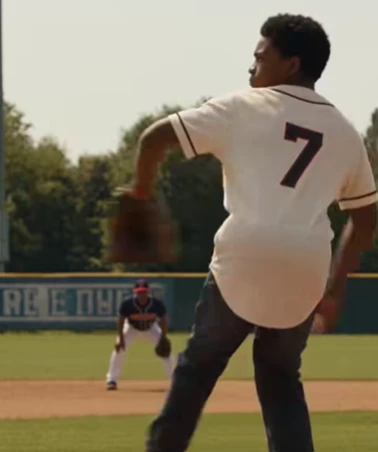
I began my windup.
My front leg lifted.
My shoulders turned.
My throwing arm came forward.
And the baseball left my hand.
The pitch looked like a fastball.
At least, that was what Cole expected.
He shifted his weight forward.
His bat began moving.
For a fraction of a second, everything happened exactly as I had practiced.
Then the ball slowed.
Cole’s swing arrived early.
The bat cut through empty air.
The baseball dropped toward the outside edge of the plate.
Mateo caught it.
A sharp pop echoed across the field.
For one second, nobody moved.
Then the umpire raised his right hand.
“STRIKE!”
I stood frozen.
Cole stared toward the catcher.
His bat remained extended.
Mateo slowly rose.
Then he shouted.
“HE MISSED!”
The crowd erupted.
Marcus jumped from the bench.
Coach Carter covered her mouth.
Someone screamed my name.
I looked toward the umpire.
He nodded.
“Swinging strike. Challenge goes to Tariq.”
My knees suddenly felt weak.
I hadn’t realized how tightly I’d been holding my breath.
Mateo ran toward me.
He threw his arms around my shoulders.
“You did it!”
I laughed.
“I did?”
“YES!”
My teammates poured onto the field.
Marcus nearly knocked me over.
Someone lifted my cap.
Someone else shouted that Southside was saved.
But I wasn’t looking at them.
I was looking toward Cole Barrett.
He stood beside home plate.
Completely still.
His expression was unreadable.
Then he dropped his bat.
And started walking toward me.
The celebration faded as Cole approached.
My teammates stepped aside.
He stopped a few feet away.
For the first time that afternoon, he wasn’t smiling.
“That was a changeup.”
I nodded.
“Yes, sir.”
He studied me.
“How old are you again?”
“Fourteen.”
Cole looked toward the mound.
Then back at me.
“Who taught you that pitch?”
“My grandfather.”
He was quiet.
Then he shook his head.
“Your grandfather knew what he was doing.”
I didn’t know what to say.
Cole held out his hand.
I shook it.
Then he turned toward the fundraising table.
“Where’s the check?”
The organizer hurried forward.
Cole removed his sunglasses.
“Make it payable to the Southside Field Repair Fund.”
A cheer rose from the crowd.
But Cole raised one hand.
“Wait.”
The cheering stopped.
He looked toward Coach Carter.
“I owe your team an apology.”
Coach Carter folded her arms.
“Yes, you do.”
Cole nodded.
He looked toward Marcus.
“I’m sorry for making fun of your equipment.”
Then toward Mateo.
“And your uniforms.”
Finally, he faced me.
“And I’m sorry I treated your glove like it was something to be ashamed of.”
I looked down.
The tape was still wrapped around the fingers.
The leather was still worn.
But it had never felt more valuable.
Cole took the ceremonial check from the organizer.
He signed it.
Then handed it to Coach Carter.
Ten thousand dollars.
Enough to begin repairing the field.
Enough to give our team another season.
Enough to make everything feel possible again.
But the afternoon wasn’t over.
A man in a dark jacket approached Cole near the dugout.
He spoke quietly.
Cole listened.
Then looked toward me.
The man was one of the fundraiser’s organizers.
He had been checking the donation records.
Apparently, several people watching the challenge had begun contributing money online.
The fundraiser total had risen while I was standing on the mound.
One local business had pledged two thousand dollars.
A retired teacher had contributed fifty.
A former Southside player had donated five hundred.
And dozens of smaller donations were arriving.
Coach Carter checked her phone.
Her eyes widened.
“Tariq.”
I turned.
“What?”
She showed me the screen.
The fundraiser had passed fifteen thousand dollars.
I stared.
“Fifteen thousand?”
She nodded.
“And it’s still going.”
Marcus began laughing.
Mateo sat down on the bench.
For several seconds, nobody spoke.
Then Coach Carter wiped her eyes.
“We might actually fix everything.”
I looked toward the field.
The broken fence.
The damaged benches.
The empty dugouts.
For months, those things had seemed permanent.
Now, suddenly, they didn’t.
That evening, Malik picked me up outside the community center.
He arrived wearing his work uniform, his hands still stained with engine grease.
I climbed into the passenger seat.
He looked at me.
“Why is everybody calling my phone?”
I smiled.
“Something happened.”
He narrowed his eyes.
“What did you break?”
“Nothing.”
“Tariq.”
“I threw a pitch.”
He stared.
“Okay?”
“Against Cole Barrett.”
Malik blinked.
Then slowly turned toward me.
“You did what?”
I told him everything.
The fundraiser.
The insults.
The challenge.
The pitch.
The check.
By the time I finished, Malik had stopped smiling.
He looked toward my glove.
“The one I fixed last night?”





