Cole smiled.
“Of course it isn’t.”
“I’ve never seen that before.”
“Then how did it get inside your bag?”
Marcus looked from one officer to the other.
“I don’t know.”
Cole pulled out his handcuffs.
“Marcus Williams, you’re under arrest.”
Twenty minutes earlier, a jewelry store three blocks away had reported a burglary.
According to police, a suspect had escaped carrying stolen merchandise.
The suspect’s description was vague.
A young male wearing dark clothing.
Marcus was eighteen.
He was wearing a dark blue hoodie.
And that was apparently enough.
By midnight, he was sitting in a holding cell.
By the next morning, he was charged with possession of stolen property and burglary-related offenses.
His mother arrived at the police station with tears streaming down her face.
“Marcus, tell me what happened.”
He gripped the telephone on the other side of the visitation glass.
“Mom, I didn’t do it.”
“I know, baby.”
“They put something in my bag.”
Patricia stared at him.
“What?”
“I don’t know how it happened. But that jewelry wasn’t mine.”
She pressed her hand against the glass.
“Then we’re going to fight this.”
Over the next several weeks, Patricia contacted attorneys throughout Baltimore.
Most wanted retainers she couldn’t afford.
One attorney quoted fifteen thousand dollars just to begin preparing the defense.
Another warned that the prosecution might offer Marcus a plea agreement.
“If he accepts responsibility, he could potentially avoid a lengthy sentence.”
Patricia shook her head.
“But he didn’t do it.”
The attorney sighed.
“Unfortunately, innocence and what the prosecution can prove are not always the same question.”
Marcus refused to plead guilty.
He would not confess to something he hadn’t done just to make the case disappear.
A public defender was eventually assigned.
Her name was Rebecca Lawson.
She was thirty-four years old, overworked, and responsible for more cases than any lawyer should have been expected to manage.
But unlike Judge Morrison and Prosecutor Price, she listened when Marcus spoke.
At their first meeting, Marcus placed a handwritten timeline on the table.
“Ms. Lawson, the police report says the officer saw me leaving the jewelry store at 8:38 p.m.”
Rebecca examined the document.
“Yes.”
“But I clocked out of the library at 8:37. The security cameras will show me leaving through the main entrance after that.”
Rebecca looked up.
“How far is the jewelry store?”
“About three blocks.”
“Could you have reached it?”
“Not within the time the officer claims. And the library’s electronic records show I was still working when the burglary alarm activated.”
Rebecca sat forward.
“Do you have proof?”
Marcus opened his notebook.
“Page seven.”
She read the document.
Then she looked at him.
“Where did you learn to organize evidence like this?”
“The law section at the library.”
For the first time since his arrest, someone smiled at him.
“Well, Marcus, you’ve done good work.”
But the most important discovery came three days later.
Marcus remembered something about the street where he had been arrested.
Across from the bus stop stood a small convenience store.
Above its entrance was a security camera.
And directly beside it was another camera pointed toward the sidewalk.
Rebecca filed a request to preserve and obtain the footage.
When the video arrived, she and Marcus watched it together.
At 8:41 p.m., Marcus appeared walking calmly toward the bus stop.
The police SUV stopped.
The officers approached.
Then, at 8:43 p.m., something extraordinary happened.
The camera captured Officer Cole opening Marcus’s backpack while Keller held his arms.
For a brief moment, Cole turned his body away.
His right hand moved toward his jacket.
Then his hand returned to the backpack.
The video angle wasn’t clear enough to show exactly what was in his fingers.
But it showed an unexplained movement immediately before the jewelry was supposedly discovered.
Marcus froze the video.
“There.”
Rebecca leaned closer.
“What?”
“Watch his right hand.”
They replayed it.
Once.
Twice.
Five times.
Rebecca’s expression became serious.
“This could be important.”
Marcus nodded.
“But there’s more.”
He opened the police report.
“Officer Cole wrote that he saw a black pouch sticking out of my open backpack before he searched it.”
Rebecca looked back at the video.
The backpack was zipped shut when Cole seized it.
She sat motionless.
Then she whispered, “That is a material discrepancy.”
Over the next several days, Rebecca prepared a motion challenging the legality of the search and asking the court to suppress the evidence.
She also requested body-camera footage, dispatch records, and additional police reports.
But when the scheduled hearing arrived, Rebecca was unexpectedly delayed in another courtroom.
Marcus was brought before Judge Morrison while an assigned attorney was still on the way.
The prosecutor suggested moving forward with procedural matters.
Marcus tried to explain that his counsel had prepared a motion requiring judicial review.
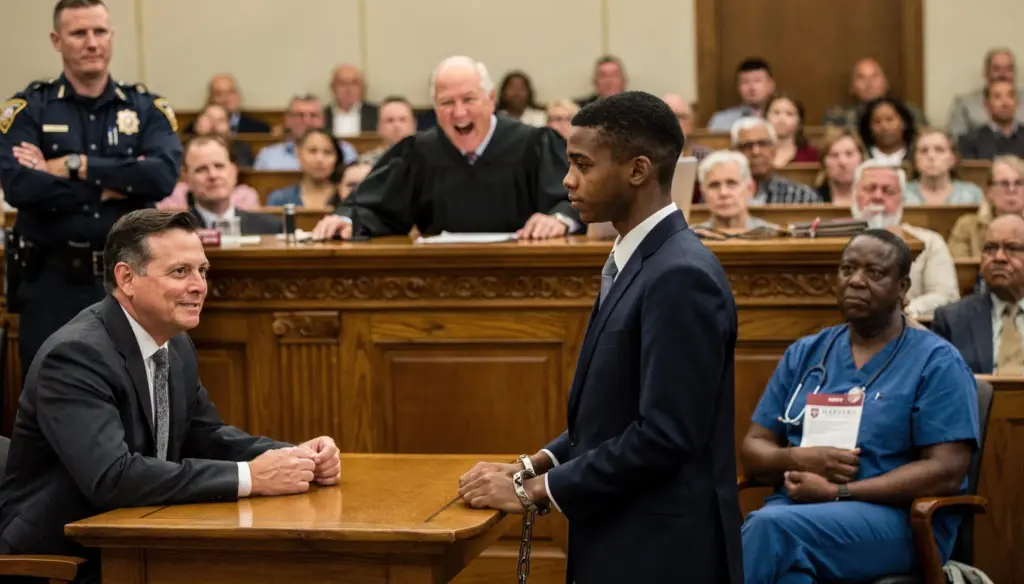
That was when the judge began mocking him.
And now, inside the crowded courtroom, the teenager was refusing to be silenced.
“Your Honor,” Marcus said steadily, “I have a constitutional right to challenge the evidence used against me.”
Judge Morrison leaned forward.
“You have a right to representation, young man. You do not have the right to turn my courtroom into a circus.”
“I agree, Your Honor. That’s why I’m asking the court not to proceed on the suppression issue without my attorney present.”
The judge blinked.
Prosecutor Price shifted in his chair.
Marcus continued.
“The prosecution’s evidence depends on a search whose legal justification has not been established. The police report contains statements that appear inconsistent with independent video evidence.”
Price jumped to his feet.
“Your Honor, the defendant is making unsupported accusations against law enforcement.”
Marcus turned toward him.
“Then the evidence should be examined.”
Judge Morrison struck his gavel.
“Enough!”
But Marcus didn’t raise his voice.
He simply looked toward the judge.
“With respect, Your Honor, the Fourth Amendment protects individuals against unreasonable searches and seizures. The question is not whether the police eventually found something suspicious. The question is whether they were legally justified in searching my property when they did.”





