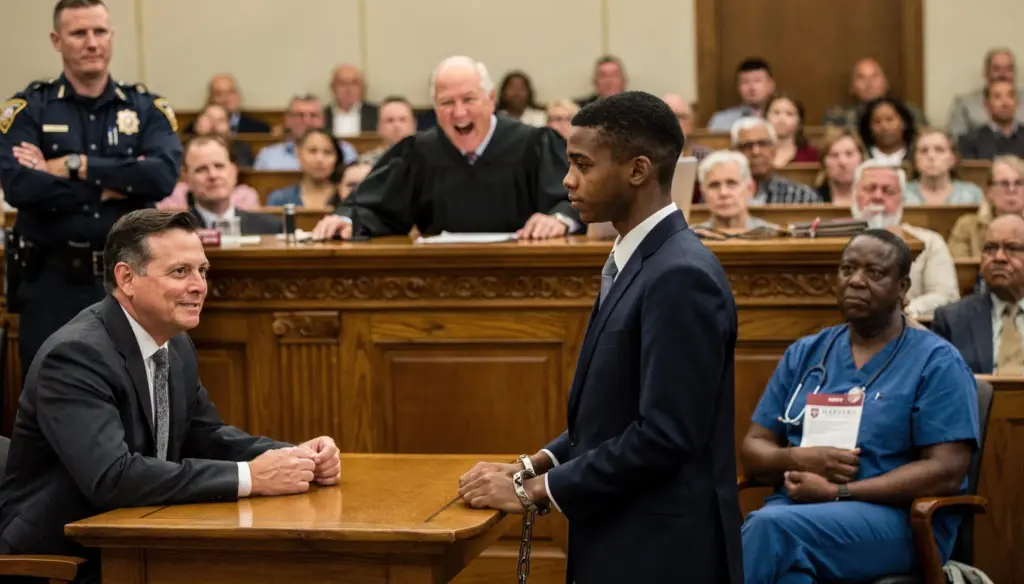
“The prosecution alleges that I committed the robbery at 8:17 p.m. However, the library’s electronic employee records show that I was working until 8:31 p.m. The library is approximately two miles from the pharmacy.”
Prosecutor Price interrupted.
“Those records haven’t been authenticated.”
Marcus nodded.
“That’s correct, which is why my attorney has requested testimony from the library supervisor and the original electronic records.”
The judge shifted in his chair.
Marcus continued.
“Additionally, the eyewitness’s initial description included a neck tattoo. The subsequent identification report does not mention that discrepancy.”
Price stood.
“Your Honor, this defendant is attempting to conduct his own trial.”
Marcus turned toward his attorney, who rose to address the court.
“Your Honor, my client has identified issues I believe warrant judicial review. I am adopting the request for disclosure of the referenced garage footage.”
Morrison frowned.
“What garage footage?”
The defense attorney handed the judge a copy of the police report.
“Page fourteen, paragraph six. It states that an officer collected surveillance video from a parking garage overlooking the pharmacy entrance.”
The judge read the paragraph.
Then he looked at the prosecutor.
“Mr. Price, where is this recording?”
Price shuffled through his documents.
“I would need to verify whether that footage was preserved.”
Marcus spoke softly.
“Your Honor, the evidence inventory lists a digital storage device under item number forty-seven.”
The prosecutor stopped moving.
Marcus continued.
“That item does not appear in the disclosure materials provided to the defense.”
A heavy silence settled over the courtroom.
Morrison examined the inventory.
“Mr. Price, approach the bench.”
The two men spoke quietly for several minutes.
When the prosecutor returned to his table, his earlier confidence had disappeared.
The judge addressed the defense.
“I will order an immediate inquiry into the missing recording.”
Marcus’s attorney requested a recess.
During the break, Patricia rushed toward her son.
“Where did you learn to speak like that?”
Marcus managed a small smile.
“At the library, Mama.”
She hugged him as tightly as the court officers allowed.
Two hours later, the hearing resumed.
A court technician had retrieved the digital recording from the police evidence system.
The video showed the pharmacy entrance at the time of the robbery.
The actual suspect emerged at 8:19 p.m.
He was noticeably taller than Marcus.
And when he turned toward the camera, a dark tattoo was clearly visible along the side of his neck.
Marcus had been at the library.
The footage did not merely raise questions about the identification.
It contradicted the prosecution’s central theory.
Judge Morrison watched the recording twice.
Then he removed his glasses.
“Mr. Price, was this recording available to your office before today’s hearing?”
The prosecutor hesitated.
“It appears that it was.”
“Why wasn’t it disclosed?”
“I cannot provide an explanation at this moment.”
Morrison turned toward Marcus.
For the first time that morning, the judge looked at him without contempt.
“Mr. Williams, you may sit down.”
Marcus remained standing.
“Your Honor, may I say one final thing?”
His attorney glanced at him, then nodded.
Morrison hesitated.
“Briefly.”
Marcus looked around the courtroom.
“When I entered this building, I was called a thug before the evidence was examined. I was told I was going to prison before my attorney had finished presenting our concerns.”
Nobody interrupted.
“I understand that courts have rules. I understand that lawyers are trained to follow them. But I also understand that being accused of a crime does not make someone guilty.”
His voice trembled slightly.
“My mother taught me to respect the law. That’s why I studied it. I never imagined I would have to use what I learned to defend my own future.”
Patricia wiped tears from her cheeks.
Marcus looked directly at the judge.
“Your Honor, I wasn’t asking for special treatment. I was asking for the evidence to be examined.”
Morrison lowered his gaze.
After consulting with counsel, the judge ordered Marcus released from custody while the prosecution reviewed the case. The court also directed that the disclosure failure be formally examined.
Several days later, prosecutors dismissed the charges after reviewing the surveillance footage, employment records, and additional investigative material.
Marcus was free.
But the consequences of the arrest did not disappear immediately.
He had missed weeks of preparation for college. His name had circulated online alongside accusations that were now withdrawn. His mother had exhausted much of her savings on transportation, legal expenses, and missed work.
Still, Marcus refused to let the experience define the rest of his life.
That autumn, he arrived at Harvard carrying two suitcases and the same spiral notebook he had used while studying law at the library.
Inside its back cover, he had written a sentence during the darkest night of his detention:
The law should protect people who have no power, not merely those who know how to demand it.
Years later, Marcus would remember the courtroom not as the place where he delivered his most impressive argument, but as the place where he learned how urgently fair representation mattered.
He also remembered the people who helped him: his mother, the librarian who encouraged his curiosity, and the attorney who ultimately brought his concerns before the court.
And when he was invited to speak to students at his former high school, he told them something different from the speech he had delivered at graduation.
“Knowing your rights matters. Having people willing to defend those rights matters just as much.”
Then he held up his old notebook.
“Never assume that the person standing in front of you has nothing valuable to say simply because of their clothes, their neighborhood, or the color of their skin.”
The audience rose to its feet.
But Marcus looked toward the front row, where Patricia sat smiling through tears.
She had once dreamed of seeing her son become an attorney.
Now she understood that his purpose was greater than earning a prestigious title.





