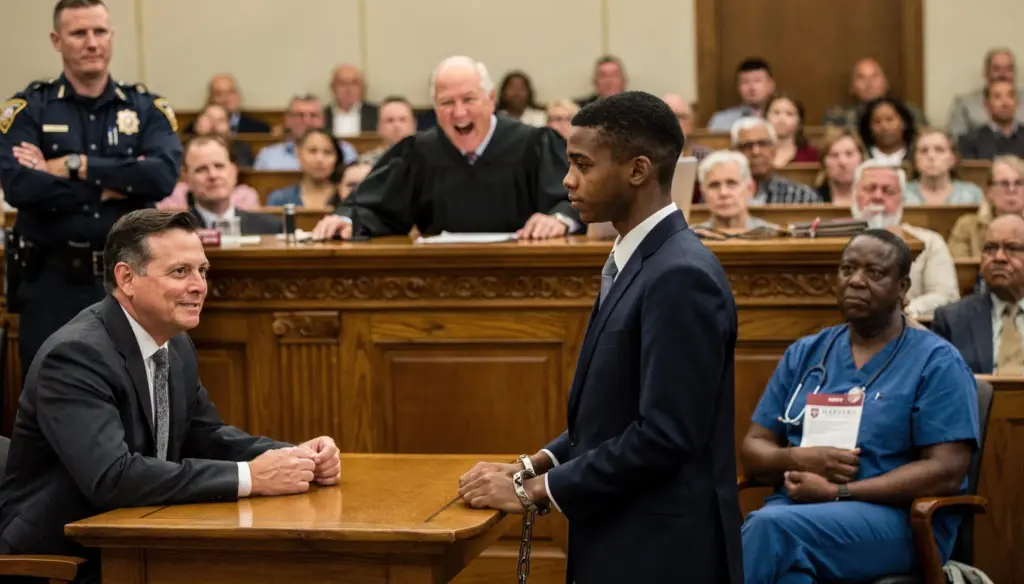
Judge Laughs at Black Teen — Courtroom Freezes When He Starts Speaking Like a Top Attorney
“Another street thug thinks he’s Perry Mason.”
Judge Morrison leaned back in his leather chair and laughed, his voice echoing through the packed courtroom. Standing before him was Marcus Williams, an eighteen-year-old Black teenager whose wrists were locked in cold steel handcuffs. His oversized suit hung awkwardly from his thin shoulders, making him look even younger than he was.
The judge gave him a dismissive wave, as though the young man’s future were nothing more than an inconvenience.
“Son, save the performance,” Morrison sneered. “This is a real courtroom, not some television drama where you get to play attorney.”
The prosecutor smirked. Several court officers exchanged amused glances, and even the bailiff rolled his eyes when Marcus attempted to speak.
“Your Honor, if I may address the evidence—”
“Enough!” Morrison interrupted sharply. “You’re going to prison, boy. The only question is how many years you’ll spend there.”
A painful silence settled over the courtroom.
In the gallery, Patricia Williams sat motionless, clutching a folded Harvard University acceptance letter against her chest. Her trembling fingers tightened around the paper, now creased from weeks of desperate handling. She had spent eleven years raising her son alone, sacrificing sleep, comfort, and nearly everything else to give him a future beyond the struggling streets of East Baltimore.
And now she was watching that future disappear.
Marcus slowly raised his head. His expression was no longer frightened. There was something different in his eyes—a quiet determination that nobody in the courtroom seemed to recognize.
“Your Honor,” he said calmly, “before you proceed, I respectfully request permission to address several constitutional violations in the prosecution’s case.”
The prosecutor stopped smiling.
Judge Morrison stared at him for a moment before laughing again.
“Constitutional violations? You memorized a few legal terms and think you’re a lawyer?”
Marcus remained perfectly still.
“No, Your Honor. But the Constitution doesn’t require me to hold a law degree to understand my rights.”
A few spectators shifted in their seats.
The judge reached for his gavel, visibly irritated by the teenager’s composure. But what nobody in that courtroom realized was that Marcus had spent years studying the very laws the prosecution was now attempting to use against him.
And the truth behind his arrest was far more disturbing than anyone suspected.
Four months earlier, Marcus Williams had stood before a completely different audience.
As the valedictorian of Benjamin Banneker High School, he delivered a graduation speech that brought nearly three hundred people to their feet.
“We are not prisoners of our zip code,” Marcus declared, his voice ringing through the auditorium. “We are architects of our destiny. Our circumstances may shape where we begin, but they do not have to determine where we finish.”
His teachers applauded. His classmates cheered. And in the front row, Patricia Williams wiped away tears as she watched her only child accomplish something she had once barely dared to imagine.
Marcus had earned a full academic scholarship to Harvard University.
His SAT score of 1580 placed him among the country’s highest-performing students. Teachers described him as one of the most gifted young minds they had encountered, a student whose ability to analyze complicated arguments frequently surprised even experienced educators.
But Marcus wasn’t interested in becoming successful simply to escape poverty.
He wanted to become a civil rights attorney.
He wanted to stand beside people who couldn’t afford powerful lawyers, people whose voices were ignored because of their neighborhoods, backgrounds, or the color of their skin.
His bedroom walls held almost no decorations. There were no expensive posters, luxury sneakers, or gaming systems. Instead, his Harvard acceptance letter hung in a simple wooden frame above a desk stacked with constitutional law books.
During the summer, while many classmates celebrated graduation at beaches and parties, Marcus worked forty hours a week at East Baltimore Public Library.
He shelved books, helped elderly visitors navigate computers, and organized reading programs for children who reminded him of himself.
Every dollar he earned went into his college savings.
Even with a scholarship, Marcus knew that attending Harvard would create expenses his mother could barely afford.
After closing time, the library became his private sanctuary.
He would settle into a quiet corner of the law section, surrounded by towering shelves, reading Supreme Court decisions until the security guard reminded him it was time to leave.
He studied the Fourth Amendment, the right to legal counsel, due process, and the complicated history of racial discrimination in American courts.
Sometimes he imagined himself standing before a judge, defending someone who had already been condemned by public opinion.
He never imagined that his first real courtroom battle would be for his own freedom.
His mother had made every opportunity possible through extraordinary sacrifice.
Patricia worked as a registered nurse at Johns Hopkins Hospital, often completing three twelve-hour shifts each week before volunteering for exhausting weekend overtime.
Since Marcus’s father died of a heart attack when he was seven, she had been everything to him—mother, father, teacher, and his strongest supporter.
Their small apartment wasn’t luxurious. The kitchen cabinets were old, the heating system barely survived winter, and the dining table doubled as Marcus’s study desk.
But Patricia insisted that their home would always be a place where education mattered more than circumstances.
“Baby, you’re going to be the first attorney in this family,” she frequently told him.
Marcus would smile and answer, “And you’re going to have the best seat in every courtroom I enter.”
Those words always made her laugh.
East Baltimore was not an easy place to grow up.
Abandoned row houses lined streets where sirens interrupted conversations, and small businesses operated behind reinforced glass. Marcus had watched friends abandon school, families struggle with unpaid bills, and young people lose their futures over mistakes they could never take back.
Yet he refused to surrender to the expectations others placed on his neighborhood.
His entire future was carefully planned.





