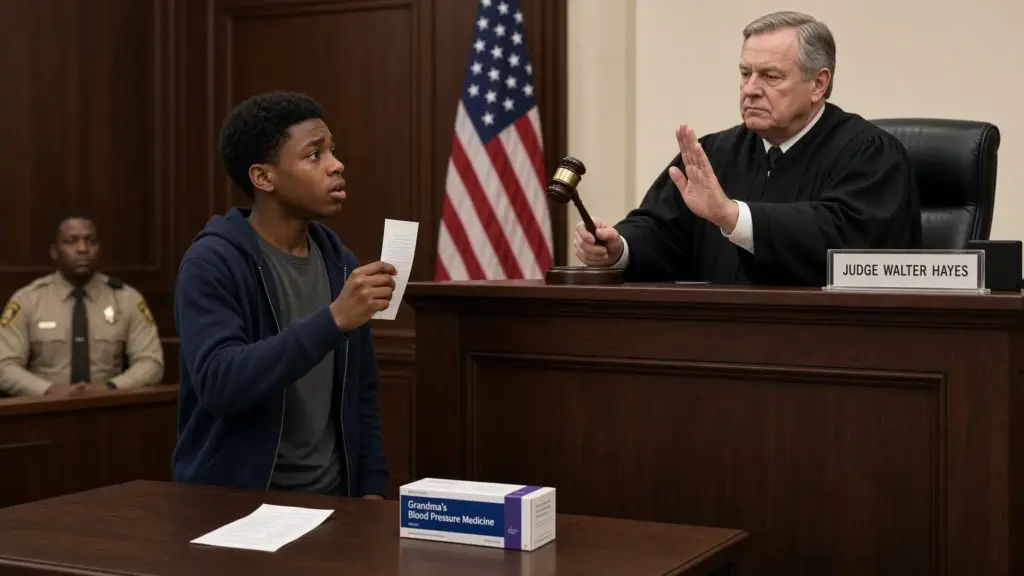
Judge Hayes cleared his throat.
“Mr. Attorney General, I wasn’t aware this was your son.”
Daniel’s expression remained cold.
“His identity shouldn’t change how this court treats him.”
The room fell silent.
Lawson continued presenting her motion.
She requested the immediate release of Isaiah and preservation of all relevant evidence.
Then something unexpected happened.
The courtroom clerk stood.
“Your Honor, may I clarify something for the record?”
Hayes frowned.
“What is it?”
“The receipt was submitted earlier. It was never marked or reviewed.”
Lawson turned.
“Thank you.”
The clerk continued.
“And the arrest report states that no missing money was recovered from the juvenile.”
A murmur spread through the gallery.
Judge Hayes looked down at the file.
For the first time, he appeared uncertain.
Lawson placed the receipt before the court.
“Your Honor, the evidence contradicts the allegation. We request immediate relief.”
After a tense exchange, Hayes withdrew the detention order pending further proceedings.
The bailiff removed Isaiah’s handcuffs.
The boy rushed toward his father.
Daniel knelt and wrapped both arms around him.
“I’m sorry, son.”
Isaiah buried his face against his father’s shoulder.
“I thought nobody was going to believe me.”
Daniel held him tighter.
“I believe you.”
But the story wasn’t finished.
The following morning, investigators reviewed the pharmacy’s security footage.
It showed Isaiah entering the store, purchasing the medication, and leaving the counter without approaching the cash drawer.
Then another recording revealed something crucial.
Earlier that morning, Gerald Mercer’s nephew Cody had opened the register while his uncle was in the storeroom.
He removed forty dollars.
Then left.
When confronted with the footage, Cody admitted taking the money.
Isaiah had been innocent from the beginning.
The criminal allegation against him was dropped.
But Daniel Sutton was deeply troubled by what had happened inside Courtroom B.
He referred the documented concerns to the appropriate judicial oversight authorities, while Isaiah’s attorney pursued the available legal remedies.
As more complaints were examined, other families came forward.
A mother whose teenage son had been detained after a school dispute.
A father whose daughter had been publicly humiliated during a hearing.
Several former court employees described a pattern of troubling remarks and irregular procedures.
An independent investigation was announced.
Judge Hayes was temporarily reassigned while the complaints were reviewed.
Meanwhile, Gerald Mercer’s accusation faced scrutiny after the surveillance footage contradicted his account.
But Isaiah wanted something more important than headlines.
He wanted to go back to school.
He wanted his grandmother to receive her medication.
And he wanted to stop feeling afraid whenever he saw a police car.
One evening, Daniel sat beside him on the porch.
“I owe you an apology,” his father said.
Isaiah looked up.
“For what?”
“For being absent when you needed me before all this happened.”
Isaiah stared at the street.
“You were always busy.”
Daniel nodded.
“I know.”
“You missed my birthday.”
“I know.”
“And my basketball championship.”
Daniel lowered his head.
“I’m sorry.”
For a long moment, neither spoke.
Then Isaiah asked quietly.
“Are you going to disappear again?”
Daniel looked at his son.
“No. I’m going to make time for you. And I’m going to prove it.”
Weeks later, Isaiah returned to the courthouse—not as a defendant, but to speak at a public forum about fairness in the justice system.
Reporters filled the room.
Community leaders sat beside families who had experienced similar treatment.
Isaiah approached the microphone.
His hands trembled slightly.
But his voice was steady.
“When I stood in that courtroom, I was scared because nobody wanted to hear my side.”
He paused.
“Then my dad came.”
Several people smiled.
“But I’ve been thinking about something.”
The room grew quiet.
“What if my dad wasn’t the Attorney General?”
Nobody answered.
Isaiah continued.
“What if he worked at a grocery store? Or drove a bus? Or couldn’t afford an attorney?”
He looked toward the audience.
“Would anybody have listened to me then?”
Daniel sat motionless in the front row.
Isaiah took a breath.
“I don’t want people to be treated fairly because their parents are important.”
He looked directly toward the cameras.
“I want them to be treated fairly because they’re people.”
The room erupted in applause.
Daniel wiped a tear from his cheek.
But as Isaiah stepped away from the microphone, an elderly woman approached him.
She held a worn photograph of a teenage boy.
“Young man,” she said softly, “my grandson stood before that same judge two years ago.”
Isaiah listened.
“He didn’t have an Attorney General to call.”
She handed him the photograph.
“His name was Marcus.”
Daniel stepped closer.
The woman looked at him.
“Mr. Sutton, my grandson’s case was never properly reviewed. We tried to get someone to listen.”
Daniel studied the documents she carried.
Then he turned toward the independent investigators attending the forum.
“This family deserves to have its concerns examined through the proper process.”
The woman began crying.
Isaiah gently touched her hand.
And in that moment, he understood something his father had spent his entire career trying to teach him.
Justice wasn’t about knowing powerful people.
It was about making sure power couldn’t decide whose voice mattered.
Because the most important question in that courtroom was never who Isaiah’s father was. It was why an innocent fourteen-year-old needed an important father before anyone would listen.
Chapter 1 – Judge Jailed a Black Boy in 30 Seconds, No Proof — Then the Boy Dialed the Attorney General: “Dad” – News