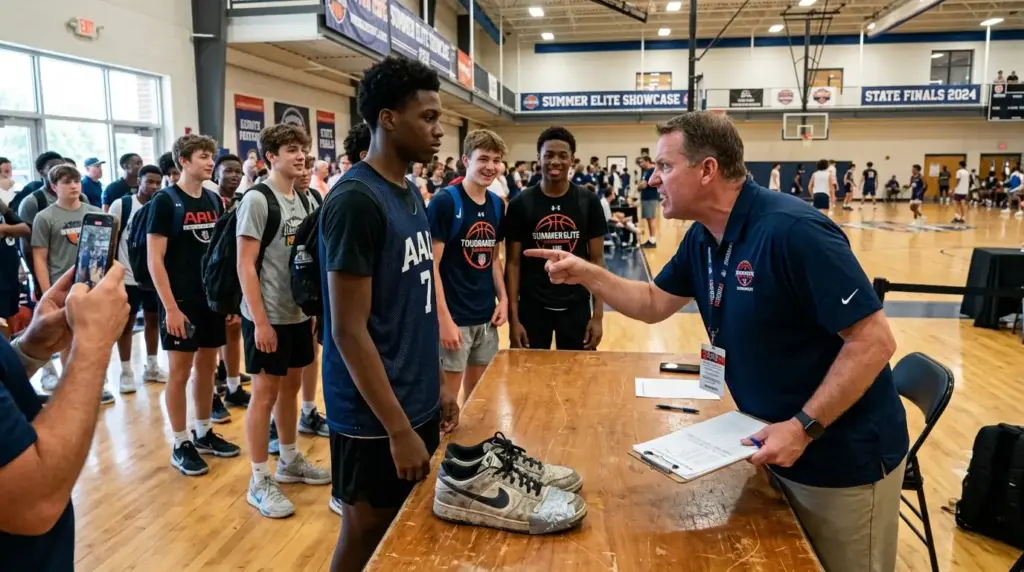
Coach Laughed at a Poor Black Kid’s Torn Shoes — Then His Three-Pointers Made an NBA Scout Freeze
“Get those trash shoes off my court, boy. This is a tournament for real basketball players, not charity cases.”
Coach Dale Rankins’s voice echoed through the crowded gymnasium as sixteen-year-old Malik Carter stood before the registration table.
His sneakers were old, the leather cracked, with duct tape wrapped around the toes. His basketball jersey had faded from years of washing.
Parents turned to stare.
Several players laughed.
Malik lowered his eyes but didn’t move.
“Sir, I paid my registration fee. My name is on the list. I just want a chance to play.”
Rankins leaned forward.
“Scouts don’t come here to watch sad stories. They come to watch talent.”
Malik slowly looked up.
“Then let my basketball do the talking.”
The coach burst into laughter.
What nobody knew was that those worn-out shoes had once belonged to a professional basketball player.
And the quiet Black teenager standing before them had inherited far more than an old pair of sneakers.
By the end of the afternoon, an NBA scout would be standing speechless beside the court, watching a performance that seemed almost impossible.
Malik Carter grew up in a small apartment on the outskirts of Chicago.
His mother, Denise, worked overnight shifts cleaning surgical wings at Fairmont General Hospital.
Every evening, she left home at ten.
Every morning, she returned exhausted, her hands aching and her eyes heavy from lack of sleep.
But she always made sure Malik had breakfast before school.
Money was tight.
Rent, groceries, electricity, and transportation consumed nearly everything she earned.
Still, Denise tried to save enough for a new pair of basketball shoes.
“Baby, those sneakers are falling apart,” she told Malik one evening.
He shook his head.
“They’re fine, Mom.”
“You’re going to hurt yourself playing in them.”
“I’ll be careful.”
What Denise didn’t understand was that Malik wasn’t refusing new shoes because he wanted to save money.
Those sneakers belonged to his father.
Julian Carter had played six seasons of professional basketball before a devastating knee injury ended his career at twenty-nine.
After leaving the league, he worked construction and coached neighborhood children on weekends.
But his favorite student was always his son.
From the age of six, Malik practiced shooting with his father on a cracked outdoor court behind their apartment.
Julian taught him footwork, balance, patience, and the importance of repetition.
“Anybody can get lucky once,” Julian would say. “A great shooter makes the same shot a thousand times.”
Then, three years earlier, Julian died unexpectedly from an undiagnosed heart condition.
Malik was only twelve.
The last thing his father had given him was a pair of worn basketball shoes.
Inside one sneaker, Julian had written a message.
Keep shooting, son. I’m always with you.
Malik wore those shoes whenever he played.
Not because they made him better.
But because they reminded him why he started.
Every morning before school, Malik practiced at the neighborhood court.
He shot one hundred three-pointers before breakfast.
After school, he returned for another two hundred.
Some nights, he practiced beneath a flickering streetlight until his mother called him home.
He had no personal trainer.
No expensive basketball academy.
No professional equipment.
Just an old ball, a rusty hoop, and a dream.
The opportunity came when Malik learned about the Chicago Elite Summer Showcase.
The tournament attracted college recruiters, professional scouts, and some of the most promising teenage players in the country.
His mother saved for weeks to pay the registration fee.
But when Malik arrived, Coach Dale Rankins nearly refused to let him participate.
“Look at those shoes!” Rankins shouted. “You expect serious scouts to take you seriously?”
Malik remained calm.
“My father always told me that people will judge you before the ball touches your hands.”
Rankins smirked.
“And?”
Malik tightened his shoelaces.
“He told me to let my shot answer.”
A few players laughed.
But an older man standing near the bleachers stopped writing in his notebook.
His name was Thomas Reynolds.
A veteran NBA scout.
And something about Malik’s words sounded strangely familiar.
After checking that Malik’s shoes were safe enough for play, tournament officials allowed him to participate.
Rankins wasn’t pleased.
“Fine,” he muttered. “Let’s see how long you last.”
Malik joined a team of players who barely acknowledged him.
Their captain, Brandon Mitchell, was a highly recruited guard with expensive shoes and a private skills coach.
Brandon looked Malik up and down.
“Just stay out of my way.”
Malik nodded.
The game began.
For the first several minutes, nobody passed him the ball.
Brandon dominated possession, attempting difficult shots while ignoring open teammates.
Their team quickly fell behind.
With six minutes remaining in the first half, Malik finally received a pass.
He stood several feet beyond the three-point line.
A defender approached.
Malik rose smoothly.
Released.
Swish.
The crowd barely reacted.
One lucky shot meant nothing.
On the next possession, Malik caught the ball in the corner.
Another three-pointer.
Swish.
Then came a third.
And a fourth.
The opposing coach called timeout.
Rankins stood near the sideline, his expression tightening.
“Who’s that kid?”
One of the assistants checked the roster.
“Malik Carter. Walk-in registration.”
The scout in the bleachers leaned forward.
Thomas Reynolds had stopped writing.
Now he was watching every movement.
Malik’s shooting mechanics were unusually consistent.
His feet were balanced.
His release was quick.
And his ability to create space reminded Reynolds of someone he hadn’t seen in years.
At halftime, Malik had scored twenty-one points.
All from beyond the arc.
His teammates surrounded him.
“Man, where did you learn to shoot like that?”
Malik smiled.
“My dad.”
Brandon stared at his shoes.
“Those things look older than you.”
“They are,” Malik replied.
Then he walked toward the bench.
The second half became unforgettable.
The opposing team began double-teaming Malik.
He responded by passing to open teammates.
When defenders backed away, he shot.
Chapter 1 – Coach Laughed at a Poor Black Kid’s Torn Shoes — Then His Three-Pointers Made an NBA Scout Freeze – News