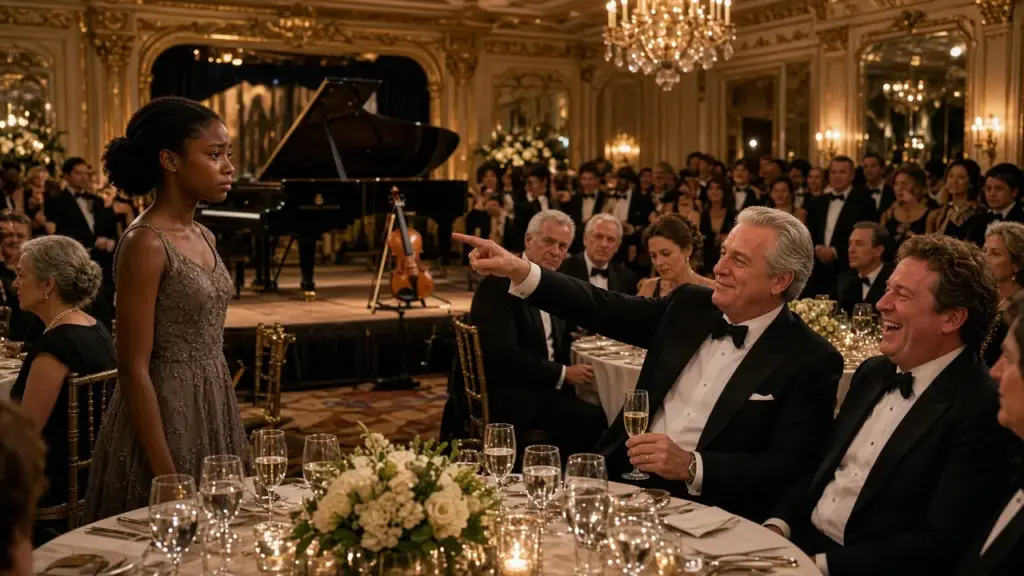
Black Orphan Asked Millionaire for Help — He Laughed: “Play Violin, I’ll Consider Adopting You”
“Play the violin, girl. Do that and maybe, just maybe, I’ll consider adopting you.”
“Sir, please. I’m just asking for a chance to study music.”
“You hear that, gentlemen? She wants to study music.”
The millionaire leaned back in his chair, a cruel smile spreading across his face. His eyes traveled down her borrowed dress, stopping at the worn shoes she had carefully polished that morning.
“Blackie, let me tell you something: girls like you don’t study music. Girls like you serve coffee to people who do.”
Laughter rippled through the ballroom. Three hundred guests heard every word. Nobody moved. Nobody defended her.
Harper Langston stood frozen beneath the enormous crystal chandelier, clutching an old violin case against her chest. Her fingers trembled, but she refused to lower her eyes.
“Then let me play,” she whispered.
The millionaire laughed even harder.
“Oh, this should be entertaining.”
Harper Langston was fifteen, Black, an orphan, and she had not come to that ballroom to leave the way they expected her to. What she did next made a $400 million man wish he had stayed silent.
Have you ever watched a room full of powerful people go completely silent because one person they underestimated refused to sit down?
To understand what Harper Langston did in that ballroom, you have to go back six hours, and then seven years before that.
Six hours earlier, she was sitting on the edge of a narrow bed in Brooklyn, holding a wooden metronome in both hands like it was something precious enough to break.
“Harper, honey, the van leaves in twenty minutes,” Sister Margaret’s voice carried up the back stairs.
Harper didn’t answer.
“Harper, you hear me, child?”
“Yes, Sister.”
“Then come down. I am not driving to Manhattan with a dress in one hand and no girl in it.”
Harper smiled faintly, but her eyes remained fixed on the metronome. It had belonged to her mother, a violinist who had died when Harper was eight. Seven years had passed, yet she could still remember the sound of her mother’s music filling their tiny apartment on cold winter evenings.
Her mother had taught her three things: never waste a note, never apologize for having a dream, and never let someone else’s cruelty decide her worth.
That morning, Harper carefully placed the metronome in her bag and reached for the violin case beside her bed. The instrument was old, its varnish scratched and its strings replaced more times than she could count. But it was the only thing she owned that still connected her to the family she had lost.
Downstairs, Sister Margaret was waiting with a pale blue dress donated by a local church.
“You look beautiful, sweetheart,” the older woman said.
Harper glanced at her reflection in the hallway mirror.
“Do you really think someone there will help me?”
Sister Margaret hesitated.
“I think someone needs to hear you play.”
The invitation to the Manhattan charity gala had arrived three weeks earlier. Wealthy donors, business executives, and influential philanthropists would gather to raise money for underprivileged children. Among them was billionaire investor Richard Caldwell, a man whose foundation claimed to support young musical talent.
Harper had spent every night preparing a letter asking for a scholarship.
She wasn’t asking for luxury, expensive clothes, or a wealthy family. She wanted lessons at a real conservatory. She wanted a chance to become the musician her mother had believed she could be.
But when she finally approached Caldwell that evening, he barely looked at her letter.
Instead, he turned her dream into a joke.
And now, standing before three hundred strangers, Harper slowly opened her battered violin case.
The laughter continued until she lifted the instrument beneath her chin.
Then she closed her eyes.
The first note rose into the ballroom, soft and trembling, like a voice returning from a distant memory.
A second note followed. Then a third.
Within seconds, the laughter stopped.
A woman near the front lowered her champagne glass. An elderly gentleman stood up so suddenly that his chair scraped across the marble floor.
And Richard Caldwell’s smile began to disappear.
Because the melody Harper was playing was not just beautiful.
It was a composition that had remained unfinished for seven years.
And someone in that ballroom knew exactly who had written it.
Chapter 1 – Black Orphan Asked Millionaire for Help — He Laughed: “Play Violin, I’ll Consider Adopting You” – News