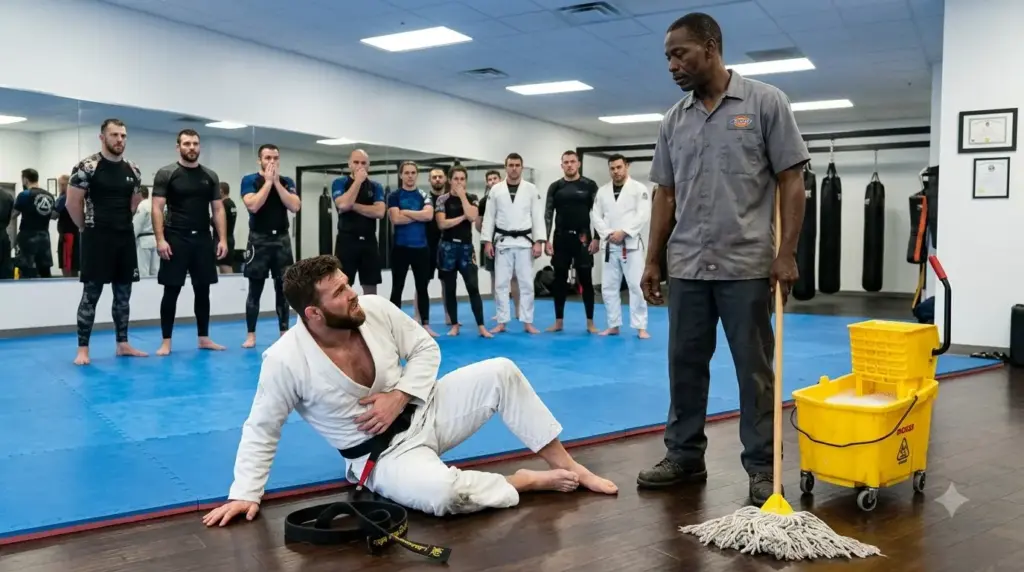
Derek nodded.
“I understand.”
Marcus looked at him.
“I hope so.”
He turned toward the door.
“Wait,” Derek said.
Marcus stopped.
“I’m sorry.”
The older man remained still.
Derek continued.
“Not because you beat me. Because I treated you like you weren’t a person.”
Marcus looked back.
The apology was clumsy.
But it sounded genuine.
“Thank you,” he said.
Then he left.
Over the next two weeks, the incident spread through the local martial arts community.
Not because someone posted a dramatic video.
Jason had stopped recording as soon as Derek grabbed Marcus, and the gym’s security footage remained private.
The story spread because twenty people had witnessed something they couldn’t forget.
A black belt had tried to force a janitor into a demonstration.
The janitor had refused.
The instructor had attacked him.
And the confrontation had ended in less than forty seconds.
But the detail that stayed with most witnesses wasn’t the speed.
It was what Marcus had said afterward.
That’s why I don’t fight.
Derek canceled his advanced classes for a month.
He met with the students who had witnessed the incident.
He apologized without making excuses.
He offered refunds to anyone who no longer felt comfortable training at Apex.
Some accepted.
Others stayed.
But the atmosphere had changed.
Parents asked questions.
Students demanded clearer safety rules.
And Derek was forced to confront the difference between teaching martial arts and performing authority.
One afternoon, Jason visited Marcus while he was cleaning the empty gym.
“Mr. Reed?”
Marcus looked up.
“You’re early.”
“Class doesn’t start for another hour.”
Jason hesitated.
“Can I ask you something?”
Marcus smiled faintly.
“You already did.”
Jason laughed nervously.
Then became serious.
“How did you survive twenty years inside?”
Marcus leaned against the mop handle.
“Not the way people imagine.”
“What do you mean?”
“I didn’t spend twenty years fighting.”
Jason frowned.
“But you know how.”
Marcus nodded.
“I learned enough to protect myself. Then I spent most of my time learning how to avoid situations where I’d need to.”
He paused.
“That was harder.”
Jason considered the answer.
“What did you do?”
“Worked in the library. Took classes. Helped other men learn to read.”
Marcus smiled slightly.
“Eventually, I started teaching conflict resolution.”
Jason stared.
“In prison?”
“Especially in prison.”
Marcus returned to cleaning.
“People think strength is always about what you can do to somebody. Sometimes it’s about what you can stop yourself from doing.”
Jason nodded slowly.
Then he looked toward the training floor.
“Would you ever teach here?”
Marcus laughed.
“No.”
“Why not?”
“Because I’m a janitor.”
Jason shook his head.
“You’re more than that.”
Marcus stopped.
He looked at the young man.
“Being a janitor isn’t something I need to rise above.”
Jason flushed.
“I didn’t mean—”
“I know.”
Marcus’s expression softened.
“It’s honest work. I’m proud of it.”
Jason nodded.
Marcus continued.
“But I appreciate you asking.”
Three months later, Apex introduced a new program.
It wasn’t a fighting class.
It wasn’t self-defense.
It was a weekly workshop called The First Thirty Seconds.
The name came from a conversation between Marcus and Derek.
Most confrontations, Marcus had explained, could become dangerous before anyone understood what was happening.
The first thirty seconds mattered.
Not because they offered an opportunity to dominate.
Because they offered an opportunity to recognize danger, establish boundaries, create distance, and seek help.
Derek asked Marcus to help design the workshop.
Marcus initially refused.
Then Rachel suggested something different.
“You don’t have to teach fighting,” she said. “Teach the things that kept you from fighting.”
That idea stayed with him.
So Marcus agreed.
The first session had eleven students.
By the fourth week, there were thirty.
They practiced recognizing escalating situations.
They discussed how pride affected decision-making.
They learned why refusing a confrontation was not the same as losing one.
And Marcus told them something he had learned through years of painful experience.
“People usually imagine violence beginning with a punch.”
He looked around the room.
“But sometimes it begins when somebody decides another person’s ‘no’ doesn’t count.”
Derek stood near the back.
He listened without interrupting.
After class, he approached Marcus.
“You know, I used to think I was teaching people confidence.”
Marcus folded the chairs.
“You were teaching them some confidence.”
Derek shook his head.
“Not the right kind.”
Marcus looked at him.
“Then teach it differently.”
Derek nodded.
“I’m trying.”
“I can see that.”
The younger man’s expression softened.
It was the first time Marcus had offered him encouragement.
Six months after the incident, Apex hosted a community open house.
Families toured the facility.
Children practiced basic drills.
Parents met the instructors.
Near the entrance, a small display explained the gym’s new safety standards.
Consent before demonstrations.
No forced participation.
Immediate respect for tapping or verbal requests to stop.
No humiliation as a teaching method.
And a clear procedure for reporting misconduct.
Marcus arrived early.
He cleaned the mirrors.
Emptied the trash.
Checked the mats.
Then changed into a plain blue shirt and joined the workshop.
That afternoon, Derek introduced him to the visitors.
“This is Marcus Reed,” he said. “He helps maintain our facility and teaches our conflict-prevention program.”
Marcus smiled.
“Good afternoon.”
Derek continued.
“He’s also the person who taught me the most important lesson of my career.”
Marcus glanced toward him.
Derek didn’t mention the fight.
He didn’t need to.
Instead, he looked toward the parents and students.
“Martial arts are supposed to make people safer. If we use them to frighten or humiliate others, we’ve forgotten why we’re here.”
The room applauded.
Marcus looked uncomfortable.
Afterward, he pulled Derek aside.
“You didn’t have to make a speech about me.”
Derek smiled.
“I know.”
Marcus shook his head.
“You’re still dramatic.”
Derek laughed.
“Working on it.”
Later that evening, after everyone had gone home, Marcus stood alone in the gym.
The fluorescent lights hummed above him.
The mats were clean.
The mirrors reflected an empty training floor.
He picked up his mop and began working.
Derek appeared at the office doorway.





