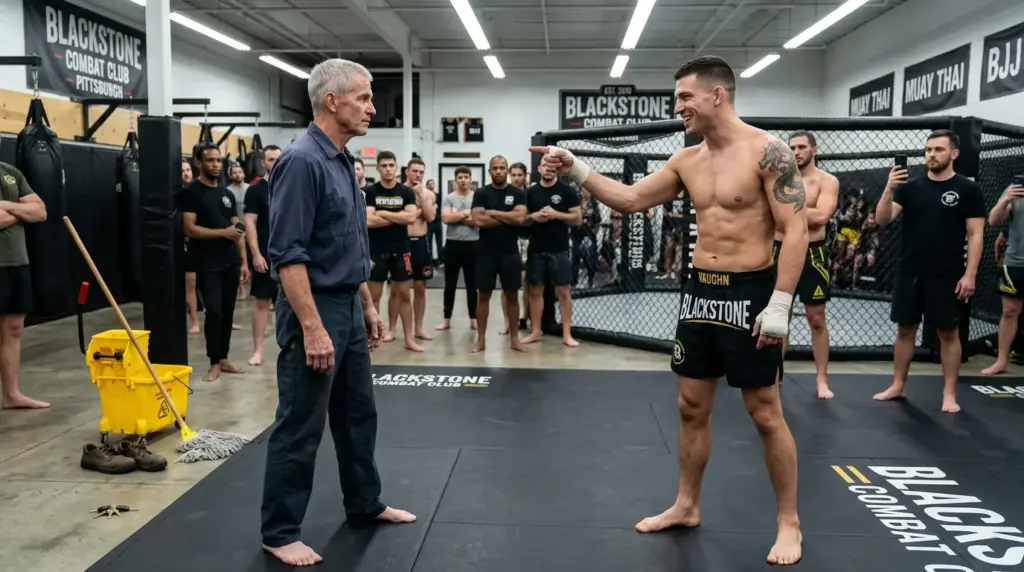
They had laughed because he laughed.
They had learned that strength gave someone permission to humiliate others.
And now they were watching him face the consequences.
Derek turned toward Kyle.
“Delete the video.”
Kyle hesitated.
“But it would get millions of views.”
“Delete it.”
Kyle obeyed.
Preston stepped forward.
“Actually, we need to talk about more than one video.”
Everyone looked toward him.
He took a breath.
“I’ve allowed things here that I shouldn’t have allowed. I kept telling myself it was harmless because Derek was bringing attention to the gym.”
He looked at Walter.
“I was wrong.”
Walter remained quiet.
Preston continued.
“Starting tomorrow, nobody gets filmed without permission. No forced challenges. No humiliating beginners. And every instructor is going to be held to the same standards.”
Maya nodded.
“Good.”
Then Preston looked toward Walter.
“Would you consider coaching again?”
Walter laughed softly.
“At my age?”
“Technique doesn’t retire just because the knees get old.”
Walter considered the question.
“I haven’t taught in years.”
Maya smiled.
“Then start with one class.”
Walter looked toward the mat.
For a long moment, he seemed to see something nobody else could.
Perhaps the old wrestling club.
Perhaps the children who had trained there.
Perhaps his wife sitting beside the wall with a thermos of coffee, waiting for him to finish another late practice.
Finally, he nodded.
“One class.”
The following Saturday, Blackstone Combat Club opened its doors at seven in the morning.
Walter arrived at six-thirty.
Not with a mop.
With an old canvas gym bag.
Inside were a whistle, a notebook, a faded wrestling jacket, and a pair of worn training shoes.
By seven, nearly forty students had gathered.
Some were professional fighters.
Others were beginners.
Several parents had brought their children after hearing about the retired coach.
Derek stood near the front.
No cameras.
No sponsors.
No championship belt.
Just a plain training shirt and an attentive expression.
Walter stepped onto the mat.
“Before we start,” he said, “I want everyone to understand something.”
The students fell silent.
“Winning matters in competition. But in training, your partner is helping you become better. If you hurt them to prove you’re strong, you’ve misunderstood the assignment.”
He looked toward Derek.
The younger man nodded.
Walter continued.
“Today we’re working on balance.”
For the next hour, he taught simple movements.
Nothing flashy.
No dramatic throws.
No complicated combinations.
He showed students how to recognize pressure, maintain posture, and avoid wasting energy.
Derek struggled with one drill.
Walter corrected him patiently.
“Slow down.”
Derek tried again.
“Better.”
He repeated the movement.
This time, it worked.
Walter smiled.
“There you go.”
Derek grinned like a teenager who had just learned his first technique.
After class, the students gathered around Walter with questions.
He answered every one.
When the last student left, Preston approached him.
“I’ve been thinking about what you said.”
Walter zipped his gym bag.
“Which part?”
“About nobody asking.”
Preston hesitated.
“I’ve worked beside you for five years, and I never bothered to learn your story.”
Walter looked at him.
“Most people are busy.”
“That’s not an excuse.”
“No,” Walter agreed. “It isn’t.”
Preston handed him an envelope.
Inside was a formal offer for a part-time coaching position with proper pay, benefits, and a schedule that accommodated his physical limitations.
Walter read it twice.
Then looked up.
“You’re serious?”
“Completely.”
Walter smiled.
“I’d like that.”
Three months later, Blackstone Combat Club looked different.
Derek still competed.
He still trained hard.
He still won fights.
But his social media videos changed.
Instead of humiliating beginners, he explained techniques.
Instead of mocking mistakes, he showed how to correct them.
And whenever someone asked him about the old janitor who had controlled him in twenty-six seconds, Derek gave the same answer.
“He taught me more in half a minute than I learned from winning twelve fights.”
Walter never liked hearing that.
He would shake his head and remind Derek that every coach, every opponent, and every training partner had contributed to his development.
But sometimes, when the gym was nearly empty, Derek would find Walter standing beside the old photographs in the hallway.
One afternoon, Derek approached him.
“Coach?”
Walter turned.
“Yeah?”
“Do you miss competing?”
Walter considered the question.
“Sometimes.”
“Do you miss winning?”
Walter smiled.
“Not as much as I thought I would.”
Derek frowned.
“What do you miss?”
Walter looked through the glass toward the training floor.
A teenage boy was helping a younger student practice a basic movement.
The younger student stumbled.
The older boy caught him before he fell.
Then they tried again.
Walter watched them for a moment.
“That,” he said.
Derek followed his gaze.
“The kids?”
“The moment somebody realizes they can do something they couldn’t do yesterday.”
Walter picked up his gym bag.
“Medals collect dust. That feeling doesn’t.”
Derek remained standing in the hallway long after Walter had gone.
For years, he had believed that respect came from defeating people.
Now he understood that the people worth respecting most were often those who had nothing left to prove.
And the old man everyone had called just the janitor had never needed a championship belt to demonstrate it.
Because real greatness isn’t measured only by the opponents you defeat. Sometimes it’s measured by the people who become stronger because you were there.





