Rumors followed.
A family emergency.
An injury.
A bad manager.
A private deal gone wrong.
Then nothing.
Samuel searched for a while.
Called numbers.
Asked coaches.
Tracked old addresses.
But baseball is full of missing boys, and the world does not pause long enough to mourn every one.
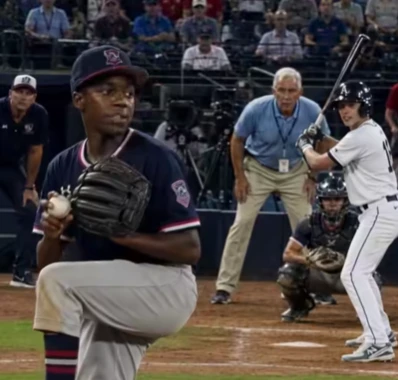
Now, as Malik Turner walked to the mound, Samuel leaned forward.
There was something in the boy’s right hand.
Something old.
Malik took the ball from the umpire.
It felt smooth in his palm.
Too new.
Tournament balls were always too new.
He rubbed it gently with both hands, then placed his fingers.
Index along the seam.
Middle finger angled.
Thumb tucked under just enough to feel the inside tension.
Not a normal grip.
Not one Coach Pike had taught him.
Not one any team coach had taught him.
It was the grip from the notebook.
The notebook under his bed.
The notebook his mother thought he had never found.
Malik had discovered it two years earlier in a cardboard box at the back of her closet while looking for tape for his glove.
A black composition notebook.
Pages filled with drawings of hands on baseballs.
Notes in handwriting he did not recognize.
Not neat, but intense.
First pitch: invite the swing.
Second pitch: remove the barrel.
Third pitch: take the room.
At first, Malik thought it belonged to his grandfather.
Then he saw the name written inside the front cover.
Darius King.
His mother said almost nothing about his father.
Only that he was gone.
Not dead.
Not alive.
Gone.
That was the word she used.
Gone was worse than dead sometimes.
Dead had a shape.
Gone changed every time Malik tried to hold it.
When Malik asked about Darius King, Angela had become still.
Too still.
“Where did you hear that name?”
He lied.
“Online.”
She looked at him for a long time.
Then said, “Stay away from old baseball stories.”
That was all.
But Malik did not stay away.
He studied the notebook at night with a flashlight.
He practiced the grips against brick walls.
He learned how to make the first pitch look slow enough to insult a hitter.
How to make the second break late.
How to make the third come from the same tunnel and end somewhere different.
He did not know whether Darius King was his father.
Not for sure.
But the notebook felt like a voice.
And every time Malik threw from it, his body understood before his mind did.
On the mound, Malik looked toward the plate.
Brayden Cole stepped in, still smirking.
The catcher, Isaiah Grant, crouched and signaled fastball.
Malik shook his head.
Isaiah frowned.
He signaled again.
Malik shook again.
From the dugout, Coach Pike shouted, “Just throw the ball!”
Malik exhaled.
Then he nodded to himself.
No sign.
No permission.
He lifted his leg.
The stadium quieted halfway.
Not because anyone respected him yet.
Because everyone wanted to see the joke land.
Malik threw the first pitch.
It came slow.
Too slow.
At least, that was how it looked.
The crowd laughed before it reached the plate.
Brayden’s eyes widened with delight.
He swung hard, ready to send the ball into the sponsor tent.
But the pitch floated a heartbeat longer than expected, then slid beneath the center of his swing like it had lost weight.
The bat cut empty air.
The catcher caught it clean.
Strike one.
The stadium changed.
Not silent.
Not yet.
But confused.
A sound moved through the crowd like a question.
Brayden turned and looked back at the catcher.
Then at Malik.
His smirk returned, but not fully.
“Lucky,” he said.
Malik did not answer.
Behind home plate, Samuel Reeves slowly stood.
His face had gone pale.
The grip.
The arm slot.
The first pitch designed to insult the swing.
He had seen it.
Fifteen years ago.
Darius King at a summer showcase in Macon, Georgia.
A hitter laughing before missing by nearly a foot.
Samuel whispered, “No.”
The scout beside him asked, “What?”
Samuel did not answer.
On the mound, Malik received the ball back.
Brayden stepped out, adjusted his gloves, and rolled his shoulders.
A boy like Brayden was not used to being embarrassed.
Not publicly.
Not by someone who looked like Malik.
He stepped back in harder.
No smile now.
The catcher gave another sign.
Malik ignored it again.
Coach Pike shouted from the dugout, “Turner!”
Malik did not look over.
The second pitch left his hand from the same window.
Brayden recognized the first half.
Slow again.
He waited this time.
Let it travel.
Prepared to crush it the moment it stayed up.
Then the ball bent late, dropping under the barrel like someone had pulled it by a string.
Brayden swung.
Missed.
Strike two.
The catcher held the glove still.
The stadium went silent.
Now no one was laughing.
The cameras zoomed in.
The scouts stood.
The commentators stopped using jokes.
Brayden stared at the mound.
His father, Leonard Cole, stood behind the Kings Elite dugout with both hands on the fence.
“What is he throwing?”
Nobody answered.
Samuel Reeves stepped closer to the field rail.
His hand gripped his notebook so tightly the paper bent.
Because now he was sure.
That was not a child guessing.
That was a sequence.
A three-pitch trap.
The same one Darius King had once described to Samuel after striking out a college-bound hitter.
“First pitch makes him think you’re weak,” Darius had said.
“Second pitch makes him think he misread you.”
“And the third?”
Darius had smiled.
“The third makes him remember you.”
Samuel’s chest tightened.
Malik stood on the mound with the ball in his hand.
Brayden stepped out again.
This time, the umpire said, “Batter.”
Brayden ignored him for one second.
He looked toward his coach.
His coach clapped.
“Stay back, Bray! He’s got nothing!”
But the coach’s voice had fear in it now.
Everyone heard it.
Malik glanced once toward the bleachers.
His mother stood frozen, both hands over her mouth.





