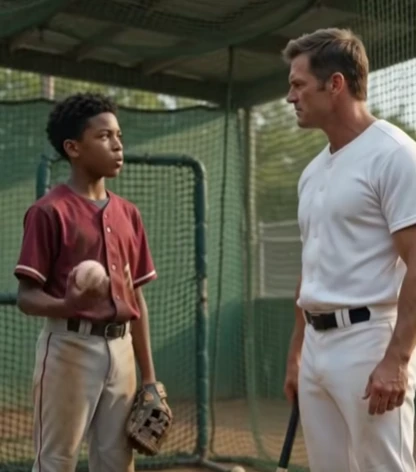
Raymond approached Tariq.
“Let me see the ball.”
The catcher tossed it back.
Tariq handed it to Raymond.
Raymond turned the baseball slowly.
There were almost no visible marks.
“You release it clean,” he said.
“My grandfather made me practice with a ball covered in marker.”
Raymond looked at him.
“Black lines around the seams?”
Tariq nodded.
“If the lines became circles, I was spinning it.”
Raymond smiled.
“Isaiah used the same trick.”
Tariq’s eyes widened.
“You knew him?”
“I caught him.”
“When?”
“A long time ago.”
“My grandfather never said he played professionally.”
“He didn’t like talking about it.”
“Why?”
Raymond looked toward the empty bullpen.
“Because the game didn’t always treat him fairly.”
Tariq waited.
Raymond rested both hands on the fence.
In 1978, Isaiah Mason had been one of the best pitchers in a small independent league in the South.
He could not throw ninety miles per hour.
He was not tall.
Scouts ignored him because he did not look powerful.
Some coaches believed a Black knuckleball pitcher was a novelty rather than a prospect.
Others claimed the pitch was too unreliable.
Isaiah kept winning.
Raymond caught for him during one long summer.
They traveled by bus through towns where restaurants served the white players first.
In one town, Isaiah was told he could enter the stadium through the player gate but could not stay in the same motel as part of the team.
He slept on the bus.
The next afternoon, he pitched eight scoreless innings.
A major league scout attended the game.
Afterward, the scout asked to see the “real prospect.”
He meant another pitcher.
Isaiah eventually injured his shoulder while trying to throw harder.
He abandoned the knuckleball because coaches said it made him look weak.
Within a year, he left baseball.
“He should’ve gone farther,” Raymond said.
Tariq looked at the ball in his hand.
“He taught me not to throw hard.”
“He learned that lesson too late.”
Coach Carter joined them.
“You’re Raymond Clark.”
Raymond nodded.
“My father used to talk about you.”
“That means your father is old.”
She smiled.
“He is.”
Tariq looked toward the stands.
His mother, Aisha Mason, was running down the aisle.
She had arrived late because her shift at the nursing home ended at three.
She reached the field and wrapped both arms around Tariq.
“I saw the replay,” she said.
“Mom, we got the money.”
“I saw.”
“And more uniforms.”
“I heard.”
“And Mr. Clark knew Grandpa.”
Aisha looked at Raymond.
Her face became still.
“You played with my father?”
“Yes.”
She released Tariq and faced him.
“My father never kept photographs from baseball.”
“He had reasons.”
“He kept one.”
Raymond waited.
“A picture of a catcher with a broken nose.”
Raymond touched the bridge of his nose.
“That would be me.”
Tariq laughed for the first time since the challenge began.
Aisha looked toward Cole Barrett.
“He mocked them?”
Coach Carter nodded.
“Until Tariq made him miss.”
Aisha’s pride was immediate, but fear followed it.
She knelt in front of her son.
“You bet the whole team on one pitch?”
“We were going to lose the field anyway.”
“You don’t carry that by yourself.”
“I knew I could throw it.”
“That isn’t the point.”
Tariq looked down.
Aisha lifted his chin.
“You were brave. But bravery isn’t believing you can’t fail.”
“What is it?”
“It’s knowing who will stand beside you if you do.”
She looked toward his teammates.
Every boy remained nearby.
None had blamed him before the pitch.
None would have blamed him if Cole had hit it.
Tariq understood.
The challenge had felt like his alone because Cole had addressed him alone.
But the field, the uniforms, and the humiliation belonged to all of them.
So did the victory.
Cole tried to leave through the tunnel.
The reporter stopped him.
“Mr. Barrett, do you have anything to say to Tariq or the Southside team?”
Cole adjusted the collar of his uniform.
“The foundation made a generous donation. I hope the children use it responsibly.”
“Do you regret your comments about their equipment?”
“I think people are too sensitive.”
“Do you regret refusing to honor the challenge?”
“I didn’t refuse. The board chose to make a donation.”
Raymond heard the answer from the field.
He shook his head.
Tariq looked at him.
“Was he always like that?”
Raymond studied Cole.
“No one starts that way.”
Cole had grown up in a working-class neighborhood.
His father repaired truck transmissions.
His mother worked in a grocery store.
Old newspaper photographs showed Cole playing in secondhand uniforms.
Somewhere between the minor leagues and the commercials, he had learned to hide where he came from.
The Southside equipment had not disgusted him because it was unfamiliar.
It had embarrassed him because it was familiar.
That did not excuse him.
But Raymond recognized the fear beneath the arrogance.
Cole was terrified that people might see the boy he used to be.
So he mocked boys who reminded him.
The event ended early.
Several sponsors refused to participate in the closing ceremony.
The foundation board scheduled an emergency meeting.
By evening, the video of Tariq’s pitch had spread across the city.
By morning, it had spread across the country.
People replayed the movement of the ball.
Sports programs invited pitching coaches to explain it.
Some called it a knuckleball.
Others called it a knuckle-change.
Raymond called it what Isaiah had called it.
The ghost pitch.
“It looks present,” Isaiah used to say, “until the hitter tries to touch it.”
The public reaction focused first on Tariq’s talent.
Then people saw the full video.
They heard the laughter.
They watched Cole hold the cracked helmet.
They heard him call Tariq a charity case.
The story changed.
Cole’s sponsors issued statements.
Two paused their contracts.
One canceled a planned commercial.
The foundation board removed Cole as chairman pending an investigation.
Reporters discovered that less than a quarter of the charity’s previous-year spending had gone directly to youth programs.





