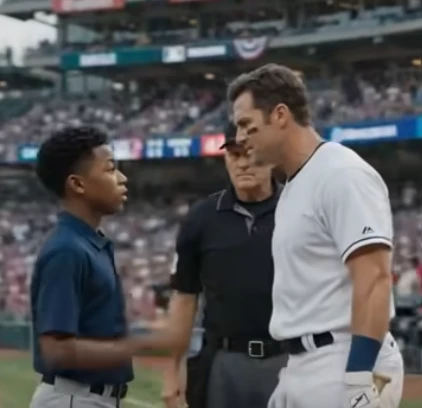
“I know.”
“Some people can tolerate that.”
“And some can’t?”
Franklin nodded.
“They don’t want an advantage.”
He looked toward the empty field.
“They want doubt removed.”
The deeper investigators dug, the more people appeared.
Miles Kerr.
Eric Baines.
Two video operators.
Assistant coach Denny Walsh.
A clubhouse attendant who moved receivers between stadiums.
The scheme had been used in at least six exhibition events and several closed preseason games.
Investigators found no proof it operated during official league games at first.
Then a backup drive surfaced.
Timestamps.
Video captures.
Pitch tags.
Regular-season dates.
Now the scandal became much larger.
Several opposing pitchers remembered strange at-bats.
A veteran named Marco Ruiz had thrown a full-count slider in a May game.
Adrian did not move until the ball broke.
Then crushed it.
At the time, commentators praised his discipline.
The video system had been active that night.
Another pitcher, Daniel Cho, changed signs repeatedly because he felt something was wrong.
Adrian struggled.
The system’s operator wrote afterward:
Cho sequence too complex. Need better decode.
That note became devastating evidence.
It also proved the cheating did not make Adrian unbeatable.
It only made the game less honest.
Cameron’s life became strange.
At school, classmates treated him differently.
Some called him famous.
Some said he had ruined baseball.
One student told him Adrian Cole would lose millions because of him.
Cameron replied:
“I didn’t install the camera.”
The student shrugged.
“You still exposed him.”
That word bothered Cameron.
Exposed.
As if he had been hunting Adrian.
He had not.
He had wanted Adrian to explain the light.
That was all.
His mother noticed Cameron becoming quieter.
One night, she placed Malcolm’s old baseball notebook on the table.
Cameron had not opened it in months.
“What’s this for?”
“You need to remember something.”
He opened the cover.
His father’s handwriting.
OBSERVE FIRST. CONCLUDE SECOND. SPEAK THIRD.
Cameron smiled.
“He really wrote like a teacher.”
“He was a teacher.”
“A coach.”
“Same disease.”
Cameron turned pages.
Pitch sequences.
Defensive alignments.
Notes about hitters.
Then a line appeared:
If noticing something makes powerful people angry, check whether you noticed the right thing.
Cameron stared.
His mother said:
“He wrote that after another coach got mad because your dad caught him changing player ages in a tournament.”
Cameron laughed.
“I never heard that story.”
“There are many stories I avoided telling you because I wanted you to become less like him.”
“Did it work?”
Tasha looked exhausted.
“No.”
Three weeks after the game, the league held a formal disciplinary hearing.
Cameron was asked to attend.
Not as an accuser.
As a witness.
The room was smaller than he expected.
Commissioner Grant.
League counsel.
Club representatives.
Player union lawyers.
Adrian Cole and his attorneys.
Franklin Shaw.
Dana Whitfield.
Cameron sat beside his mother.
He wore a borrowed blazer.
The sleeves were slightly too long.
He hated it.
When called, he described the camera.
The signals.
The flashes.
His cardboard notes.
Adrian’s attorney questioned him.
“You are fifteen?”
“Yes.”
“You have no professional baseball experience?”
“No.”
“You have never worked in electronic scouting?”
“No.”
“You are not an expert in stadium broadcast systems?”
“No.”
“You had never seen the camera before that day?”
“No.”
“So when you concluded it was involved in cheating, that was speculation.”
Cameron looked at him.
“I didn’t conclude that.”
The attorney paused.
“You accused Mr. Cole.”
“No.”
“You told him the camera moved before pitches.”
“Yes.”
“And the light predicted fastballs.”
“Yes.”
“That is an accusation.”
“It’s an observation.”
The attorney frowned.
Cameron continued.
“I asked him to explain it.”
The commissioner leaned forward.
The attorney changed direction.
“You wrote eleven pitch outcomes.”
“Yes.”
“One was wrong.”
“Yes.”
“So your pattern was imperfect.”
“Yes.”
“Meaning it could have been coincidence.”
Cameron looked toward the evidence screen.
League investigators had already presented logs showing the system sometimes deliberately skipped signals.
He said:
“I thought that too.”
The attorney smiled.
“At first?”
“Yes.”
“So you admit uncertainty.”
“Of course.”
The lawyer’s smile widened.
Cameron added:
“That’s why I kept counting.”
Franklin looked down to hide a smile.
The attorney stopped.
That sentence ended the argument better than anything Cameron could have planned.
He had not believed himself blindly.
He had tested the pattern.
Then investigators played the video.
Cameron standing beside the dugout.
Camera turns.
Light flashes.
Pitch.
Again.
Again.
Then Cameron approaching Adrian.
Audio had been captured by a field microphone.
“That camera moves before every signal.”
Adrian laughing.
“You collect baseballs. Stop pretending you understand professional strategy.”
Then:
“Explain why that light flashes before every fastball.”
Adrian’s face changed.
The room watched.
Adrian immediately ordered security to remove Cameron.
Then another piece of evidence appeared.
The text message from Miles Kerr.
Kid in dugout staring at light today.
Adrian:
Handle it.
Timestamp: fourteen minutes before the confrontation.
Cameron stared.
Adrian had known Cameron was watching before Cameron spoke to him.
That detail upset him more than he expected.
Adrian’s humiliation had not been spontaneous arrogance.
It had been defense.
Make the boy look foolish before anyone considered whether he was right.
That was deliberate.
Commissioner Grant asked Adrian:
“Why did you order a fifteen-year-old stadium employee removed?”
Adrian’s attorney objected to the wording.
Grant ignored him.
Adrian answered:
“He was distracting players.”
Grant pointed toward the message.
“You were warned he was watching the signaling device.”
Silence.
Then Adrian finally stopped denying the core truth.
He said Miles Kerr developed the system.
He said he initially resisted.
Then tried it during batting practice.
Then exhibition games.
Then regular games.
“It was supposed to be temporary.”
Franklin Shaw shook his head.
Adrian continued.
“I told myself everybody was looking for edges.”
Commissioner Grant asked:
“Did everybody have a camera reading the catcher?”
“No.”
“Did the opposing pitcher know?”
“No.”
“Did the opposing catcher consent?”
“No.”
“Then what exactly made it part of normal competition?”
Adrian said nothing.
The league suspended Adrian for the remainder of the season and the following season.
He lost awards eligibility for the year.





