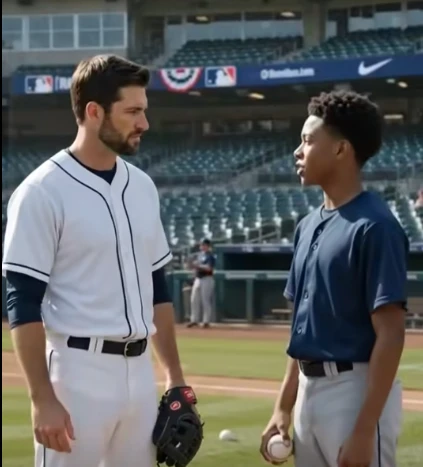
Ryan eventually pleaded guilty to conspiracy, obstruction, and fraud connected to the medical network.
He stood in court wearing a gray suit instead of a uniform.
The judge asked whether he wished to address the victims.
Ryan looked at my father.
“I was a kid when it began.”
Lionel answered from the gallery.
“So was I.”
Ryan lowered his eyes.
He received a prison sentence.
His foundation closed.
Its academies were transferred to an independent trust.
Money from his instructional videos, trademarks, and endorsement contracts funded restitution and new scholarships.
The pitch was renamed officially.
The Benton Fall.
My father refused to trademark it.
He published the grip, mechanics, and history for free.
A reporter asked why he did not want the money Ryan had made from it.
Lionel said, “I want the money returned.”
“I do not want the lie repeated with my name on top.”
The court ordered royalties distributed among the academy victims.
Some people called my father a hero.
My mother never did.
She loved him.
She also required him to account for the years he stayed away.
They did not move back together immediately.
Lionel rented a small apartment three blocks from ours.
He attended counseling.
He came to dinner on Sundays.
Sometimes he and my mother argued in the kitchen while I sat in the living room pretending not to hear.
Healing was not the moment he walked onto the field.
Healing was paperwork.
Appointments.
Angry questions.
Days when my mother refused to answer his calls.
Nights when my father woke believing the apartment door had locked from the outside.
It was my learning that a person could survive something terrible and still hurt the people he loved while trying to protect them.
It was Lionel learning that returning did not restore his old authority.
He had to earn trust from the beginning.
He started with baseball.
Not because baseball was the most important thing.
Because it was the one language we already shared.
The first time we trained together, he brought rolled socks.
I stared at them.
“We have baseballs.”
“I know.”
“You think I’m six?”
“No.”
“Then why?”
He tossed one sock ball toward me.
“Because the first thing I taught you should not belong to Ryan.”
We practiced in the apartment hallway.
My mother complained about the lamp.
For twenty minutes, it felt almost like the life we lost.
Then my father corrected my wrist.
I pulled away.
“You don’t get to show up after seven years and act like my coach.”
He nodded.
“You’re right.”
That made me angrier.
“Stop agreeing with everything.”
“What do you want me to say?”
“I want you to explain why the evidence mattered more than me.”
His face changed.
“It didn’t.”
“Then why didn’t you come home?”
“Because I was afraid they would take you.”
“They already took you.”
“I know.”
I threw the sock ball at the wall.
“I needed a father, not a secret investigator.”
Lionel sat on the floor.
“I cannot give you those years.”
“No.”
“I cannot make the choice right.”
“No.”
“But I can stop defending it.”
That was the first honest place we found.
He did not ask me to forgive him.
He came back the following week.
And the week after that.
Professional scouts called our apartment for months.
Some offered private workouts.
Some promised equipment.
One sent a car before asking whether we wanted it.
My mother rejected every offer until an independent attorney reviewed it.
Arthur agreed.
“People who ignored you yesterday will rush you today,” he told me.
“Attention is not respect.”
My ninety-eight-mile-per-hour pitch became famous online.
Slow-motion clips received millions of views.
Children tried to copy the Benton Fall.
Sports programs called me a future superstar.
Arthur watched one interview and turned off the television.
“You threw four pitches.”
“Three real ones.”
“Exactly.”
“You don’t think I’m good?”
“I think your arm is fifteen.”
That answer disappointed me.
Then I understood it protected something Ryan never had protected.
My future.
Arthur built a training plan focused on control, strength, rest, and school.
He limited my pitches.
He refused to let scouts attend private sessions.
When one team offered to place me in a showcase immediately, Arthur said no.
The executive reminded him that I had thrown ninety-eight.
Arthur replied, “A radar number is not permission to use a child.”
I returned to school baseball.
For the first time, I was allowed to pitch in an official game.
My first start was terrible.
I walked three batters.
Hit another.
Threw two wild pitches.
The crowd had come expecting the Benton Fall.
I barely found the strike zone.
After the third inning, I sat in the dugout with a towel over my head.
My father sat in the bleachers.
Arthur stood behind the fence.
Neither came toward me.
Coach Ellis crouched beside the bench.
“You finished?”
I looked at him.
“For today?”
“For yourself.”
I removed the towel.
“No.”
“Good.”
I returned for the fourth inning.
I stopped trying to throw ninety-eight.
I threw eighty-seven.
Then eighty-five.
I found the plate.
The Benton Fall came in the sixth inning with two strikes.
The batter swung over it.
The catcher held the ball for a second.
Then tossed it back.
No stadium screen.
No national cameras.
No superstar laughing.
Just one clean pitch in a high school game.
It felt better than ninety-eight.
We lost 5–3.
My mother took us for hamburgers afterward.
Lionel sat across from me.
“You stayed within yourself.”
“You used to say that?”
“No.”
“Arthur does.”
My father smiled.
“He stole it from me.”
Arthur, sitting at the end of the table, raised one finger.
“Unlike certain people, I provide credit.”
We laughed.
It was the first baseball joke that did not feel haunted.
Three years later, I stood on the mound at Keystone Field again.
The stadium had changed.
The underground laboratory was sealed and converted into an evidence archive before being permanently closed.
The Calloway name had been removed from the youth academy.





