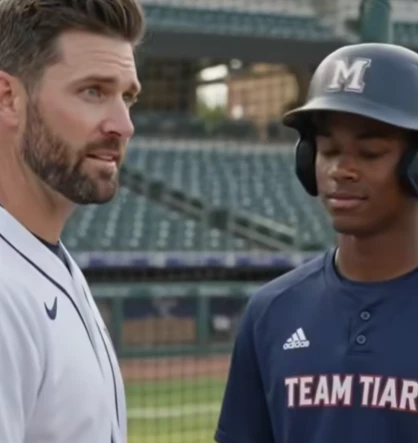
Malik read the sentence twice.
Grant looked toward the flash drive.
Walter handed it to Dean Mercer.
“Open the first file.”
The hitting coach connected it to a tablet.
A video appeared.
Spring training.
Eleven years earlier.
Darius Turner stood in a batting cage facing full-speed pitches.
Grant Holloway waited behind him.
Darius drove six straight inside fastballs into left field.
Then Grant entered.
He missed four of seven.
A coach’s voice could be heard.
“We can fix Holloway.”
Another answered.
“Not if Turner keeps making him look ordinary.”
The video changed.
A closed meeting room.
The camera angle came from a bag placed beneath a chair.
Darius sat across from two executives, the manager, and Grant.
An executive slid a contract across the table.
“You accept assignment to the minors.”
“You stop challenging medical decisions.”
“And you receive a guaranteed salary for two seasons.”
Darius looked at Grant.
“Are you okay with this?”
Grant remained silent.
Darius asked again.
“You know I’m healthy.”
Grant looked toward the executive.
Then down at his hands.
The video ended.
Every player near the dugout stared at Grant.
He did not deny it.
Malik’s voice was quiet.
“You knew.”
Grant’s face turned red.
“I was trying to survive too.”
“You were already the first-round pick.”
“That meant they expected me to become something.”
“So they erased him.”
“I didn’t erase anyone.”
“You watched.”
Grant looked toward the crowd.
The superstar who had spent years controlling every public moment now stood inside one he could not direct.
Then the team president, Martin Keene, entered the field from the first-base tunnel.
He was sixty.
Silver-haired.
Perfect suit despite the heat.
“End this now.”
Walter faced him.
“Were you in that meeting?”
Martin ignored the question.
He addressed security.
“Remove the boy and Mr. Sloan from the field.”
No one moved.
The security supervisor had watched the video.
Martin looked toward Dean.
“Turn off the stream.”
Dean checked the tablet.
“It is not on the stadium stream.”
Walter nodded toward the phones throughout the stands.
“It doesn’t need to be.”
Martin’s composure weakened.
He turned toward Malik.
“You are a minor employee creating a disturbance.”
“I accepted a challenge from your player.”
“Your employment is terminated.”
Renee Turner’s voice came from the gate near the dugout.
“No, it isn’t.”
Everyone turned.
She wore her bus-driver uniform.
Her supervisor had called after seeing a clip of Malik online.
Renee left her route at the stadium stop and ran through the employee entrance.
She crossed the field toward her son.
Martin pointed at her.
“You need to leave.”
Renee did not slow.
“My son is fourteen.”
“You hired him without telling me why his name mattered.”
She stood beside Malik.
“So before anyone removes him, you are going to explain what your organization knew about his father.”
Martin looked toward Walter.
“This is an internal personnel matter.”
Renee laughed once.
“You made my family an internal matter eleven years ago.”
Walter looked at her.
“You knew?”
“I knew Darius said the team ruined his career.”
“Why didn’t you tell Malik?”
“Because Darius became someone Malik should not have had to rescue.”
Her voice shook.
“He was right about the team.”
“He was also wrong to leave us.”
Malik looked at her.
“You knew Walter?”
“I met him twice.”
“You never told me.”
“I wanted you to love baseball without inheriting your father’s war.”
Malik looked toward the old scorecard in his hands.
“That didn’t protect me.”
“No.”
Renee lowered her eyes.
“It only made you enter the same place without knowing what they remembered.”
That admission mattered.
She did not defend the silence.
She named its cost.
Martin Keene attempted to delay the game.
The league office had already been notified.
So had the players’ union.
The public batting-practice video spread across social media.
The clip showed Grant mocking Malik.
The challenge.
The request to move the left fielder.
The ball striking the wall.
Then Walter naming Darius Turner.
Within an hour, reporters discovered old minor-league statistics.
Darius’s numbers had been difficult to find.
But not impossible.
Archived newspaper reports described him as the organization’s most complete young hitter.
An old article quoted Walter Sloan calling him “the best inside-fastball hitter I have ever evaluated.”
Then the articles stopped.
The official record listed injury, poor rehabilitation, and release.
No mention of the false medical reports.
No mention of the meeting.
No mention of the missing footage.
The league postponed the game.
Players returned to the clubhouse.
Fans remained in the stadium, chanting Malik’s name.
Malik did not feel victorious.
He sat inside a small interview room with Renee and Walter.
“What else is on the drive?” he asked.
Walter looked toward his mother.
Renee nodded.
“Show him.”
The second folder contained documents from Darius’s youth-baseball arrest.
A payment record showed money moving from a Captains-affiliated charity to the facility owner three days before the bats appeared in Darius’s truck.
Another file contained an email from Martin Keene.
Turner is contacting reporters again.
Make sure he no longer looks credible around children.
The equipment theft had been staged.
Darius had been telling the truth.
But the evidence did not make him blameless.
The final audio recording came from six months after the arrest.
Darius spoke alone.
His voice sounded exhausted.
“If Malik hears this someday, he needs to know I did not leave because he was a burden.”
“I left because I became ashamed of the man I was inside that house.”
“I drank.”
“I frightened his mother.”
“I kept telling myself I was fighting for justice while I was destroying the people waiting for me.”
Malik looked toward Renee.
She wiped her eyes.
The recording continued.
“The Captains stole my career.”
“That is true.”
“But they did not force me to disappear from my son.”
“That choice belongs to me.”
Malik stared at the screen.
For years, he had imagined one explanation would settle everything.
Either Darius abandoned them because he did not care.
Or powerful people forced him away.





