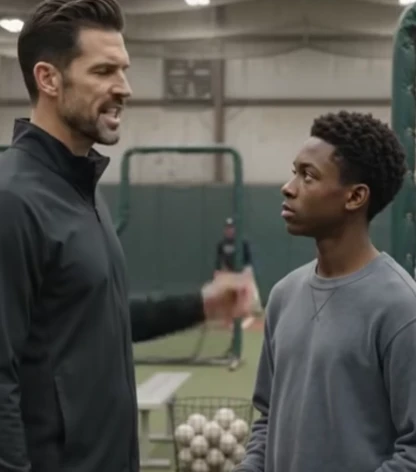
Marcus heard her.
He turned back toward Elijah.
“You have never played on a team.”
“I played with my father.”
“In an alley?”
“At Washington Park.”
More laughter.
Marcus’s voice hardened.
“You came into my academy with taped shoes, no team, no coach, and no money.”
He pointed toward the display of championship photographs.
“You have no idea what elite baseball requires.”
Elijah met his eyes.
“I know I could strike you out in three pitches.”
For one second, the lobby went silent.
Then it erupted.
Parents laughed openly.
Several boys slapped each other’s shoulders.
A man near the coffee station nearly spilled his cup.
Marcus stared at Elijah as though the child had spoken in another language.
“You could what?”
“Strike you out.”
“In three pitches?”
“Yes.”
Marcus glanced toward the phones recording them.
Pride made the decision before judgment could stop it.
He took a baseball from a display basket and threw it against Elijah’s chest.
The boy caught it with both hands.
“You get one.”
The laughter grew louder.
Marcus pointed toward the indoor diamond.
“One pitch.”
“If you throw a strike, I’ll refund every registration fee today and let you join the evaluation.”
“And if I miss?”
“You walk out and never return.”
Elijah looked at the ball.
“I said three.”
“You should be grateful I offered one.”
“You’re afraid of the other two?”
Marcus’s jaw tightened.
Howard Lawson placed a hand near Elijah’s shoulder.
“Son, you should leave.”
Elijah stepped away from him.
“I came to be evaluated.”
Marcus opened the glass door.
“Then let’s evaluate you.”
Within three minutes, the confrontation moved from the lobby to the academy’s main indoor field.
Parents crowded behind the netting.
Young players filled the dugouts.
Phones appeared everywhere.
Melissa stood near the registration desk, visibly worried about what she had helped begin.
Marcus selected a professional maple bat from the rack.
He removed his jacket.
He did not take a helmet.
One of the academy coaches, Travis Cole, hurried toward him.
“Marcus, this is unnecessary.”
“It will take one pitch.”
“He is twelve.”
“Exactly.”
Marcus entered the batter’s box.
He rolled his shoulders and took two smooth practice swings.
The sound of the bat cutting through the air silenced the crowd.
Elijah walked toward the mound.
His cracked sneakers left faint marks in the red clay.
He placed his father’s glove beside his chest and looked toward home plate.
There was no catcher.
Marcus pointed behind him.
“Hit the net.”
Elijah shook his head.
“I need a target.”
A few parents laughed again.
Marcus called toward the dugout.
“Somebody catch him.”
No academy player moved.
They had come to be evaluated by Marcus Holloway.
None wanted to look foolish catching a poor boy’s challenge pitch.
Then an elderly man rose from a folding chair near the backstop.
His name was Walter Briggs.
He was seventy-six and walked with a slight bend in his left knee.
Few of the parents recognized him.
Older baseball people did.
Walter had spent nine seasons as a major-league catcher and more than thirty years as a scout, coach, and bullpen instructor.
He had caught thousands of pitchers.
He claimed he could identify a player by the sound of the ball entering a glove.
Walter had helped Marcus when he was a teenager.
He had also avoided the academy for almost a decade.
He attended that morning only because Marcus invited him to speak to the evaluated players.
Walter picked up a catcher’s mitt.
“I’ll do it.”
Marcus frowned.
“You don’t need to.”
“I said I’ll catch.”
Walter put on a mask but no chest protector.
He lowered himself behind the plate with difficulty.
Elijah watched him settle.
“Give me a low target,” the boy said.
Walter held the glove near his left knee.
Elijah placed two fingers across the baseball.
Then he shifted his index finger slightly along the outer seam.
Walter saw the grip.
His body stiffened.
He rose so quickly that the mask fell back from his face.
“Don’t throw that pitch!”
Everyone turned toward him.
Marcus stepped out of the box.
“What?”
Walter stared at Elijah’s hand.
“Where did you learn that grip?”
Elijah did not answer.
The ball remained hidden near his glove.
Walter walked halfway toward the mound.
“Boy, listen to me.”
But Elijah had already begun his windup.
His left foot lifted.
His hands separated.
His right arm came forward with a compact motion that looked too simple to produce real power.
The baseball tore across the plate.
Marcus swung late.
The ball struck the back net before Walter could return his glove to position.
A hard digital beep came from the radar unit.
The display flashed:
88.2 MPH
Nobody laughed.
Marcus remained frozen with the bat over his shoulder.
Elijah’s cap had slipped slightly to one side.
He adjusted it.
The radar operator checked the machine.
Then he checked it again.
“Eighty-eight point two,” he said.
“That’s impossible,” someone whispered.
The coach examined the display.
“It’s calibrated.”
A parent shouted, “Check his age.”
Elijah looked toward her.
“I’m twelve.”
Marcus lowered the bat.
The first pitch had passed him before he completed his swing.
But embarrassment would not let him stop.
He pointed toward the mound.
“One fastball proves nothing.”
Elijah picked up another ball from the bucket beside him.
“You offered one.”
“You said three.”
“Yes.”
Marcus stepped back into the box.
“So throw three.”
Walter removed his mask.
“Marcus, stop this.”
“Why?”
Walter’s eyes moved from Elijah’s grip to the faded glove.
“Because you know what that pitch was.”
Marcus did not look at him.
“No, I don’t.”
Walter walked toward the mound.
“Elijah, let me see your glove.”
The boy held it close to his chest.
“It was my father’s.”
“I know.”
Elijah’s eyes narrowed.
“How?”
Walter pointed toward the inside thumb.
“Because those initials belong to Isaiah Carter.”
The field became silent.
Marcus’s face changed.
It was not recognition alone.
It was fear.
Walter reached the mound.
“Is Isaiah your father?”
“Yes.”





