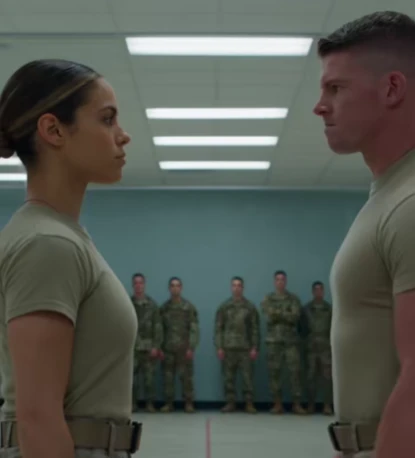
She could also see uncertainty.
He seemed to be searching for an explanation that would preserve his original accusation.
But the screen was not responding to his confidence.
It displayed the recorded movement.
Nothing more.
Nothing less.
Hayes leaned closer to the device.
He lifted one finger toward the replay control.
The observer beside him remained attentive.
The screen’s pale light reflected faintly against Hayes’s face.
Emily looked toward the long mirror.
It reflected the soldiers standing along the wall.
Their expressions were serious.
Some seemed surprised.
Others appeared relieved that the dispute was being examined.
Bennett stood near the rear.
His earlier uncertainty had been justified.
The movement was fast.
The exact sequence was difficult to judge without playback.
Emily hoped he understood that refusing to guess had been the correct decision.
She remembered his hesitation when Lawson questioned him.
He had been caught between the pressure to agree and the responsibility to report accurately.
Hayes had praised him for admitting uncertainty.
That moment had mattered.
It showed the soldiers that honesty could include saying they did not know.
Emily returned her attention to the screen.
The frozen frame remained unchanged.
She could see the dark boundary.
She could see the heel beyond it.
She could see the supporting leg angled toward the outside.
The image was not dramatic.
It contained no faces.
No expressions.
No visible confrontation.
Only boots and a line.
Yet those simple details threatened to overturn the instructor’s accusation.
Emily found that strangely appropriate.
The argument had been filled with anger.
Lawson had raised his voice.
He had questioned her judgment.
He had tried to make the dispute about respect.
But the relevant rule concerned a physical boundary.
And the recording showed physical movement.
The truth did not need to match the volume of the argument.
It needed to match the evidence.
Hayes looked toward Lawson.
“Do you recognize the movement?”
Lawson’s jaw tightened.
“I recognize the drill.”
“That’s not what I asked.”
The instructor looked away briefly.
Emily remained composed.
Hayes turned back toward the screen.
He appeared to be preparing another replay.
The room was silent enough for Emily to hear the faint electrical hum from the equipment.
The small display showed the raised leg.
The supporting heel.
The dark boundary.
Hayes lifted his finger.
Then he paused.
He seemed to realize that the next question could be answered without replaying the entire sequence.
He looked toward the instructor.
And his expression hardened.
Phase Five: Reveal and Ending
“Whose boot is that?”
Hayes pointed toward the frozen heel on the screen.
Lawson did not answer.
The question remained suspended in the fluorescent-lit room.
Emily stood several feet away, her arms relaxed at her sides.
She barely raised one eyebrow.
She had heard the question.
She understood its significance.
But she did not speak for the instructor.
Hayes kept his finger near the display.
“Lawson?”
The instructor leaned forward.
His jaw muscles tightened.
He studied the recorded image.
The heel remained beyond the dark boundary.
The trousers above it were camouflage.
The boot was tan.
Its position matched the aggressive movement captured moments earlier.
But Hayes had not yet announced whose foot it belonged to.
He was giving Lawson the opportunity to identify it.
The instructor seemed unable to decide what to say.
Emily could see the hesitation.
Earlier, Lawson had answered every question immediately.
He had accused her without uncertainty.
He had dismissed her observations.
He had demanded that the soldiers accept his explanation.
Now a simple identification question had stopped him.
Emily felt no satisfaction in his discomfort.
She understood how difficult it could be to admit a mistake publicly.
She had experienced embarrassment during training.
She remembered falling during a balance drill in front of her platoon.
She remembered the heat rising into her face.
She remembered wanting to explain that the floor was slippery.
But her instructor had asked her to examine her own foot placement.
She had done so.
She had discovered that her stance was too narrow.
The correction had improved her technique.
That experience stayed with her.
Mistakes were not the enemy of training.
Refusing to examine them was.
Emily looked toward Lawson.
She hoped he would recognize the distinction.
But he remained silent.
Hayes did not rush him.
The master sergeant had seen similar moments before.
He understood that authority could make admitting error difficult.
An instructor’s reputation rested partly on confidence.
Students expected clear demonstrations.
They expected consistent standards.
They expected the person teaching them to understand the technique.
But experienced instructors were still human.
They could misjudge distance.
They could lose balance.
They could remember a movement incorrectly.
A professional response required acknowledging those possibilities.
Hayes knew that.
He also knew that public correction could become humiliating if handled carelessly.
He had no interest in turning the review into entertainment.
The soldiers were watching.
That made his responsibility greater.
He needed to establish the facts.
He needed to maintain discipline.
And he needed to demonstrate that the standards applied to everyone.
He looked toward the screen again.
The image remained frozen.
One heel crossed the line.
The other pair of boots appeared inside the permitted area.
The camera had preserved a crucial moment.
But the official interpretation had not yet been announced.
Hayes kept his expression neutral.
He wanted Lawson to examine the evidence rather than react defensively.
The instructor shifted his weight.
His boots made a faint sound against the floor.
Emily noticed.
The movement reminded her of the original demonstration.
Lawson had been aggressive.
He had driven his knee upward.
He had shifted his weight too far.
Then his supporting foot had slid.
The recording had captured the sequence.
She knew what she saw.
But she would not interrupt the review.
Her composure was not indifference.
Her heartbeat had quickened.
She understood that the outcome could affect how the soldiers treated her.
If Hayes accepted Lawson’s accusation, she might face criticism for a boundary violation she believed she had not committed.





