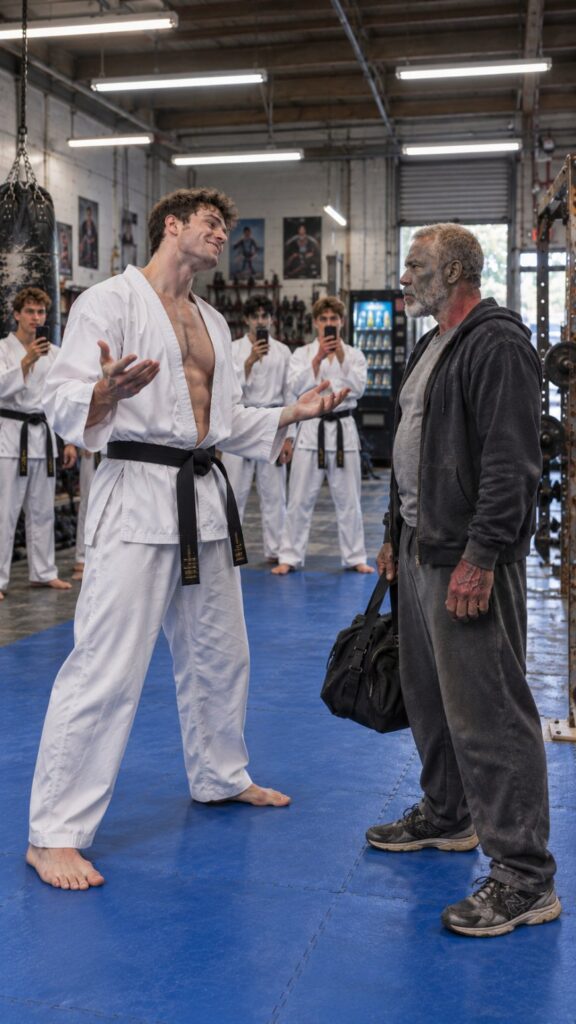
“That man right there,” Garrett continued, his voice ringing with absolute reverence, “trained me. He trained my entire platoon. He trained thousands of United States Marines at the most advanced, brutal close-combat facility in the United States military.”
Garrett reached into his pocket, pulled out his phone, and rapidly scrolled through a hidden photo album. He turned the screen around, holding it up high for the crowd to see.
It was a grainy, older photograph. The sky was gray, the dirt was red clay. In the center of the frame was a younger Victor Shaw, wearing woodland camouflage utility trousers and a green t-shirt, flawlessly demonstrating a painful joint lock on a massive Marine recruit who looked twice his size. Behind them, rows of recruits watched in perfect, silent formation.
“Marine Corps Martial Arts Program,” Garrett announced to the silent room. “MCMAP. This man held the highest instructor belt in the entire combat system. A sixth-degree black belt. There are maybe eighty people alive on the planet today who have earned what he has.”
Garrett slowly lowered his phone. He turned his eyes down to Tyler, who was now sitting up on the mat, his face pale, his breath catching in his throat.
“You,” Garrett said to Tyler, his voice dripping with disgust. “You just asked a man who spent thirty years teaching Marines how to survive hand-to-hand combat in a warzone to spar with you for laughs.”
The words hit the room like a physical shockwave.
People stared at Victor. They stared at the faded green tattoo on his forearm. They stared at the old, frayed red wraps in his hands. They looked at the way he sat, his back perfectly straight, his eyes calm, carrying the quiet, invisible weight of a man who had seen and done things they couldn’t possibly imagine.
Victor hadn’t wanted this attention. He had fought hard to leave it behind. He had buried his wife in this town, bought a quiet little house, and tried to shrink away into the background. Victor lived by a very simple, unbreakable rule: if you have to tell people what you are, you probably aren’t it anymore.
Tyler slowly pulled his knees to his chest. He looked at Victor. He didn’t look at the gray t-shirt, or the wrinkles around his eyes, or the color of his skin that he had spent weeks making passive-aggressive jokes about.
He looked at the man. He saw the predator that had been hiding in plain sight.
“Why…” Tyler croaked, his voice small, broken, and devoid of any ego. “Why didn’t you say something? Why didn’t you tell me who you were?”
Victor finished unweaving the red wrap from his right hand. He folded it neatly, aligning the edges perfectly, and set it on the wooden bench beside his water bottle. He looked at Tyler.
“Because the ones who talk about it the most,” Victor said quietly, his voice echoing in the dead silent gym, “usually did the least.”
That afternoon, a video of the fight went viral on social media.
It wasn’t posted by Tyler Brooks. It wasn’t posted on his elite martial arts page. It was posted by a nineteen-year-old kid in the background who had kept his camera rolling the entire time.
The caption read: “Arrogant Black Belt Challenges the Wrong Old Man.”
By midnight, the video had four hundred thousand views. By morning, it had crossed two million.
The comments section became a massive, sprawling battlefield. People were tagging their friends, arguing about fighting styles, and writing long paragraphs about respect, ego, and what it truly means to underestimate someone based purely on how they look or where they come from.
Tyler’s name spread rapidly across the internet. Screenshots of his old, arrogant posts circulated everywhere. His “levels to this game” clips, his flashy highlight reels, his perfectly curated brand—all of it was recontextualized and utterly destroyed by thirty seconds of raw footage showing him flat on his back, helpless, with a sixty-three-year-old man’s knee casually resting on his spine.
The internet is ruthless, and it demands blood from those who place themselves on pedestals. The mockery was relentless.
Tyler took his entire social media presence down that very night.
For the first time in four years, his accounts went completely dark. His students texted him constantly. He didn’t respond to a single one. His mother called twice. He let the phone ring out on the nightstand, lying in the dark of his apartment, staring at the ceiling, feeling the phantom pain in his elbow and the crushing weight of his own shattered reality.
He didn’t leave his apartment for three days.
At the Ridgefield Community Gym, things slowly went back to normal. The news vans that had parked outside on day two eventually left when they realized Victor wasn’t going to give them an interview.
Dale Perkins went back to talking about the hardware store. Nancy Wallace went back to her treadmill routine.
Victor Shaw came in exactly at 6:30 AM every single day. He wore his gray t-shirt. He wrapped his hands. He hit the heavy bag, did his pull-ups, stretched his joints, and minded his own business. If the lingering stares or the whispers of the crowd bothered him, he never showed a single sign of it.
But on the fourth morning, something in the routine finally broke.
Victor was sitting on his bench, midway through wrapping his left hand, when the glass front doors of the gym opened. It was 5:58 AM. It was before the regulars arrived, before the parking lot lights had even fully warmed up against the morning fog.
Tyler Brooks walked in.
He wasn’t wearing his pristine white dobok. He wasn’t wearing his embroidered fourth-degree black belt. He didn’t have his students with him. He didn’t have a camera crew.





