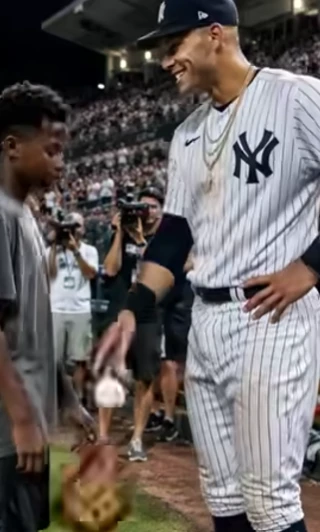
But confidence looked different when pointed at a kid with old shoes.
Caleb glanced at Isaiah.
The boy was standing with Walter, listening carefully while an evaluator explained the next steps.
No gloating.
No smirk.
No celebration.
That somehow made Caleb feel worse.
If Isaiah had acted arrogant, Caleb could have hated him more easily.
But the kid looked overwhelmed.
Respectful.
Still slightly hurt.
And everyone could see why.
Troy said,
“You may want to say something.”
Caleb snapped,
“To who?”
“To him.”
Caleb laughed bitterly.
“So now I apologize to a random kid because he threw a weird pitch?”
Troy looked at the phone.
“No.”
“Because you laughed at him before he did.”
That sentence landed harder than Troy expected.
Caleb stared at him.
Troy immediately looked away, but he did not take it back.
Caleb turned toward the field.
For the first time all afternoon, he looked less angry than cornered.
Walter took Isaiah aside after the evaluation form was finished.
They stood near the bullpen fence, away from the cameras.
Walter lowered his voice.
“Isaiah, I’m going to tell you something important.”
Isaiah nodded.
“Yes, sir.”
“You have talent.”
Isaiah’s eyes dropped.
“Thank you.”
Walter continued,
“But talent is not the same as ready.”
Isaiah looked up.
“I know.”
“Good.”
Walter pointed gently toward his shoulder.
“That pitch has feel, but your body needs strength.”
“Your mechanics need cleaning.”
“Your arm needs protection.”
“If the wrong adults see one good video and start pushing you too hard, they can hurt you.”
Isaiah listened closely.
No one had ever talked to him like that.
Not like a miracle.
Not like a joke.
Like a player who needed care.
Walter continued,
“I don’t want today to become people asking you to throw that pitch fifty times for cameras.”
Isaiah nodded.
“My dad used to say never show it too much.”
Walter smiled faintly.
“Your dad was right.”
Isaiah looked at him.
“What was he like when you saw him?”
Walter took a slow breath.
The stadium noise seemed to fade around them.
“He was quiet.”
Isaiah smiled a little.
“That sounds like him.”
“He wore a factory team jersey.”
“Number 18, I think.”
Isaiah’s eyes widened.
“My mom has that jersey.”
Walter nodded.
“He came into a tournament nobody expected him to matter in.”
“First inning, everybody thought he was just a soft-throwing right-hander.”
“By the fourth, nobody could square him up.”
Isaiah gripped the fence.
“Did you talk to him?”
“After the game.”
“What did he say?”
Walter smiled sadly.
“He said he couldn’t travel.”
“Had a baby on the way.”
“Needed steady work.”
Isaiah looked down.
“Me.”
Walter’s voice softened.
“Yes.”
“You.”
For a long moment, neither of them spoke.
Then Walter said,
“He chose a life.”
“That does not mean he lacked talent.”
Isaiah rubbed his thumb along the seam of the baseball.
“He always said baseball gave him something even if it never gave him money.”
Walter nodded.
“That sounds like a man who understood the game better than most professionals.”
Isaiah looked toward Caleb without meaning to.
Walter followed his gaze.
Then said quietly,
“Do not let one famous man decide how much your father’s lesson is worth.”
Isaiah turned back to him.
“Yes, sir.”
Walter held out a business card.
“Give this to your mother.”
Isaiah took it carefully.
The card read:
Walter Hayes
Independent Scouting Consultant
Player Development Advisor
Walter tapped the card.
“I’ll call her tonight.”
“Not to promise things I can’t control.”
“Not to sell dreams.”
“To explain a path.”
Isaiah looked at the card like it might disappear.
“Thank you.”
Walter nodded.
“You earned the conversation.”
Then, after a pause, he added,
“And Isaiah?”
“Yes, sir?”
“When people ask about that pitch, don’t let them make it only about today.”
Isaiah looked down at the baseball.
Walter said,
“Tell them it started before the lights came on.”
[End of Part 6]
Part 7
By the next morning, the clip had traveled farther than anyone at the showcase expected.
It was on local sports pages.
Then youth baseball forums.
Then national baseball accounts that loved stories about hidden talent.
The headline changed depending on who shared it.
Poor Kid Asks for One Pitch, Superstar Laughs, Scout Steps In.
Unknown 14-Year-Old Freezes Dallas Showcase With Rare Pitch.
Old Scout Recognizes Grip From Pitcher He Saw 20 Years Ago.
But the clip that spread fastest was not the full evaluation.
It was the beginning.
Isaiah standing in his faded shirt.
Caleb Monroe laughing.
Caleb saying,
“Throw from the parking lot.”
Then Isaiah’s quiet answer.
“I only asked for one pitch.”
People replayed that line.
They quoted it.
They argued about it.
Some defended Caleb.
They said he was joking.
They said showcases had rules.
They said not every kid could just walk in.
Others disagreed.
They said rules were one thing, humiliation was another.
They said a grown man with a microphone should know the difference.
They said Isaiah had shown more class than the superstar.
Isaiah did not see most of it at first.
His mother would not let him scroll.
Lena Reed had gotten home from her hospital laundry shift after midnight, exhausted, smelling faintly of detergent and warm linen.
Isaiah was still awake at the kitchen table.
The baseball sat in front of him.
Walter’s business card lay beside it.
When Lena walked in, she did not ask a single question.
She crossed the kitchen and hugged him so tightly he could barely breathe.
Only then did she let herself cry.
Not loudly.
Not dramatically.
Just enough for Isaiah to feel the years inside it.
The years of trying to keep shoes on his feet.
Gloves patched.
Food in the fridge.
Rides arranged.
Practice time protected.
Dreams alive without promising what she could not guarantee.
“My baby stood tall,” she whispered.
Isaiah closed his eyes.
“Yes, ma’am.”
Later, they watched the full video together.
Not the viral edit.
The full recording Walter sent.
Lena watched Caleb laugh.
Her face hardened.





