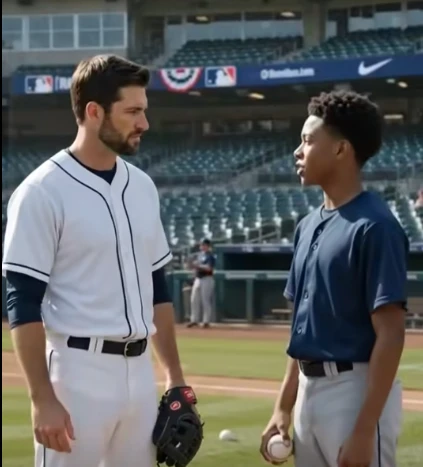
Baseball Superstar Laughed at the Black Ball Boy’s “Weak” Pitch — Then the Man With the Radar Gun Said, “Give Him Three More.”
The first pitch hit the dirt almost ten feet before home plate.
Baseball superstar Ryan Calloway threw his head back and laughed.
The sound traveled through Keystone Field and came back from the empty upper deck.
Hundreds of children laughed with him.
Then an elderly man behind the backstop lowered his radar gun and said, “Give him three more.”
The laughter stopped.
My name is Micah Benton.
I was fifteen years old, six feet tall, and officially employed as a ball boy at Keystone Field outside Pittsburgh.
I collected foul balls.
I carried equipment.
I scrubbed mud from practice baseballs.
And whenever professional players entered the field, I was expected to become invisible.
The job paid eleven dollars an hour.
Most of that money went toward the rent on the small apartment I shared with my mother.
Nobody at the stadium knew I practiced pitching after the grounds crew went home.
Nobody knew I had memorized every seam on a baseball before I turned seven.
And nobody knew why my mother had made me promise never to throw in front of Ryan Calloway.
Ryan was one of the biggest names in baseball.
He had a championship ring.
Three All-Star selections.
A signature shoe deal.
And a pitch so famous that children copied it in backyards across the country.
He called it the Calloway Drop.
It looked like a fastball until the final few feet.
Then it fell sharply beneath the bat.
Ryan claimed he had created the grip when he was sixteen.
His training company sold instructional videos teaching young pitchers how to throw it.
His foundation operated elite baseball academies in five states.
That Saturday, he returned to Keystone Field for a televised charity clinic.
Hundreds of children filled the lower seats.
Local reporters stood beside the dugout.
Scouts watched from behind home plate.
I had been assigned to carry baseballs between the bullpen and the main field.
The trouble began when one of Ryan’s warm-up throws bounced away from the catcher.
The ball rolled toward the foul line.
I picked it up.
The catcher lifted his glove.
I threw the ball from nearly seventy feet away.
It reached him chest-high.
Ryan looked at me.
“Not terrible.”
A few players laughed.
I turned away.
Then Ryan called me back.
“Ball boy.”
I stopped.
“Someone told me you think you’re a pitcher.”
“I didn’t say that.”
Ryan looked toward the children in the stands.
“So you don’t want to pitch?”
I could feel every camera turning toward us.
My supervisor stood beside the dugout shaking his head.
He wanted me to return to work.
Ryan held out another baseball.
“Come on.”
“Show everyone that arm.”
I should have refused.
My mother had warned me about this exact moment.
But Ryan’s smile made it clear that refusing would become part of the joke.
I walked toward the mound.
Someone handed me an old glove.
The catcher crouched behind home plate.
Ryan remained a few feet away with his arms folded.
“Try not to hurt yourself.”
The crowd laughed again.
I looked at the baseball he had given me.
A small blue mark appeared beside one seam.
I had seen markings like that inside the stadium training room.
But before I could examine it more carefully, Ryan pointed toward the plate.
“We don’t have all day.”
I took a short breath.
Then I threw.
The ball left my hand badly.
My fingers slipped beneath the seam.
It dropped early and struck the dirt.
The stadium radar display flashed a number.
62 MPH.
Ryan bent forward laughing.
“I’ve seen ten-year-olds throw harder than that.”
My face burned.
Several children began whispering.
One reporter aimed her camera directly at me.
My supervisor stepped onto the grass.
“That’s enough, Micah.”
Then the man behind the backstop spoke.
“Give him three more.”
He wore a faded brown jacket and held an old black radar gun.
He appeared to be in his seventies.
His white hair was cut short.
A silver stopwatch hung around his neck.
Ryan glanced toward him.
“The kid had his chance.”
The old man walked down the aisle.
“No.”
“He had your ball.”
Ryan’s smile disappeared.
The man entered the field through the gate.
He asked me to hand him the baseball.
He placed it on a small digital scale from his equipment bag.
A regulation baseball weighed approximately five ounces.
The ball Ryan gave me weighed twelve.
It was a weighted training ball designed for controlled drills.
It was never supposed to be thrown at full speed.
The old man held it up.
“Did you know what this was, Mr. Calloway?”
Ryan shrugged.
“Someone put it in the wrong bucket.”
The old man looked toward the dugout.
Every regulation ball was stored in a white bucket.
The weighted balls were kept inside a black equipment case.
Ryan had removed the ball from that case himself.
Several cameras had recorded him doing it.
The old man placed three regulation baseballs on the mound.
Then he raised the radar gun.
“Three more.”
Ryan stepped closer.
“This is my clinic.”
“And that is my calibrated equipment.”
“Who are you?”
The old man looked at him.
“Arthur Wynn.”
The name changed the entire mood around home plate.
Arthur Wynn had served as a national scouting director for almost thirty years.
He had signed championship pitchers.
He had discovered players nobody else believed in.
And twelve years earlier, he had disappeared from professional baseball after accusing a private academy of altering youth scouting reports.
That academy now belonged to Ryan Calloway.
Arthur pointed toward the first baseball.
“Throw naturally.”
I looked toward my supervisor.
He did not stop me.
I placed my fingers across the seams.
I lifted my knee.
Then I threw.
The ball struck the catcher’s glove with a crack that echoed through the empty upper deck.
Arthur checked his radar gun.





