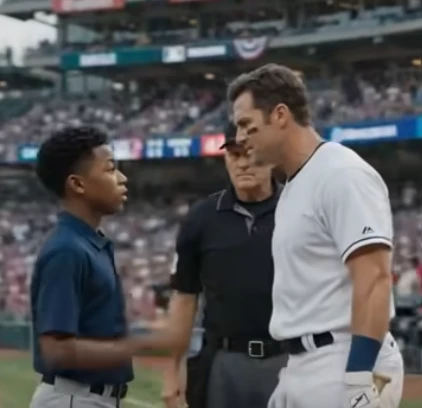
Baseball Superstar Mocked a Black Ball Boy for Pointing at the Center-Field Camera — Then the Head Umpire Said, “Shut Down the Scoreboard.”
Fifteen-year-old Cameron Ellis noticed the camera because nobody had told him not to look at it.
Everyone else in Harbor Field was watching the stars.
The exhibition game had sold out weeks earlier.
Forty thousand fans filled the seats beneath a clear summer sky.
Former champions sat in luxury boxes.
College prospects filled the dugouts.
Scouts with radar guns crowded behind home plate.
Television crews moved through the aisles.
And at the center of all that attention stood Adrian Cole.
Twenty-nine years old.
Three-time league batting champion.
Two-time Most Valuable Player.
The most recognizable hitter in professional baseball.
Adrian had a swing children copied in parks.
His face appeared on shoes, drinks, video games, and billboards.
When he entered the batter’s box, people stopped talking.
Cameron had admired him since he was eight.
That made what happened next hurt more.
Cameron was working the exhibition as a ball boy through Harbor Field’s summer youth program.
The job paid barely above minimum wage.
His mother, Tasha Ellis, had insisted he save half.
Cameron secretly planned to use most of the rest for a refurbished laptop.
Not for games.
For baseball video.
His father had taught him to watch games differently.
Malcolm Ellis had never played professionally.
He had coached high school baseball for sixteen years and worked nights repairing industrial air-conditioning systems.
He believed baseball was a language.
“You can watch the obvious thing,” he used to tell Cameron.
“Or you can watch what makes the obvious thing happen.”
When Cameron was nine, his father would pause televised games between pitches.
“What changed?”
Cameron learned to look at fielders.
Catchers.
Coaches.
Defensive positioning.
Footwork.
Signals.
Tiny movements.
Malcolm died from a heart condition when Cameron was twelve.
After that, Cameron watched even more closely.
It was one of the few ways he still felt like they were talking.
So while everyone at Harbor Field watched Adrian Cole crush batting-practice balls into the upper deck, Cameron occasionally looked somewhere else.
That was how he noticed the center-field camera.
It was mounted above the enormous scoreboard.
At first, Cameron assumed it belonged to the broadcast crew.
Harbor Field had cameras everywhere.
But this one moved differently.
It was small.
Black.
Almost hidden behind a horizontal panel beneath the scoreboard structure.
And before certain pitches, it rotated.
Not after.
Before.
Cameron noticed it during the second inning.
The visiting catcher crouched.
He gave a sequence of signs.
The camera above center field shifted slightly toward home plate.
Then, less than two seconds later, a tiny white light inside the home dugout flashed.
Once.
The next pitch was a fastball.
Adrian Cole was not batting.
Cameron forgot about it.
Then the light flashed twice before a breaking ball.
Cameron noticed because he had been sent to retrieve a foul ball near the dugout railing.
He stopped.
Looked up.
Pitch.
Curveball.
He frowned.
Maybe coincidence.
Next hitter.
Camera turned.
One flash.
Fastball.
Next.
Two flashes.
Slider.
Cameron stood beside the ball bucket.
His pulse increased.
He started counting.
One flash.
Fastball.
Two.
Breaking ball.
No flash.
Changeup.
Not every time.
But enough.
Then Adrian Cole stepped to the plate in the fourth inning.
The crowd rose.
Cameron forgot the ball bucket completely.
The visiting pitcher, twenty-two-year-old prospect Lucas Reed, had struck out three batters already.
His fastball touched ninety-eight.
His curveball dropped sharply.
Adrian took his place in the box.
Lucas looked in.
The catcher gave a sign.
Cameron looked toward center field.
The camera turned.
One flash from the dugout.
Fastball.
Adrian started early.
CRACK.
Line drive foul.
He had been ahead of ninety-seven miles per hour.
Cameron stared.
Second pitch.
Camera turned.
Two flashes.
Curveball.
Adrian stayed back and drove it into right-center field.
Double.
The crowd exploded.
Cameron did not clap.
He looked at the dugout.
A home-team assistant wearing a headset stood near the tunnel.
His left hand was resting beside a small LED work light clipped beneath a shelf.
The assistant stepped away as Adrian reached second.
Cameron felt sick.
He watched the next inning.
Again.
Camera.
Light.
Pitch.
Again.
Camera.
Light.
Pitch.
By the sixth inning, Cameron had written a pattern on the cardboard bottom of the ball box with a pen.
1 = FB
2 = BREAK
0 = OFFSPEED / NONE
Seven observations.
Then nine.
Then eleven.
Ten were correct.
That was too many.
Cameron tried telling an equipment assistant.
The man barely listened.
“Probably broadcast cues.”
“It moves before the catcher finishes signaling.”
“Kid, I’m working.”
Cameron tried another staff member.
“Scoreboard camera.”
“They test those all game.”
“But the dugout light—”
“Go get the balls by third.”
So Cameron did.
He had spent most of his life learning what happened when adults thought a child had confused noticing with understanding.
Still, he could not stop watching.
By the seventh inning, Adrian was three for three.
Double.
Single.
Home run.
Every swing looked prepared.
Not merely talented.
Prepared.
There was a difference.
Cameron had watched hundreds of Adrian’s at-bats.
Even great hitters guessed wrong.
They flinched at sliders.
Started on changeups.
Got jammed by fastballs.
Nobody knew every pitch.
But that afternoon, Adrian never seemed surprised.
That was what bothered Cameron.
Not that he hit everything.
That nothing surprised him.
When Adrian returned to the dugout after his home run, Cameron finally spoke.
“That camera moves before every signal.”
Adrian stopped.
He had been taking off his batting gloves.
“What?”
Cameron pointed toward center field.
“The camera above the scoreboard.”
Several players looked over.
Adrian glanced up.
Then back at Cameron.
“So?”
“It turns toward the catcher before the pitch.”
An assistant coach frowned.
“Why are you talking to players?”
Cameron ignored him.
“And then that light flashes.”
He pointed beneath the dugout shelf.
The small LED was dark now.
Adrian followed his finger.
His expression changed for half a second.
Cameron saw it.





