PART 2
The dojo filled differently on Wednesday night.
Parents arrived early, claiming seats along the walls like spectators at a championship bout. Students who normally left after class lingered with nervous energy. Even some of the afternoon students had returned, drawn by word of mouth and curiosity.
Parenting
I entered through the back door at exactly 6:45 p.m. carrying a small duffel bag instead of my usual cleaning supplies. I’d traded my work clothes for black athletic shorts and a plain gray t-shirt. My hair was pulled back in a tight ponytail, and my feet were bare.
The conversations died as I walked across the dojo floor.
Where before I’d moved like someone trying to remain invisible, now every step carried purpose. My posture was straighter, my gaze direct. I looked, several parents realized with surprise, like an athlete.
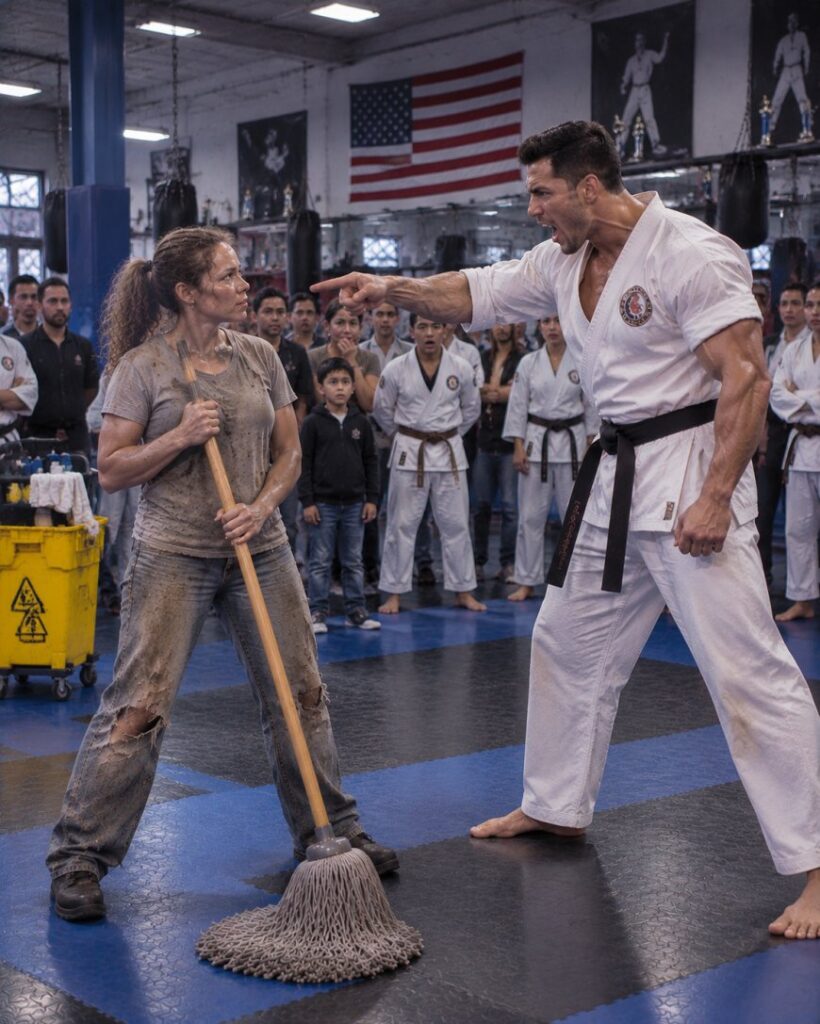
Ryan was already warming up on the mat, his movements sharp and aggressive. He wore his traditional white gi with the black belt knotted perfectly around his waist. His warm-up routine was impressive — high kicks, spinning techniques, combinations that showcased his flexibility and power. He was putting on a show, and he knew it.
David Park stood at the edge of the mat, wearing his instructor uniform and carrying a clipboard. His expression was carefully neutral, but his eyes tracked my movements with growing interest.
“All right, everyone,” David called out. “We’re going to do this properly. Official rules, official witnesses, no phones, no recording devices, no social media posts. What happens here stays here.”
Aiden sat in the front row with his mother, his eyes wide with excitement and worry. When I passed near him, I paused and signed something quickly. The boy’s worried expression transformed into a smile, and he signed back enthusiastically.
Marcus Chen, watching from across the room, felt his stomach tighten. He’d spent the day thinking about those calluses on my hands, about the way I’d moved during last night’s confrontation. Something about me reminded him of his college wrestling coach. That same controlled intensity that spoke of serious training.
Anatomy
“Fighters to the center,” David announced.
Ryan strode to the middle of the mat with confident swagger, bouncing slightly on his toes, rolling his shoulders. I approached from the opposite side, my movement economical and fluid.
We stood facing each other three feet apart. The contrast was stark. Ryan in his crisp white gi, tall and lean with the defined musculature of someone who trained for appearance as much as function. Me in simple workout clothes, shorter and stockier. My build suggested functional strength over aesthetic muscle.
“Standard rules,” David announced to the room. “No strikes to the head, no small joint manipulation, no throws that risk serious neck or spine injury. Match ends with submission, unconsciousness, or referee stoppage.” He looked at both fighters. “Understood?”
Ryan nodded curtly. I bowed slightly, a gesture so natural it seemed instinctive.
“Touch gloves and return to your corners.”
We stepped forward. Ryan extended his hand aggressively, trying to intimidate with his grip strength. I met his hand calmly, my own grip solid but not competing. When we separated, Ryan flexed his fingers again, just as he had the night before.
We returned to opposite sides of the mat.
The room held its breath.
“Begin.”
Ryan came forward immediately, his strategy clear. Use his reach and aggression to overwhelm me before I could settle into any kind of rhythm. He threw a series of probing punches and kicks. Nothing committed, just testing my reactions.
I didn’t retreat. Instead, I moved laterally, my footwork smooth and balanced. I kept my hands up in a guard that looked more like boxing than traditional martial arts, my body positioned at angles that made Ryan’s strikes miss by inches.
“Come on,” Ryan called out, his voice carrying to the spectators. “Don’t just run around.”
But I wasn’t running. I was reading him. Every time Ryan committed to a technique, I was already moving away from it, my spatial awareness allowing me to see attacks before they fully developed.
The first real exchange came when Ryan threw a hard right cross, followed by a low kick. I slipped the punch with minimal movement and caught the kick, my hands locking around Ryan’s ankle with surprising speed.
For a moment, we were connected, Ryan hopping on one foot while I controlled his trapped leg. The room expected me to sweep him or throw him off balance. Instead, I simply released his foot and stepped back.
Ryan landed awkwardly, his confidence flickering for the first time.
In the crowd, Marcus Chen leaned forward. That hand positioning when I’d caught the kick. He’d seen it before in highlight reels of Olympic judo competitions.
“What was that?” Ryan demanded, his breathing already slightly elevated. “You had me and you just let go.”
I didn’t respond. Couldn’t respond in the way he expected. But my message was clear in my posture, my expression. I was showing him something, giving him information he wasn’t yet ready to understand.
Ryan’s next attack was more aggressive, a combination of punches followed by an attempt to grab me in a clinch. But when his hands reached for me, I seemed to flow around them like water. My movement was so smooth, so efficient that Ryan found himself grasping air while I repositioned behind him.
Again, I could have struck or thrown him. Again, I chose not to.
The crowd began to murmur. This wasn’t what they had expected. Not the brutal confrontation Ryan had promised, but something more like a chess match played at fighting speed.
“Stop playing games.” Ryan’s frustration was building now, his techniques becoming sloppier as his anger grew. “Fight me.”
But I was fighting. Just not in any way Ryan understood. Every exchange revealed more about his patterns, his tendencies, his weaknesses. I was learning him, downloading his fighting style like a computer analyzing data.





