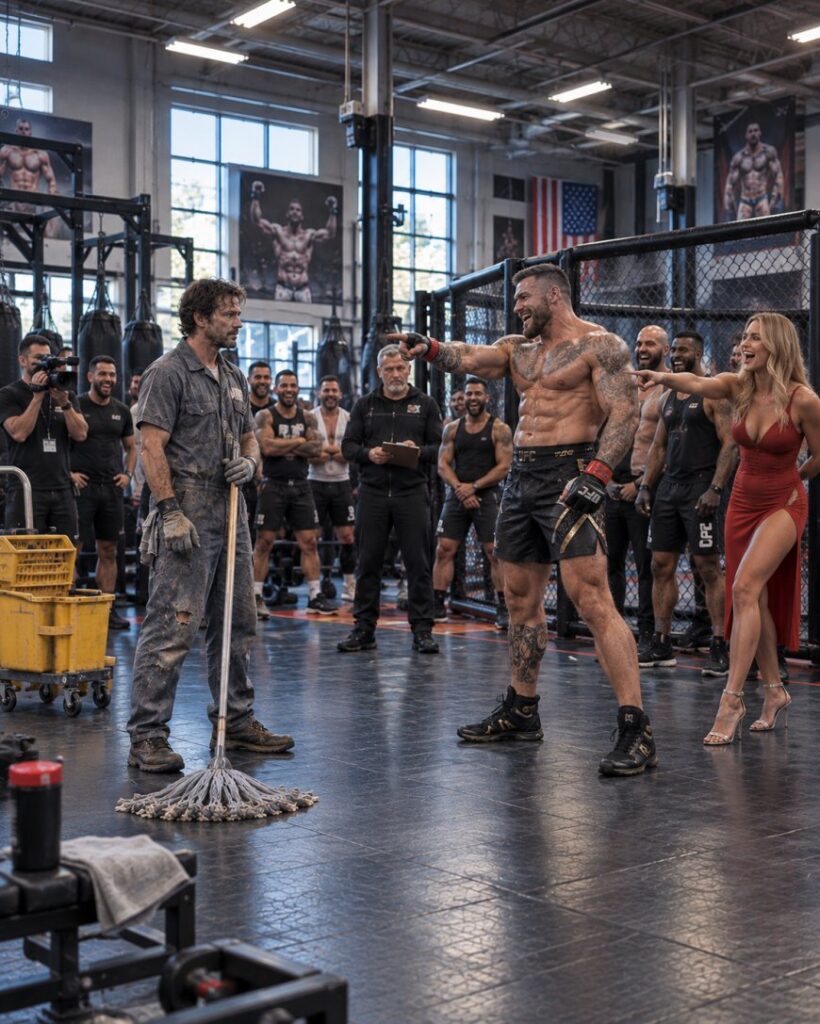
PART 2
There was no feeling-out period. No cautious opening exchange. Cole had decided before the bell rang that this would be quick and clean and good on camera.
Cameras
He threw a jab at Julian’s chin — sharp and practiced, the same jab that had started every combination in his last four title defenses.
Julian moved his head to the right. Not dramatically. Just enough. The punch went past his ear and found nothing.
Language Resources
Cole reset and threw a cross. Julian rolled his shoulder back and the glove skimmed air. A left hook followed immediately, and Julian dipped his chin two inches to the left, and that punch missed as well.
The room was still laughing. They were waiting for the story they had already written in their heads to play out the way they expected.
Cole threw a low kick at Julian’s lead leg. Julian’s foot was no longer there. He had withdrawn it with the unhurried precision of someone who had already calculated where the kick was going before Cole’s hip had begun to rotate.
The laughter stopped.
Julian had not thrown a single strike. He was moving in a small, efficient circle, his hands up, his weight distributed in a way that looked relaxed until you tried to locate his center of gravity and realized you couldn’t quite fix it.
Coach Ray, standing outside the cage with his clipboard forgotten at his side, recognized what he was seeing.
Julian wasn’t defending. He was reading. Cataloging. Processing. Building a picture of Cole’s patterns the way a person reads a document they intend to reference later.
Cole changed his rhythm. He threw a feint left, then shot a right hand at Julian’s temple. Julian didn’t flinch at the feint and wasn’t where the right hand arrived.
Cole tried a quick combination — jab-jab-cross — and Julian slipped each one with the minimum necessary movement. No wasted energy. No dramatic retreating. He stayed close. That was the thing that began to unsettle Cole more than the misses themselves. Julian wasn’t running. He was right there, within range, calmly not being hit.
Inside Cole’s chest, something that had started as impatience was shading into something he hadn’t felt in a competition context in a very long time.
He had thrown more than ten strikes. Not one had landed cleanly.
Cole pushed forward, trying to crowd Julian against the fence. For a moment, it seemed like he might succeed. Julian’s back foot found the cage, and the room tensed.
But then Cole overcommitted on a looping right hand, his weight coming too far forward, and Julian stepped to the outside of it with a footwork adjustment so small it was almost invisible — and suddenly Cole was the one facing the fence.
Cole turned and reset. His breathing had changed. He was aware of it, and he didn’t like being aware of it.
That was when Julian threw his first punch.
It came off the back of Cole’s reset, timed to the exact moment Cole’s weight was transferring forward again. A jab — compact, direct, no telegraphing in the shoulder at all. It caught Cole flush on the center of his forehead. Not hard enough to rock him. But clean. Perfectly clean.
The sound it made was sharp in the quiet of the gym.
The room erupted. Marcus stood up from his knee. The camera operator took a half step forward without meaning to.
Julian was already back in his stance, three feet away, his expression unchanged.
“That’s one,” he said. “You said once.”
Cole looked at him. The smirk that had been sitting on his face since before the bell was gone. In its place was something harder — the look of a man recalculating while trying not to appear to be recalculating.
“We’re not done,” Cole said.
Julian kept his voice level. “You said once was the condition.”
“One more round,” Cole said, moving back to the center of the cage. There was nothing casual about it anymore.
Julian stood still for a moment, then nodded once and brought his hands back up.
What followed was different in kind from the first exchange. Cole came with his real combinations — the sequenced, layered attacks that had earned him the belt. He was no longer performing. He was fighting.
And Julian, who had spent six years telling himself that part of his life was finished, found that his body did not entirely agree.
He began to counter. Not to punish, and not to perform — just to answer the way a conversation has to be answered when the other person raises their voice. A jab to Cole’s lead shoulder when Cole’s guard opened on the right. A short right hand to the ribs when Cole’s elbow flared. A low kick to the inside of Cole’s lead leg, placed with the kind of accuracy that comes from having thrown that exact punch to that exact location enough times to understand the angle required.
Each strike landed and was immediately withdrawn. No follow-through. No attempt to build on the damage.
Brett, the heavyweight who had been watching from outside the cage, turned to the man standing next to him and said quietly, “He’s not trying to beat him. He’s showing him everything that’s wrong.”
The man next to Brett didn’t respond. He was watching too carefully to respond.
Cole felt it. He understood what was happening at some level below conscious articulation, and it made him angrier than being beaten would have. Being beaten would have been clean. This was something else — being mapped, being annotated, being used as a demonstration.
He swung harder.
A right hand with significantly more behind it than any sparring situation warranted. Julian slipped it and said flatly, “Stop here.”
From outside the cage, Coach Ray’s voice cut through. “Cole, settle down.”
Cole did not settle down.
He came forward again, his footwork sloppy now — the way footwork always gets when anger overrides training. Julian moved, and Cole followed, and the strikes Cole was throwing had lost their architecture.





