PART 3: THE COACH RAN ONTO THE FIELD—BUT TURNER’S NEXT WORDS SILENCED THE STADIUM
The coach had barely reached the dugout steps when the catcher pulled off his mask.
“Coach! You need to see this!”
The crowd was still roaring.
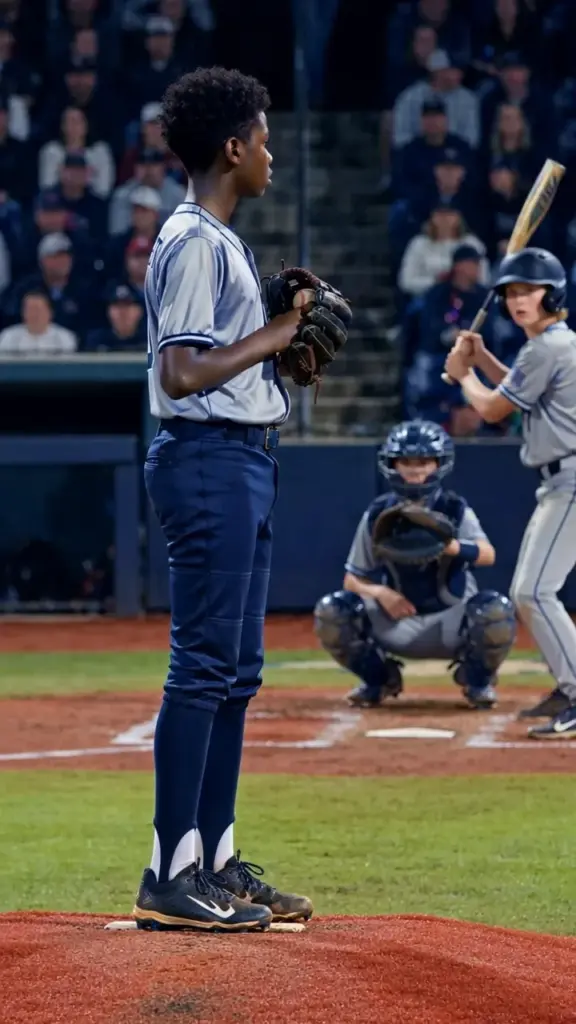
Turner stood motionless on the mound, his glove hanging beside his leg.
The scoreboard displayed a number nobody expected.
104 MPH.
The fastest pitch Turner had ever thrown.
But Coach Bennett wasn’t smiling.
He had spent twenty-three years coaching baseball. He had seen extraordinary pitches, impossible catches, and championship games decided by inches.
He had never been frightened by a number on a scoreboard.
Until tonight.
Because just seconds before Turner released that ball, Bennett had noticed something.
Something the thousands of spectators couldn’t see.
Turner’s throwing arm had begun trembling.
Not from nerves.
Not from excitement.
From pain.
And Bennett had shouted for him to stop.
Turner threw anyway.
Now the coach hurried onto the field.
“Turner!”
The young pitcher looked toward him.
“Coach, I got him.”
“I don’t care about the strikeout.”
Turner’s expression changed.
The catcher approached, still holding the baseball.
“Coach, that pitch was unbelievable.”
Bennett ignored him.
He stopped directly in front of Turner.
“Show me your hand.”
Turner hesitated.
“Why?”
“Your hand. Now.”
Slowly, Turner removed his glove.
His fingers were shaking.
Bennett stared.
“How long?”
Turner looked away.
“Coach—”
“How long has your arm been hurting?”
The stadium noise seemed to fade.
Turner swallowed.
“Since the fifth inning.”
Bennett closed his eyes.
Three innings.
The boy had been pitching through pain for three innings.
And nobody had known.
Turner was seventeen years old.
For most of his life, baseball had been the only thing that made sense to him.
His father had taught him to throw when he was five.
By ten, he could place a fastball exactly where he wanted.
By fourteen, college scouts were attending his games.
And by seventeen, people were calling him the most promising pitcher Westbridge High had produced in a generation.
But talent came with expectations.
His teammates expected victories.
His school expected championships.
His father expected a scholarship.
And Turner had begun believing that every pitch was a test of whether he deserved any of it.
That night, scouts from three universities were sitting behind home plate.
He knew exactly where they were.
He had looked toward their seats before every inning.
And when his arm began hurting, he made a decision.
He wouldn’t tell anyone.
Not tonight.
Not with the season on the line.
Coach Bennett looked toward the dugout.
“Get the trainer.”
Turner stepped forward.
“Coach, please.”
Bennett turned.
“What?”
“Just let me finish.”
“No.”
“We’re one out away.”
“I said no.”
Turner’s eyes filled with frustration.
“You don’t understand.”
Bennett stared at him.
“Then explain it.”
Turner looked toward the stands.
His father was sitting near the front row.
Beside him were the scouts.
Turner lowered his voice.
“If I come out now, they’ll think I’m weak.”
Bennett followed his gaze.
Then looked back at the boy.
“Who told you that?”
Turner didn’t answer.
Bennett waited.
Finally, Turner whispered, “My dad said scouts want someone who finishes what he starts.”
The coach’s expression softened.
For a moment, he saw something he had missed all season.
Not arrogance.
Not stubbornness.
Fear.
A seventeen-year-old boy terrified that one decision could destroy his future.
Bennett placed a hand on Turner’s shoulder.
“Listen to me.”
Turner stared at the dirt.
“Look at me.”
Slowly, he raised his head.
“You don’t earn a future by risking your ability to play in it.”
Turner swallowed.
“But the game—”
“The game will continue.”
“What if we lose?”
Bennett looked toward the dugout.
“Then we lose together.”
The trainer arrived.
After a brief examination, she told Bennett that Turner needed to stop pitching and receive further medical evaluation.
Turner didn’t argue.
He simply handed the baseball to his coach.
For the first time all evening, his shoulders dropped.
Bennett raised his arm toward the bullpen.
The crowd began murmuring.
Some spectators booed.
Others shouted that Turner should be allowed to finish.
Then the stadium announcer spoke.
“Pitching change for Westbridge.”
A young relief pitcher stepped out of the bullpen.
His name was Daniel Reyes.
He was sixteen.
He had pitched only twelve varsity innings that season.
And now he was being asked to finish the biggest game of his life.
Turner watched him approach.
Daniel looked terrified.
“Coach,” Daniel whispered, “I’ve never pitched in front of this many people.”
Bennett smiled.
“Neither had Turner, once.”
Daniel glanced toward the scoreboard.
Two outs.
Bottom of the ninth.
Westbridge leading by one.
Runner on third.
The championship was one pitch away from changing hands.
Turner stepped toward Daniel.
For a moment, everyone expected him to offer advice about fastballs or curveballs.
Instead, he said something different.
“Don’t try to throw like me.”
Daniel looked confused.
“What?”
Turner smiled faintly.
“Throw like you.”
Daniel climbed onto the mound.
The crowd roared.
The batter stepped into the box.
Daniel took a breath.
His first pitch missed outside.
Ball one.
The second bounced in the dirt.
Ball two.
The crowd grew louder.
Daniel looked toward the dugout.
Bennett raised one hand.
Slow down.
Daniel nodded.
The third pitch crossed the plate.
Strike one.
The fourth was fouled backward.
Strike two.
Now the count was even.
The batter stepped out.
Adjusted his gloves.
Returned to the box.
Daniel gripped the ball.
He glanced toward third base.
Then toward the catcher.
He delivered.
The batter swung.
A sharp line drive flew toward left field.
The stadium rose.
For one terrible second, Bennett thought the game was over.
Then Westbridge’s left fielder sprinted toward the foul line.
He stretched out his glove.
Dove.
And caught the ball inches above the grass.
Three outs.
Game over.
Westbridge had won.
The stadium exploded.
Players poured from the dugout.
Daniel dropped to his knees.
The catcher raced toward him.
And Turner stood near the bench, watching his teammates celebrate.