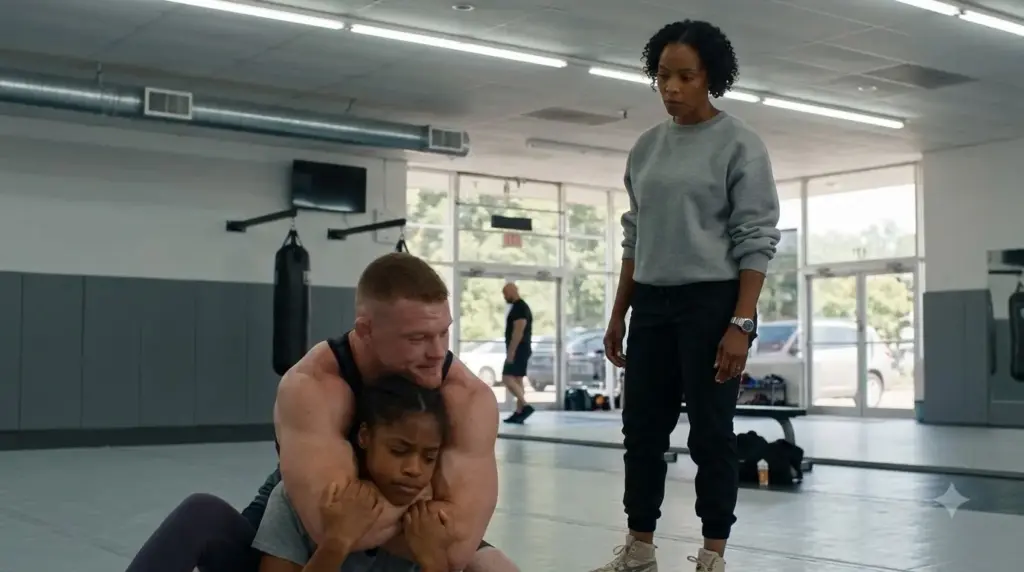
Eight Seconds of Silence
The music stopped.
Evelyn Shaw looked at the referee.
“Call an ambulance.”
Grant Voss laughed.
“She’s fine. She just got scared.”
Evelyn didn’t look at him.
“Tessa, can you hear me?”
The young fighter blinked.
Her lips moved, but no sound came out.
Evelyn lowered herself beside her.
“Don’t try to stand. Help is coming.”
Tessa’s breathing was shallow, and she seemed confused. Evelyn asked the referee to keep the surrounding spectators back while someone called emergency services.
Grant stood over them, adjusting his championship belt.
“You’re making this into a bigger deal than it is.”
Evelyn finally raised her eyes.
“She tapped five times.”
“So?”
“So you were supposed to stop.”
Grant smiled.
“Lady, this is a combat sport.”
“And that was a surrender.”
The referee, Paul Mercer, looked down at his shoes.
Evelyn noticed.
“Did you see her tap?”
Paul swallowed.
“Yes.”
“Did you tell him to release?”
“Yes.”
“Then why did it continue?”
Paul glanced toward Grant.
And said nothing.
That silence troubled Evelyn more than Grant’s laughter.
Because she recognized it.
She had heard that same silence in hospital corridors, disciplinary hearings, and locker rooms where injured athletes were afraid to tell the truth.
It was the sound of people who knew something was wrong but had learned that speaking could cost them everything.
Twenty minutes later, Tessa was being transported to the hospital.
The exhibition had been suspended.
Spectators gathered near the exits, replaying videos on their phones.
Grant remained beside the cage, arguing with the event organizer.
“You’re seriously canceling the rest of the show because some woman overreacted?”
Marcus Pell, the security officer, approached Evelyn.
“Ma’am, the director wants to speak with you.”
“Who is the director?”
“Leonard Price.”
Evelyn knew the name.
Leonard had been involved in professional combat sports for nearly twenty years.
He was a successful promoter, a skilled negotiator, and a man who understood how much money could be made from a fighter with the right reputation.
Evelyn followed Marcus into a narrow office overlooking the training floor.
Leonard stood behind a polished desk.
He was wearing a dark suit and an expression of practiced concern.
“Mrs. Shaw.”
“Ms. Shaw.”
“Of course. Please sit.”
Evelyn remained standing.
Leonard smiled thinly.
“I understand you interrupted our exhibition.”
“I intervened when a fighter continued a choke after his opponent surrendered.”
“Grant says it was part of the demonstration.”
“Tessa tapped repeatedly. The referee ordered a release.”
Leonard folded his hands.
“These situations can look worse than they are.”
Evelyn studied him.
“Have you watched the footage?”
“Not yet.”
“Then you don’t know what it looked like.”
His smile disappeared.
“Ms. Shaw, I appreciate your concern. But we have qualified professionals handling this.”
“Good. Then they can preserve the recordings and cooperate with the appropriate authorities.”
Leonard leaned back.
“And what exactly is your involvement?”
Evelyn reached into her handbag.
She removed a small identification card.
Leonard glanced at it.
Then looked again.
His posture changed.
Dr. Evelyn Shaw — Independent Medical and Athlete-Safety Consultant.
Below her name was the insignia of the National Combat Sports Safety Commission, a fictional independent oversight body that had been asked to review the exhibition’s safety arrangements.
Leonard’s face tightened.
“You’re with the commission?”
“I’m conducting an independent review.”
“Why didn’t you announce yourself?”
“Because I wanted to see how the event operated when nobody knew they were being evaluated.”
Leonard stared at her.
Evelyn returned the card to her bag.
“Now I’d like to know why your referee was unable to stop a fighter who ignored a clear surrender.”
Evelyn hadn’t always worked in athlete safety.
Twenty-six years earlier, she had been a competitive martial artist.
She had trained in small gyms, traveled to tournaments, and spent years learning how to control her body under pressure.
She had loved the sport.
But during a regional championship, she witnessed an incident that changed her life.
A nineteen-year-old fighter named Clara Jennings had been caught in a dangerous hold.
Clara tapped.
Her opponent continued.
The referee hesitated.
By the time the hold was released, Clara had suffered a serious injury.
She survived, but her recovery was long and difficult.
Evelyn visited her in the hospital.
Clara asked a question Evelyn never forgot.
“Why didn’t anyone stop it?”
Evelyn had no answer.
At the time, she was twenty-five and still believed that every sport protected its athletes through rules.
That day, she learned that rules meant nothing if the people responsible for enforcing them were afraid to act.
She eventually left competition, studied medicine, and specialized in sports injuries and athlete protection.
Her work took her to tournaments across the country.
She reviewed incidents.
Helped develop safety procedures.
And trained officials to recognize when competition had crossed into preventable harm.
Over time, she developed a reputation for being difficult.
Not because she shouted.
Not because she threatened people.
But because she refused to accept explanations that didn’t match the evidence.
When organizers claimed an injury was unavoidable, she asked for the footage.
When coaches blamed athletes for being weak, she examined the medical records.
And when officials insisted that everything had been handled properly, she asked them to explain exactly what they had done.
That approach had made her respected by some people.
And deeply unpopular with others.
Grant Voss was about to discover why.
The next morning, Evelyn visited Tessa at the hospital.
The young fighter was sitting upright in bed.
Her voice was hoarse, and she looked exhausted.
Her mother, Caroline Marlow, stood near the window.
When Evelyn entered, Caroline immediately approached her.
“You’re the woman who helped my daughter?”
Evelyn nodded.
“I was there.”
Caroline took her hand.
“Thank you.”
Evelyn looked toward Tessa.
“How are you feeling?”
Tessa shrugged.
“Embarrassed.”
Evelyn pulled up a chair.
“Why?”
“Because everybody saw me lose.”
Evelyn studied her.
“Tessa, you tapped.”
“I know.”
“That’s what you’re supposed to do when you need the hold to stop.”
Tessa stared at the blanket.





