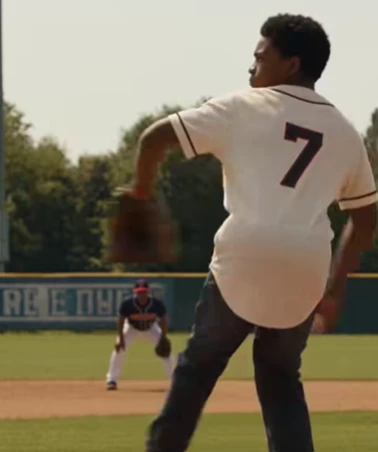
The Ten-Thousand-Dollar Pitch
Cole Barrett pointed his bat toward the pitching mound.
“One pitch, kid. That’s all you get.”
I tightened my grip around my old glove.
“That’s all I need.”
The crowd surrounding Southside Field erupted in laughter.
Cole shook his head, smiling as though he had just been handed the easiest challenge of his career.
“Let me make sure I understand. If I can’t hit your pitch, your team gets ten thousand dollars?”
“Yes, sir.”
“And if I hit it?”
I hesitated.
I hadn’t thought that far ahead.
Cole noticed.
His smile widened.
“Then you admit, in front of everybody, that your little team doesn’t belong on a real baseball field.”
My stomach tightened.
Behind me, Marcus muttered something angry.
Coach Carter stepped forward.
“Absolutely not.”
Cole looked at her.
“What? The kid made the challenge.”
“He’s fourteen,” she replied. “And you’re a grown man who came here as a guest.”
I looked at Coach Carter.
“It’s okay.”
“No, Tariq. It isn’t.”
I understood why she was angry.
But I also understood something else.
If I walked away, Cole would leave with his money, and Southside Field would still be closed.
I turned toward him.
“There’s one condition.”
Cole laughed.
“Now you’re negotiating?”
“Yes, sir.”
“All right. Let’s hear it.”
“If you lose, you write the check today. Not next week. Not after you talk to your manager.”
Cole tilted his head.
“Anything else?”
“The money goes directly to the field repair fund.”
For a moment, he looked genuinely surprised.
Then he nodded.
“Fine.”
Coach Carter stepped between us.
“Before anybody throws anything, we’re writing down the rules.”
Cole rolled his eyes.
But Coach Carter wasn’t finished.
“A foul ball doesn’t count as a hit. A missed swing or a called strike means Tariq wins. If the pitch is outside the strike zone and Cole doesn’t swing, the challenge is over without a winner.”
She looked at both of us.
“And we use a neutral umpire.”
Cole shrugged.
“Whatever makes you happy.”
Coach Carter pointed toward the fundraiser organizer.
“Get it in writing.”
For the first time that afternoon, I realized how serious this had become.
There would be no excuses afterward.
No arguments about what had happened.
One pitch.
One professional hitter.
And ten thousand dollars hanging between us.
While the organizers prepared the agreement, I walked toward our equipment bag.
Mateo followed me.
“Are you insane?”
“Probably.”
He didn’t laugh.
“Tariq, that’s Cole Barrett.”
“I know.”
“He hit forty home runs in one season.”
“I know.”
“He played against pitchers throwing ninety-five miles an hour.”
“I know, Mateo.”
“Then why are you doing this?”
I looked toward the damaged field beyond the fence.
The backstop was twisted.
The grass had grown unevenly.
A yellow warning sign hung across the locked entrance.
“Because nobody else is going to save it for us.”
Mateo sat beside me.
For a while, neither of us spoke.
Then he pointed toward my glove.
“Your brother fix that again?”
I nodded.
“Last night.”
“Does he know what you’re doing?”
“No.”
Mateo looked toward Cole, who was posing for photographs near the fundraising table.
“He’s going to destroy your pitch.”
I swallowed.
“Maybe.”
Mateo frowned.
“That’s not very confident.”
I looked at him.
“Being confident doesn’t mean pretending something can’t go wrong.”
He considered that.
Then smiled faintly.
“That sounds like something your grandfather would say.”
“It probably is.”
Mateo stood.
“All right.”
He picked up his catcher’s mask.
“If you’re really doing this, I’m catching.”
The agreement was signed fifteen minutes later.
Cole Barrett stood near home plate, stretching his shoulders.
He had borrowed a helmet from one of the older players.
A small crowd gathered along the fence.
Parents lifted their phones.
Children climbed onto the benches for a better view.
Coach Carter asked everyone to move behind the protective netting.
Then she approached me.
“Tariq, look at me.”
I did.
“You don’t have to do this.”
“I know.”
“Whatever happens, your teammates aren’t going to think less of you.”
I nodded.
She studied my face.
“Are you sure you want to continue?”
I looked toward the mound.
Then toward Cole.
“Yes.”
Coach Carter took a breath.
“All right.”
She placed a hand on my shoulder.
“Then remember what you’ve practiced. Don’t try to become somebody else just because he’s watching.”
I smiled.
“Yes, Coach.”
I walked toward the mound.
The dirt was damp from the previous night’s rain.
My worn shoes sank slightly into the surface.
I scraped my right foot against the pitching rubber.
Then looked toward home plate.
Cole Barrett stood in the batter’s box.
He tapped his bat twice.
“Ready, superstar?”
I didn’t answer.
I was studying his stance.
His weight rested heavily on his back leg.
His hands were high.
His front shoulder pointed toward me.
He looked relaxed.
Almost bored.
But when Mateo crouched behind the plate, Cole’s expression changed.
He narrowed his eyes.
For the first time, he was paying attention.
I had been practicing one particular pitch for almost a year.
My grandfather called it the disappearing ball.
It wasn’t a magical pitch.
It wasn’t even especially fast.
It was a changeup that moved differently from my ordinary fastball because of the way I released it.
Grandpa had taught me to throw it after noticing that I couldn’t generate the same velocity as the bigger boys.
“Stop trying to beat them with speed,” he told me one afternoon.
“Then how am I supposed to beat them?”
He placed a baseball in my hand.
“Make them wrong about what they’re seeing.”
I didn’t understand.
So he showed me.
Again.
And again.
He explained how hitters judged a pitch from the movement of a pitcher’s arm.
How timing mattered.
How a slower ball could be difficult to hit if it looked like a faster one during the delivery.
For months, I struggled.
Sometimes the ball sailed too high.
Sometimes it dropped into the dirt.
Sometimes it didn’t move at all.
But I kept practicing.





