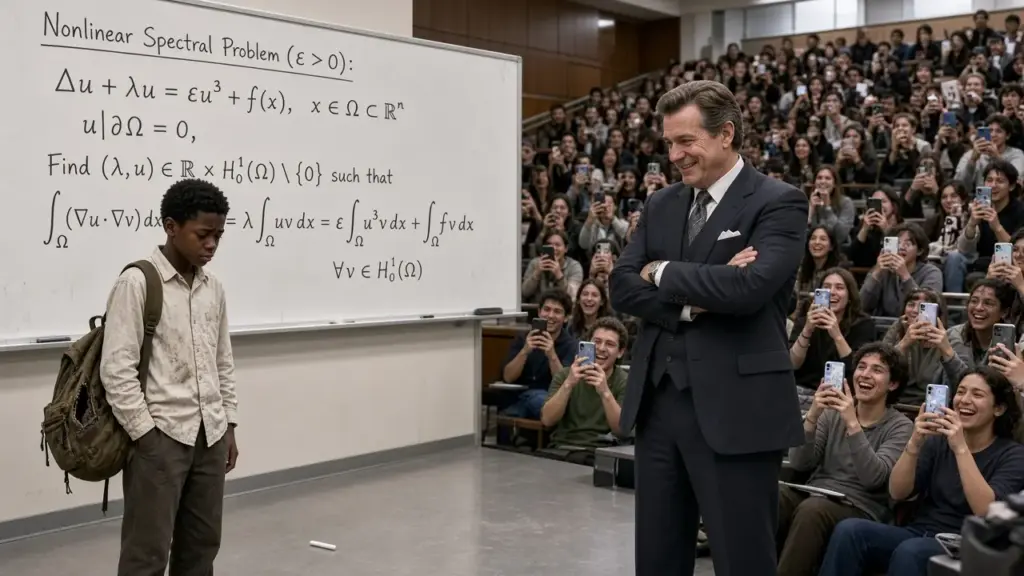
The Boy Who Solved the Impossible
Andre Powell was eleven years old when Professor Richard Sinclair decided to humiliate him in front of forty university students.
The professor had expected tears.
He had expected the boy to run.
Instead, Andre stood beneath the enormous chalkboard, holding a piece of white chalk between his fingers.
His oversized blue sweatshirt hung loosely from his shoulders. His sneakers were worn at the heels, and there was a small hole near the cuff of his left sleeve.
Behind him, students laughed.
Someone whispered, “This is going to be embarrassing.”
Another student lifted a phone to record.
Professor Sinclair leaned against his desk.
“Well, janitor’s boy? We’re waiting.”
Andre didn’t answer.
He studied the equation.
It was an advanced mathematical problem involving nonlinear differential equations, boundary conditions, and a complicated sequence of transformations.
Sinclair had deliberately selected it from a graduate-level research paper.
He knew most of the students in the room couldn’t solve it.
That was the point.
He wanted the child to fail publicly.
But Andre noticed something unusual.
The equation wasn’t impossible.
It was incomplete.
A condition necessary to determine a unique solution was missing.
Andre looked toward the professor.
“Sir, there’s something wrong with the question.”
The classroom erupted.
Sinclair laughed.
“Of course there is. The problem must be wrong because you can’t solve it.”
Andre shook his head.
“That’s not what I mean.”
“Then explain yourself.”
Andre pointed toward the final expression.
“You haven’t specified the boundary condition at the second endpoint.”
Sinclair’s smile faded slightly.
“What?”
“Without it, there could be multiple valid solutions.”
A student in the front row stopped laughing.
Andre continued.
“If you give me the missing condition, I can solve the problem you’re asking. Otherwise, I can show you a family of solutions.”
Sinclair straightened.
“You think you’re qualified to correct a university professor?”
Andre lowered his eyes.
“No, sir. I’m just reading what you wrote.”
That answer made several students uncomfortable.
Sinclair picked up another piece of chalk.
“Fine. Assume the boundary value is zero.”
Andre nodded.
“Thank you.”
Then he began writing.
The first line was simple.
The second introduced a substitution.
By the fourth, Andre had transformed the original expression into a more manageable form.
His handwriting was small but remarkably neat.
He paused occasionally, not because he was confused, but because he was checking each step.
Sinclair watched with folded arms.
At first, he looked amused.
Then impatient.
Then concerned.
A graduate student named Vanessa Brooks leaned forward.
She had spent three weeks studying a similar mathematical model for her master’s thesis.
She recognized Andre’s approach immediately.
“Professor,” she whispered, “he’s using a valid transformation.”
Sinclair ignored her.
Andre continued.
The chalk scratched against the board.
One minute passed.
Then three.
Then five.
When Andre reached the final line, he stopped.
He checked the boundary conditions.
Then underlined his answer.
The room was silent.
Vanessa stood.
“That’s correct.”
Sinclair turned sharply.
“Sit down, Miss Brooks.”
But she didn’t.
“Professor, his solution satisfies the equation and the conditions you gave him.”
Another graduate student opened his laptop.
He began checking the calculations independently.
Then looked up.
“She’s right.”
Sinclair stared at the board.
His face reddened.
Andre placed the chalk in the tray.
“May I go now, sir?”
Nobody laughed.
Not one person.
The recording reached the university administration before lunch.
By two o’clock, thousands of people had watched the professor insult a child whose mother cleaned the building.
By evening, the video had spread far beyond Philadelphia.
But Andre knew nothing about that.
He was sitting in the maintenance office beside his mother.
Denise Powell had been called away from her cleaning shift.
She stood beside the desk, still wearing her faded gray uniform.
Her supervisor, Mr. Harlan, looked uncomfortable.
“Denise, your son entered a restricted classroom.”
Denise glanced at Andre.
“Why were you there?”
Andre looked at his shoes.
“I wanted to hear the lecture.”
“You know you’re supposed to stay in the staff lounge.”
“I know.”
“Then why didn’t you?”
Andre hesitated.
“Because they were talking about differential equations.”
Denise closed her eyes.
She had spent years trying to keep her son safe.
She knew he was brilliant.
She also knew the world didn’t always welcome children who were different.
Mr. Harlan cleared his throat.
“The professor has filed a complaint.”
Denise looked up.
“Against my son?”
“Yes.”
“For what?”
“Disrupting his class.”
Denise stared at him.
Then asked quietly, “Did he mention what he said to Andre?”
Mr. Harlan didn’t answer.
Denise reached for her son’s hand.
“Come on, baby.”
As they walked toward the exit, Andre whispered, “Mom, I’m sorry.”
She stopped.
“Look at me.”
He raised his head.
“Did you insult anyone?”
“No.”
“Did you hurt anyone?”
“No.”
“Then don’t apologize for understanding something.”
Andre swallowed.
“But you might lose your job.”
Denise looked toward the university’s grand marble staircase.
For six years, she had cleaned those steps before sunrise.
She had polished floors that students walked across without noticing her.
She had worked through holidays, illness, and exhaustion.
And now her son was afraid that being intelligent might cost her everything.
She knelt beside him.
“Andre, listen carefully. My job is important. But you are more important.”
He hugged her.
Neither noticed the elderly man standing near the stairwell.
He had heard every word.
His name was Professor Emeritus Samuel Whitaker.
At seventy-four, Whitaker had retired from teaching but still visited the mathematics department twice a week.
He had spent forty years studying mathematical modeling and had published research used by universities around the world.
Earlier that afternoon, one of his former students had sent him the video.
He had watched it three times.
Not because of the confrontation.
Because of the mathematics.
Whitaker had recognized something unusual in Andre’s solution.
The boy hadn’t simply repeated a method from a textbook.
He had chosen an approach that showed a remarkably mature understanding of the underlying structure.
Whitaker approached Denise.
“Mrs. Powell?”
She turned.
“Yes?”





