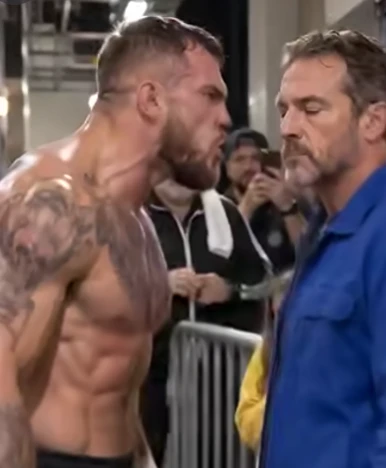
Rhett Dugan’s fingers tightened around my collar until the fabric pressed against my throat.
He was six feet two inches tall, weighed 230 pounds, and had knocked out seven professional fighters in his last nine victories.
I was forty-three, wore a maintenance uniform five days a week, and had a nine-year-old daughter standing directly behind me.
To everyone watching, the outcome seemed obvious.
Rhett smiled.
“What’s a man like you going to do?”
I looked past his shoulder.
Sadie was holding the stranger’s phone against her chest. Her eyes were wide, but she wasn’t crying. She was watching me with the same intense curiosity she showed whenever she encountered something she didn’t understand.
That frightened me more than Rhett’s grip.
I didn’t want her to remember her father as a man who enjoyed hurting someone.
“Last time,” I said quietly. “Stop.”
Rhett laughed.
Then he pulled me forward.
What happened next lasted approximately five seconds.
I turned away from the pressure on my collar, broke free of his grip, and moved to the side. Rhett lunged after me, but his own momentum carried him off balance.
I redirected him toward the padded floor beside the seating section.
He landed heavily.
Before he could scramble upright, I controlled his movement just long enough to keep him from charging toward Sadie.
Then I released him and stepped away.
No punches.
No dramatic finishing move.
No attempt to humiliate him.
Just enough to stop the immediate danger.
“Security!” someone shouted.
Two guards pushed through the crowd.
Rhett struggled to his feet, his face burning red.
“You think you can touch me?”
I moved backward toward Sadie.
“It’s over.”
Rhett pointed at me.
“You’re dead, old man!”
One of the guards stepped between us.
“Sir, you need to calm down.”
Rhett shoved the guard’s arm away.
“Do you know who I am?”
The guard looked at him.
“Yes. And you still need to come with us.”
People were recording from every direction.
Someone shouted my name.
Someone else cheered.
But I barely heard them.
I turned toward Sadie.
“Sweetheart, are you okay?”
She nodded.
Then looked at the place where Rhett had fallen.
“Dad?”
“Yes?”
“How did you do that?”
I swallowed.
For nine years, I had been waiting for that question.
And I had never found an answer I liked.
Before Sadie was born, I was a different man.
My name was still Grant Mercer, but almost everything else about my life had changed.
I spent ten years training professional mixed martial artists.
I worked with men who eventually competed in sold-out arenas, signed million-dollar contracts, and became household names.
I wasn’t famous.
I wasn’t interested in becoming famous.
I was the man who arrived before sunrise to unlock the gym, reviewed fight footage until midnight, and told exhausted athletes things they didn’t want to hear.
My job was to notice weaknesses before opponents discovered them.
I studied balance, timing, distance, and the tiny movements that revealed what a fighter intended to do.
I loved the sport.
But I never loved the attention surrounding it.
The cameras made everything louder.
Victory became a product.
Defeat became entertainment.
And somewhere along the way, people began confusing the ability to hurt someone with the right to do it.
I learned that lesson through a fighter named Daniel Price.
Daniel was twenty-four when he joined our gym.
He had extraordinary talent and a personality that made everyone feel welcome.
He remembered the names of the cleaning staff.
He helped younger fighters with their equipment.
He called his mother after every training session.
But he wanted to become a champion more than anything.
One afternoon, during preparation for an important fight, Daniel complained of dizziness after a hard sparring exchange.
I told him to stop.
His manager disagreed.
“We’re three weeks out,” he said. “He needs the rounds.”
Daniel insisted he could continue.
I refused.
An argument followed.
Eventually, another coach allowed him to return to training after I had left the room.
Daniel suffered a serious brain injury.
He survived.
But his career ended that day.
I visited him in the hospital every week.
Sometimes he remembered our conversations.
Sometimes he struggled to find the words.
His mother never blamed me.
That somehow made everything worse.
I had spent years teaching fighters how to win.
But I had failed to protect one from a system that treated his health as less important than a championship opportunity.
Six months later, I resigned.
I sold my interest in the gym.
Stopped attending fights.
And moved to Belidge with my wife, Leah.
We wanted a quieter life.
Then Sadie was born.
And for a while, we had exactly that.
Leah taught elementary school.
I found work maintaining a community sports center.
We lived in a modest house with a small backyard and a kitchen window that stuck whenever it rained.
We weren’t wealthy.
But we were happy.
Then Leah became ill.
For nearly two years, our lives revolved around hospital appointments, medication schedules, and the terrible uncertainty of waiting for test results.
She died when Sadie was six.
The morning after her funeral, Sadie climbed into my bed and asked whether I could still make pancakes.
I said yes.
She asked whether I would remember how her mother made them.
I said I’d try.
So I learned.
And I kept learning.
How to braid hair.
How to attend parent-teacher conferences without crying.
How to answer questions about death without pretending I understood everything.
How to be a father when the person who made parenting feel possible was gone.
For nine years, I built my life around protecting Sadie’s childhood.
I never imagined that one evening at an MMA event would bring my old life back.
By the time security escorted Rhett Dugan away, the corridor had become chaotic.
People shouted questions.
Phones followed us.
One man tried to shake my hand.
Another asked whether I had trained professionally.
I ignored them.
Sadie held my hand tightly.
“Dad, can we go home?”





