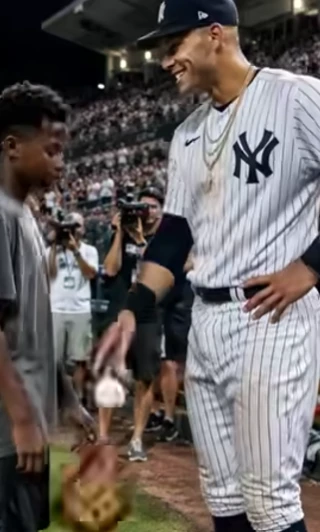
Part 1
The youth baseball showcase in Dallas was built to look like a dream.
Bright stadium lights.
Fresh white chalk lines.
College banners hanging along the outfield fence.
Television cameras near the dugout.
Reporters standing beside the batting cage.
Parents sitting in the lower rows with phones already recording.
Everywhere you looked, there were boys in clean uniforms.
New cleats.
Custom gloves.
Team bags with embroidered names.
Private coaches whispering last-minute advice.
This was not just a baseball event.
It was a stage.
And everyone knew it.
At the center of that stage stood Caleb Monroe.
Twenty-eight years old.
A superstar outfielder.
Gold chains around his neck.
Custom cleats shining under the lights.
A contract worth more money than most families in the stadium would ever see.
Kids had been lining up all afternoon just to take pictures with him.
Parents called him a role model.
Reporters called him the future of baseball.
Caleb loved hearing both.
He smiled when cameras pointed at him.
He signed autographs slowly, making sure every lens caught the angle.
He laughed loudly with coaches.
He tossed balls into the crowd.
He acted like the showcase belonged to him.
And in some ways, it did.
His name had sold tickets.
His appearance had brought reporters.
His reputation had brought sponsors.
But near the edge of the field, just outside the dugout entrance, stood a boy almost nobody noticed.
His name was Isaiah Reed.
Fourteen years old.
Black.
Thin shoulders.
Faded gray practice shirt.
Old sneakers with one lace tied in a knot.
A worn baseball glove tucked under his left arm.
And a scuffed baseball held carefully in his right hand.
He had no team bag.
No custom jersey.
No parent filming from the front row.
No private trainer standing behind him.
His mother had dropped him off two blocks away before heading to her evening shift at a hospital laundry service.
She had kissed his forehead and said,
“Ask respectfully.”
“Stand tall.”
“And don’t let anyone make you ashamed of wanting a chance.”
Isaiah had nodded.
He had promised.
Then he walked the rest of the way to the stadium alone.
For almost two hours, Isaiah stood near the fence and watched.
He watched every pitcher warm up.
Every windup.
Every release.
Every shoulder angle.
Every mistake.
He noticed things other people missed.
A boy in blue cleats dropped his elbow before release.
A left-hander twisted too early and lost his balance.
One pitcher threw hard but gripped the ball too tight.
Another had beautiful form but no movement.
Isaiah watched all of it with quiet eyes.
Not jealous.
Not bitter.
Learning.
Because that was how he had learned almost everything.
By watching.
By repeating.
By practicing when nobody was watching back.
Behind home plate, an older scout sat with a clipboard on his knee.
His name was Walter Hayes.
Seventy-three years old.
Gray hair.
Dark sunglasses.
A plain navy cap pulled low.
He had spent almost fifty years around baseball.
Minor leagues.
College diamonds.
Empty practice fields.
Dusty towns where nobody famous ever came.
Walter had seen players who looked perfect and never became anything.
He had seen awkward kids turn into legends.
And he had learned one rule above all others.
Baseball talent did not always arrive wearing the right uniform.
That afternoon, Walter was supposed to be watching the invited pitchers.
The boys with names already printed on scouting sheets.
The boys whose parents had paid entry fees, travel costs, training packages, and highlight video edits.
But every few minutes, Walter’s eyes drifted back toward Isaiah.
The kid was too still.
Too focused.
Most boys who stood outside the action looked nervous or bored.
Isaiah looked like he was studying a language only he could hear.
Walter noticed how the boy held the baseball.
Not casually.
Not like a kid squeezing a souvenir.
His fingers rested along the seams with strange patience.
His thumb sat hidden underneath, not centered, but angled.
Every so often, Isaiah would roll the ball half an inch in his palm, adjust his grip, then look toward the mound again.
Walter lowered his pen.
He had seen that grip before.
Not often.
Not in years.
And certainly not from a fourteen-year-old boy standing at the edge of a showcase with shoes held together by knots.
But he did not move yet.
Scouts learned patience.
Sometimes a player revealed himself only if the world gave him a reason to.
And Isaiah Reed was about to get one.
During a short break between pitching groups, the field relaxed.
Players walked toward coolers.
Coaches checked clipboards.
Parents lowered their phones.
Caleb Monroe stepped near the mound, laughing with two reporters while a microphone clipped to the field speaker still picked up pieces of his voice.
He was telling a story about his rookie season.
The crowd loved it.
Caleb loved the crowd loving it.
Isaiah looked toward the mound.
His fingers tightened around the baseball.
This was the moment.
He knew it might be his only one.
His mother’s words moved through him.
Ask respectfully.
Stand tall.
Isaiah took one step forward.
Then another.
Then another.
A few boys near the dugout noticed him.
One smirked.
Another whispered something.
Isaiah kept walking.
He stopped several feet from Caleb and waited for the superstar to finish laughing.
“Excuse me,” Isaiah said.
Caleb turned halfway.
At first, he looked past him, as if the voice had come from someone more important.
Then his eyes dropped to Isaiah.
The faded shirt.
The old glove.
The sneakers.
The scuffed baseball.
Caleb’s smile changed.
Not disappeared.
Changed.
Became sharper.
“What’s up, little man?”
Isaiah swallowed.
“I was wondering if I could try one pitch.”
For a second, Caleb stared at him.
Then he laughed.
Not a small laugh.
A loud one.
The kind meant for other people to hear.
“You?”
A few players near the dugout turned around.
Isaiah nodded.
“Just one pitch.”
Caleb glanced at the reporters.
Then at the crowd.





