Baseball Superstar Mocked a Black Kid’s Poor Team — So the Boy Put $10,000 on One Pitch
The crowd began laughing before Tariq Mason even touched the baseball.
It started near the first-base fence, where several sponsors stood beneath a white tent drinking lemonade from plastic cups.
Then the laughter spread toward the bleachers.
A few parents covered their smiles.
Others did not bother.
The Southside Falcons stood in a crooked line beside the visiting dugout, trying not to react.
Their navy jerseys had been washed so many times that some looked gray.
Three boys wore white baseball pants.
Two wore black.
One wore faded sweatpants because his only uniform pants had torn during practice.
Their cleats did not match.
Their batting helmets were scratched.
Their equipment bag had a broken zipper held closed by red electrical tape.
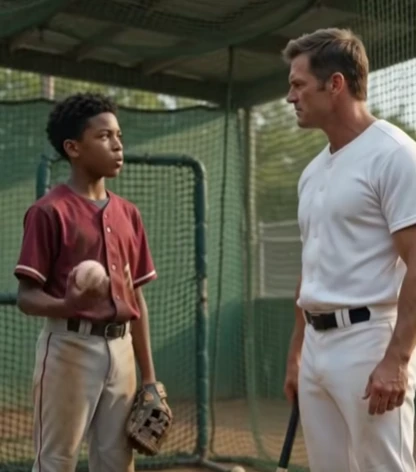
At the front of the line stood fourteen-year-old Tariq Mason.
He was thin enough that his jersey hung loosely from his shoulders.
The white number seven on his back had started peeling at one corner.
His glove was dark brown, nearly black with age, and wrapped with tape around two fingers.
Across from him stood Cole Barrett.
Cole was the most famous baseball player to come out of Bellhaven County in twenty years.
He had been an All-Star in the major leagues.
He had appeared in national commercials.
His photograph hung in sporting-goods stores across the state.
Children wore his number.
Adults repeated stories about his home runs as though they had personally helped him hit them.
Cole had grown up fifteen minutes from Southside, but no one looking at him that afternoon would have guessed it.
His uniform was bright white.
His shoes were spotless.
A gold chain rested against his neck.
He held a polished black bat worth more than every glove in the Falcons’ equipment bag combined.
Cole picked up one of Southside’s batting helmets.
A crack ran along the back, repaired with black tape.
He turned it slowly in his hands.
“This is your team?” he asked.
Nobody answered.
Cole looked toward the sponsor tent.
“I’ve seen better gear at a garage sale.”
Several adults laughed.
Tariq heard one man say, “He’s not wrong.”
The Falcons lowered their eyes.
Their coach, Denise Carter, took one step forward.
“We didn’t come here for a fashion show.”
Cole placed the helmet on top of the bag.
“No, Coach. You came here asking for money.”
Behind home plate, a banner stretched between two metal poles.
HELP SAVE SOUTHSIDE FIELD
GOAL: $10,000
The Falcons’ home field had been closed for nearly six months.
A winter storm had damaged the backstop.
The dugout roof leaked.
The infield flooded whenever it rained.
The city claimed repairs would cost more than the youth program could afford.
Unless the team raised ten thousand dollars before the end of summer, the field would be removed from the youth league schedule.
The Falcons would have nowhere to play.
That was why Coach Carter had accepted an invitation to Cole Barrett’s charity baseball exhibition.
The event was supposed to raise money for youth sports.
At least, that was what the flyer said.
Cole had invited wealthy donors, local business owners, television reporters, and several retired athletes to watch children compete in batting contests and fielding drills.
Every participating team received new equipment.
Every team except Southside.
Their registration, Cole’s staff later claimed, had been submitted one day late.
They were allowed to attend.
They were allowed to stand for photographs.
But they would receive no grant and no equipment.
Coach Carter had still brought the boys.
She believed that if donors saw them play, someone might help.
Instead, Cole Barrett had turned them into entertainment.
He lifted Tariq’s glove by two fingers.
“You planning to pitch with this thing?”
More laughter came from the fence.
Tariq looked at the glove.
It had belonged to his older brother, Malik.
Malik had worn it through high school.
He had repaired it three times.
When he left for military training, he handed it to Tariq and said, “A good glove remembers good hands.”
Tariq held out his palm.
“Give it back.”
Cole raised one eyebrow.
The laughter faded slightly.
“What did you say?”
“My glove.”
Cole studied him.
Tariq’s voice had not been loud.
It had not been disrespectful.
That seemed to bother Cole more.
He dropped the glove into Tariq’s hand.
“Maybe you should ask the fundraiser to buy you a new one.”
Tariq slid his hand inside it.
“One pitch.”
Cole turned away.
“What?”
Tariq looked toward the banner behind home plate.
Then at the oversized ceremonial check lying on a folding table.
The check was made out for ten thousand dollars, but the recipient line was blank.
It was supposed to go to whichever youth program Cole selected at the end of the event.
“If I throw one pitch you can’t hit,” Tariq said, “Southside gets that check.”
The entire field seemed to stop.
Even the children running near the concession stand became quiet.
Cole faced him again.
“One pitch?”
Tariq nodded.
“One.”
Cole’s smile returned.
It was not a friendly smile.
It was the smile of a man who had just been handed a way to turn humiliation into a performance.
“And if I hit it?”
Tariq swallowed.
He could feel Coach Carter staring at him.
He could feel his teammates behind him.
He knew he had no authority to promise anything.
No money.
No field.
No future.
But Cole had already made them into a joke.
Tariq decided the joke would at least have an ending.
“If you hit it,” he said, “you can tell every person here that we never belonged on this field.”
One of the Falcons whispered, “Tariq, no.”
Coach Carter stepped beside him.
“That’s enough.”
Cole held up a hand.
“No, Coach. Let the young man talk.”
Tariq looked at Cole without blinking.
The crowd had gone completely silent.
Then a chair scraped against concrete near the third-base dugout.
An old man stood.





