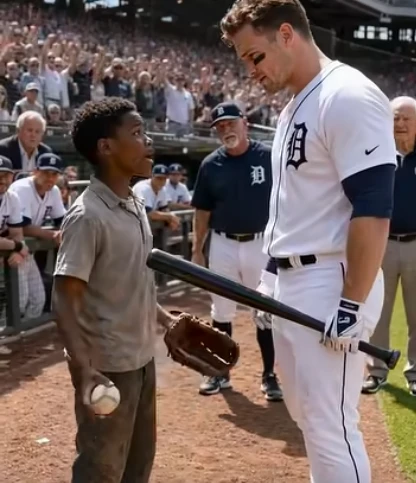
Superstar Mocked a Black Kid’s Old Glove — Then Challenged Him to One Pitch
The crowd at Harrison Field had come to see Derek Vaughn.
Major League superstar.
Home run champion.
Gold-chain smile.
Television face.
The kind of player who signed baseballs with one hand while checking camera angles with the other.
That Saturday afternoon, the stands were packed for the Derek Vaughn Youth Power Classic, a charity event with sponsor banners, local news crews, and hundreds of kids wearing Vaughn’s number across their backs.
Parents stood in long lines near the dugout, hoping their children might get a picture.
Reporters gathered near the batting cage, waiting for Derek to say something polished about giving back.
Little League teams sat shoulder to shoulder along the first-base line, staring at him like he had stepped out of a video game.
And near the dugout, thirteen-year-old Eli Carter stood quietly with an old brown glove hanging from his left hand.
The leather was cracked.
The stitching was loose.
The pocket was dark from years of sweat, dirt, and rain.
His shoes were worn at the soles.
His black T-shirt had the Harrison Field staff logo on it, though it was too large for his shoulders.
He was only supposed to collect practice balls.
That was the job.
Carry the dented bucket.
Stay near the foul line.
Pick up the baseballs that rolled toward the fence.
Do not talk to players unless spoken to.
Do not step onto the grass unless a coach waved him over.
And above all, do not interrupt Derek Vaughn.
Eli knew rules like that without needing anyone to say them twice.
He had learned early that some places welcomed kids like him only if they were useful and quiet.
His mother, Angela Carter, worked the concession stand near section 112.
His father, Malcolm Carter, worked nights repairing city buses.
The family did not have money for private lessons, travel teams, or a closet full of clean uniforms.
Eli had one glove.
His father’s glove.
The old brown one with the initials M.C. burned into the side near the thumb.
Malcolm had given it to him on his tenth birthday.
Not wrapped.
Not polished.
Just held out across the kitchen table in both hands.
“This glove has heard a lot of baseball,” his father had said.
Eli had laughed.
“Gloves can’t hear.”
Malcolm smiled.
“Good ones can.”
That glove had been with Eli through every empty-lot practice, every schoolyard catch, every evening under the streetlight behind their apartment building.
He loved it because it belonged to his father.
He hated it sometimes because other kids laughed at it.
Both things were true.
At Harrison Field, the laughter came before the first pitch.
One of Derek’s teammates noticed the glove while Eli was gathering balls near the dugout.
“Man,” the player said, grinning. “That thing older than the stadium?”
Another player leaned over the rail.
“Careful. It might turn to dust if he catches with it.”
Eli lowered his eyes and kept dropping balls into the bucket.
He had learned not to feed jokes.
If you answered, they grew.
Derek Vaughn heard the laughter and turned.
He was wearing a white practice jersey, dark sunglasses, and batting gloves even though he was not batting at that moment.
His smile widened when he saw Eli’s glove.
“Kid,” he called. “You bring that from a museum?”
The players laughed louder.
A few fans near the railing joined in because Derek Vaughn had made it safe.
Eli tightened his grip on the bucket handle.
“No, sir.”
Derek walked closer.
The cameras followed him.
That was how everything changed.
Not because Derek was interested in Eli.
Because Derek was interested in an audience.
“What’s your name?” Derek asked.
“Eli.”
“Eli what?”
“Eli Carter.”
The smile stayed on Derek’s face, but something in his eyes shifted when he heard the last name.
Only for a second.
So quick most people missed it.
Eli missed it too.
He was too busy feeling every person in the front rows staring at his shoes, his old glove, his bucket, his brown skin, and the space between him and a superstar who knew exactly how small a kid could feel under stadium lights.
Derek nodded toward the glove.
“You actually play with that?”
Eli looked at it.
“Yes, sir.”
“What position?”
“Pitcher. Sometimes shortstop.”
“Pitcher?”
The word came out like a joke already halfway laughed.
Eli said nothing.
Derek lifted his bat from the rack and rolled it across his shoulders.
“Everybody’s a pitcher until somebody important steps in the box.”
A few players chuckled.
Eli turned away and went back to collecting balls.
He was almost at the foul line when a wild throw sailed from near first base, skipped off the edge of a player’s glove, and rolled directly to his feet.
The crowd barely noticed.
Eli bent down, picked it up, and tossed it back.
He did not wind up.
He did not show off.
He did not even think.
His fingers found the seams the way they always did.
His shoulder stayed closed.
His wrist snapped late.
The ball cut through the air and popped into Derek’s glove harder than anyone expected.
Derek looked down at his hand.
Then at Eli.
The laughter stopped for half a beat.
“Was that supposed to be a pitch?” Derek asked.
Eli shook his head.
“I was just returning the ball.”
The players laughed again, but softer now.
Derek stepped closer, raising his voice so the crowd could hear.
“Kids like you carry buckets. You don’t throw to players like me.”
Eli stayed quiet.
His father’s voice rose in memory.
Never let somebody else’s mouth decide what your hands know.
Derek pointed toward the mound.
“You think you’ve got an arm?”
Eli looked at the field.
Then back at him.
“I’m not trying to embarrass anyone.”
That made Derek smile wider.
“Oh, now I have to see this.”
He lifted his bat and walked toward home plate.





