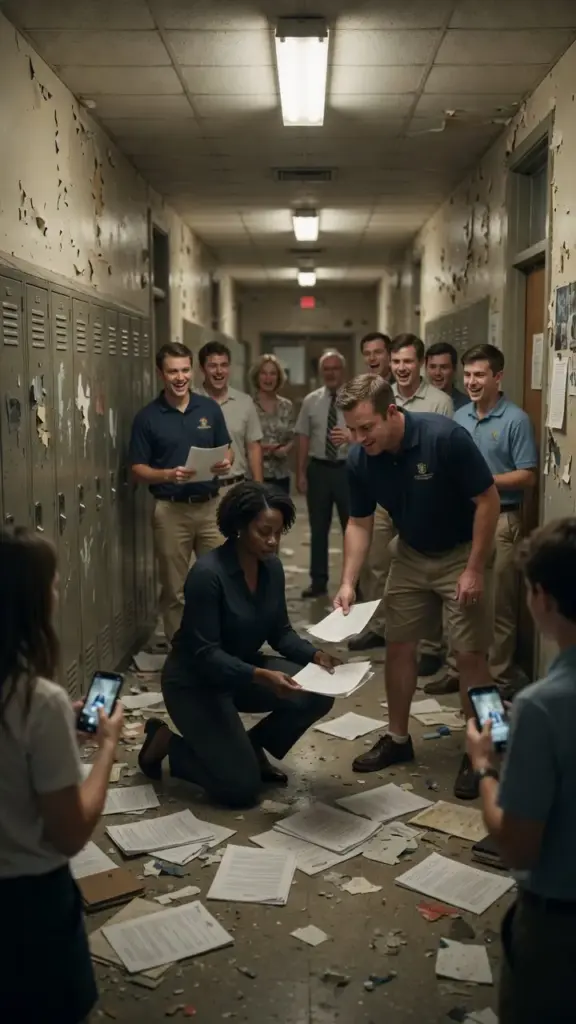
The rest was Jallen’s phone. Eleven minutes and 43 seconds of uncut video. Every shove, every swing, every takedown, timestamped, geo-tagged, saved to his cloud drive and backed up on a USB stick that Quinn now kept in a locked box under her bed. But Quinn didn’t release the video. Not yet. Donna told her to wait. “Let them build their lie as tall as they want. The taller it gets, the harder it falls.” By Wednesday, Derek’s version had reached the local news. Channel 4 ran the story at 6:00. The anchor read from a statement provided by Derek’s attorney. “Five Ridgemont High staff members were violently attacked during a school-sponsored event by a fellow employee. The victims are seeking full criminal prosecution and civil damages.” They showed Derek’s photo, smiling coaching jersey, arms around students. They showed Quinn’s employee badge photo, unsmiling, flat lighting, the kind of picture that makes anyone look like a suspect. No context, no student interviews, no mention that Derek threw the first shove.
Derek watched the broadcast from his living room. Craig sat next to him, beers on the table. Derek leaned back and grinned. “She’s done,” he said. “Nobody comes back from this.” Craig nodded. “What about the kid’s video? The one who was filming.” Derek waved his hand. “A student’s phone video against five adult witnesses and a police report. Nobody’s going to care.” He was wrong. But he didn’t know that yet. By Thursday, Quinn’s name was everywhere, and not in a good way. Local Facebook groups split down the middle. Half the comments said she was a hero. The other half called her dangerous. “She attacked five men. What kind of teacher does that?” “Doesn’t matter what they said to her. Violence is never the answer. She should be in jail, not a classroom.” Quinn read none of it. Donna told her to stay off the internet. “Anything you post, anything you like, anything you comment, it becomes evidence. Go dark.” Quinn went dark. She unplugged her router, turned off her phone after 8:00 p.m. She ran 5 miles every morning at dawn, came home, and reviewed her evidence folder. Twelve incidents before the fitness challenge. Dash cam footage of Craig near her truck the night her tires were slashed. A saved voicemail from Whitfield’s office admitting he’d received her complaint. Eleven journal entries with dates that matched email trails and Jallen’s video.
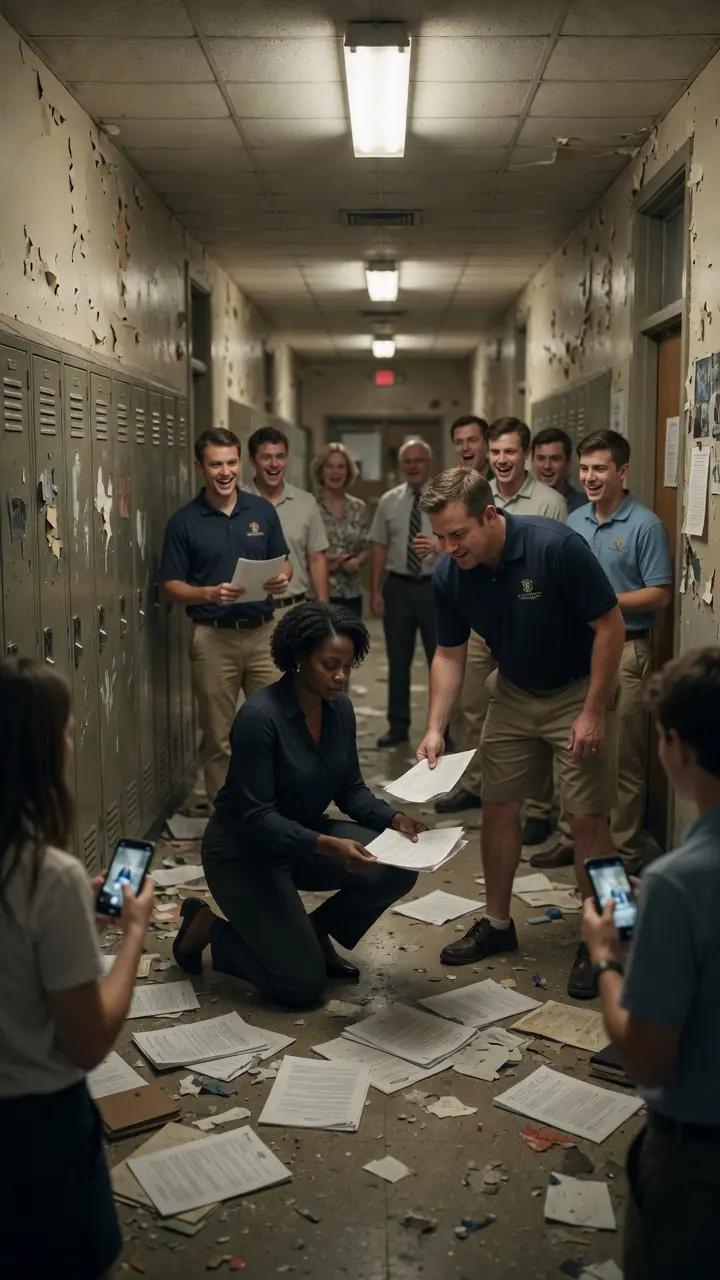
Donna drove down from Atlanta on Friday. They sat at Quinn’s kitchen table until midnight, organizing everything into a single file, chronological, cross-referenced, and clean enough to present in any courtroom. “When do we use this?” Quinn asked. “At the hearing, in front of everyone, on the record.” Donna closed the folder. “They want a public execution. We’ll give them a public trial.” The school board hearing was set for the following Thursday. Both sides would present evidence, open session, community invited. Derek spent the week rehearsing his testimony with his lawyer. The story was simple. Quinn had snapped during the fitness challenge and attacked five unarmed men. No provocation, no warning, just violence. He also made calls. Three school board members had known Derek for over a decade. He coached their kids, ran their fundraisers, shook their hands at church every Sunday. He reminded each of them casually, carefully how much he’d done for Ridgemont. “You know me,” he told board member Patricia Caldwell over the phone. “15 years. You really going to take the word of a woman who’s been here 3 weeks?” Patricia didn’t answer right away. Then she said, “Just tell the truth, Derek. That’s all any of us have to do.” Derek hung up and poured himself another drink. He wasn’t worried about the truth. He was worried about control. And for 15 years, control had never been a problem.
Meanwhile, something was happening that Derek didn’t see. Donna had filed a counter complaint on Quinn’s behalf. Harassment, workplace intimidation, and destruction of evidence. Attached to the complaint were four things. Quinn’s incident journal, the dash cam footage, a formal request to investigate the deleted security tapes, and a subpoena for Ridgemont’s fundraiser financial records from the past 3 years. The subpoena landed on Principal Whitfield’s desk on Monday morning. He read it twice, then he closed his office door and didn’t come out for an hour. Three former Ridgemont teachers, the ones who quit before Quinn arrived, had also been contacted by Donna. Each one agreed to submit a written statement describing their experience with Derek Morrison. Same pattern, same tactics, intimidation, isolation, forced resignation. None of them had spoken up before. They were afraid. But Quinn’s video, the one the whole country had seen, changed something. It made them feel less alone.
On Wednesday night, the night before the hearing, Quinn sat on her apartment floor, evidence folder on the table, boots by the door, journal in her lap. She turned to the first page, the entry from her first week at Ridgemont. She read it out loud to herself quietly, the way her grandmother used to read scripture on Sunday mornings. Then she closed the journal, turned off the light, and went to bed. Tomorrow, she wouldn’t need her hands. She would need her voice.
Thursday, 9:00 a.m. Ridgemont High Auditorium. Every seat was taken. Parents, students, local reporters. Two camera crews from Atlanta stations that had picked up the story. A row of folding chairs had been added along the back wall, and those were full, too. People stood in the doorway, some held phones, some held signs. Stand with Quinn on one side of the aisle, protect our staff on the other. The school board sat behind a long table on the stage. Five members, Patricia Caldwell in the center, microphones, water pitchers, a stack of folders thick enough to prop open a door. Derek Morrison sat on the left side of the auditorium with his lawyer, a man named Glenn Archer, gray suit, silver watch, the kind of attorney who bills by the half hour and never smiled. Craig, Vince, Brady, and Neil sat in the row behind them, all in collared shirts, all quiet. Derek had told them to look calm, professional, like victims. Quinn sat on the right side, Donna Greer beside her, one folder on the table. Quinn wore a navy blouse and flat shoes. No jewelry, no expression. She looked the way she always looked. Still. Patricia Caldwell opened the session. “This is a public hearing regarding the incidents of April 14th at the Ridgemont staff fitness event. Both parties will present statements and evidence. We’ll begin with the complainant.”





