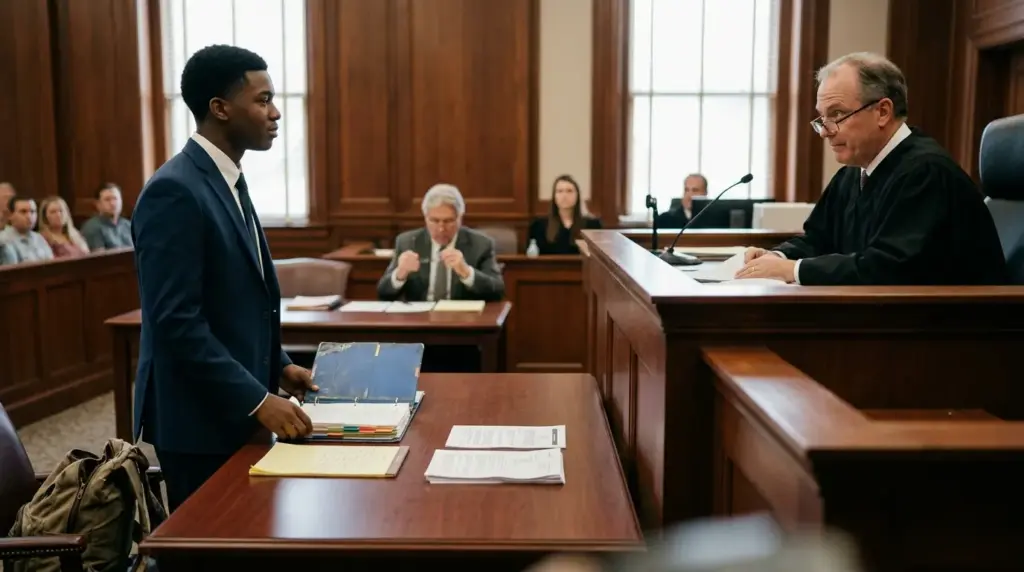
The Judge Smirked at the Teen and Said, “You’re Not a Lawyer” — Then He Opened His Notes
Still, getting licensed had not immediately created a career.
At nineteen, Julian Avery had a law degree, a bar license, and exactly forty-three dollars in his checking account.
Large firms weren’t interested.
One hiring partner had actually laughed during his interview.
“You’re younger than our summer interns.”
Another told him to come back when he had more life experience.
Julian understood their hesitation.
He just wished they would judge his work before judging his face.
So he joined a small legal-aid organization.
The salary was modest.
The office furniture was older than he was.
But the clients needed help.
And that was where he met Evelyn Price.
Evelyn was eighty-two years old, a retired school cafeteria manager who had lived in the same small house for forty-six years.
Her husband had died twelve years earlier.
Her only daughter lived out of state.
And now a development company was demanding seven hundred thousand dollars from her.
According to Westover Development Group, Evelyn had personally guaranteed a commercial loan connected to her late husband’s former business.
If the company prevailed, she could lose nearly everything she owned.
Evelyn insisted she had never signed the guarantee.
“I don’t even know what half those papers mean,” she told Julian during their first meeting.
Julian asked her one question.
“Mrs. Price, did anyone ever explain this agreement to you?”
She shook her head.
“Baby, nobody ever showed me that agreement.”
Julian opened his notebook.
“Then we’ll start there.”
For three weeks, he worked through the evidence.
Bank records.
Property filings.
Loan documents.
Emails.
Signature samples.
Then he noticed something strange.
The personal guarantee supposedly signed by Evelyn was dated March 14.
But the document’s notary acknowledgment appeared to reference a different date.
And the signature page looked unusually clean compared with the rest of the scanned agreement.
Julian requested the original.
Westover’s attorneys provided another digital copy instead.
That copy contained a different footer and page arrangement.
Julian requested clarification.
No meaningful explanation came.
Now, standing inside Courtroom 4B, he finally had an opportunity to raise the issue.
Judge Randall Cole examined the two versions of Exhibit 12.
His earlier smirk had disappeared.
“Mr. Caldwell, why are these documents different?”
Martin Caldwell adjusted his glasses.
“Your Honor, these are likely scanning or compilation differences.”
Julian stood.
“May I respond?”
The judge nodded.
“Briefly.”
Julian opened his notes.
“The difference isn’t limited to page numbering. In the discovery copy, the signature page follows the financial disclosures. In the filed exhibit, it appears before them.”
He placed two enlarged copies on the display.
“And the notary acknowledgment contains a different date.”
Caldwell frowned.
“That doesn’t establish wrongdoing.”
Julian nodded.
“Agreed. I’m not asking the court to make that finding today.”
The judge leaned forward.
“Then what are you asking?”
“That the court require production of the original executed agreement, including its attachment history, and decline to enforce the disputed guarantee until its authenticity can be examined.”
Silence.
Judge Cole studied the documents.
Then looked toward Caldwell.
“Do you have the original?”
Caldwell hesitated.
“Not physically present, Your Honor.”
“Where is it?”
“With the client’s document custodian, as I understand it.”
Julian turned another page.
“Your Honor, we requested the original seventeen days ago. We received a response stating that the original was unavailable.”
Caldwell looked sharply at him.
Julian continued.
“That response was sent by Mr. Caldwell’s office.”
He handed the clerk a copy.
The judge read it.
Then looked up.
“Mr. Caldwell, why was the court not informed that the original may be unavailable?”
Caldwell cleared his throat.
“We believed the certified electronic copy was sufficient.”
Julian remained standing.
“Your Honor, there is one additional issue.”
The judge sighed.
“What now, Mr. Avery?”
Julian opened the last section of his binder.
“The date.”
Caldwell frowned.
“What about it?”
Julian pointed toward the disputed guarantee.
“March 14.”
He paused.
“Mrs. Price was hospitalized that day.”
The courtroom became completely silent.
Evelyn sat behind Julian, clutching her purse.
Julian continued.
“She underwent emergency surgery that morning. Her hospital records indicate she remained admitted throughout the day.”
Caldwell immediately stood.
“Objection. Medical records require proper authentication.”
Julian nodded.
“Which is why we’ve submitted a declaration from the hospital’s records custodian and requested permission to present the relevant certified records.”
Judge Cole reviewed the filing.
Then looked toward Evelyn.
“Mrs. Price, is this accurate?”
Julian gently raised his hand.
“Your Honor, I would ask that my client not be questioned without being sworn and without an opportunity for counsel to address the evidentiary issues.”
The judge paused.
Then nodded.
“Fair point, Mr. Avery.”
Caldwell looked increasingly uncomfortable.
Julian turned another page.
“And there’s more.”
He displayed an email from Westover’s former loan administrator.
The message discussed assembling missing documentation several months after the supposed guarantee had been signed.
Julian was careful.
He didn’t accuse anyone of forging the document.
He didn’t claim the email proved fraud.
He simply showed that the company’s records raised questions its lawyers had not answered.
Judge Cole removed his glasses.
“Mr. Caldwell, I am not prepared to enforce a personal guarantee while these discrepancies remain unresolved.”
Caldwell opened his mouth.
The judge raised his hand.
“I’ve heard your position.”
Then he turned toward Julian.
“Mr. Avery, your motion for additional discovery is granted. The plaintiff will produce the available original records and relevant document history. The enforcement request is continued pending further proceedings.”
Evelyn covered her mouth.
Julian sat down slowly.
It wasn’t a final victory.
But her home was safe from the immediate enforcement request.
And for the first time in months, she could breathe.
As the hearing ended, Caldwell approached Julian.
“Young man.”
Julian looked up.
“Yes, sir?”
Caldwell hesitated.
“That was a well-prepared argument.”
“Thank you.”
“Where did you learn to organize evidence like that?”
Julian closed his binder.
“My father repairs elevators.”
Caldwell blinked.
“I’m sorry?”





