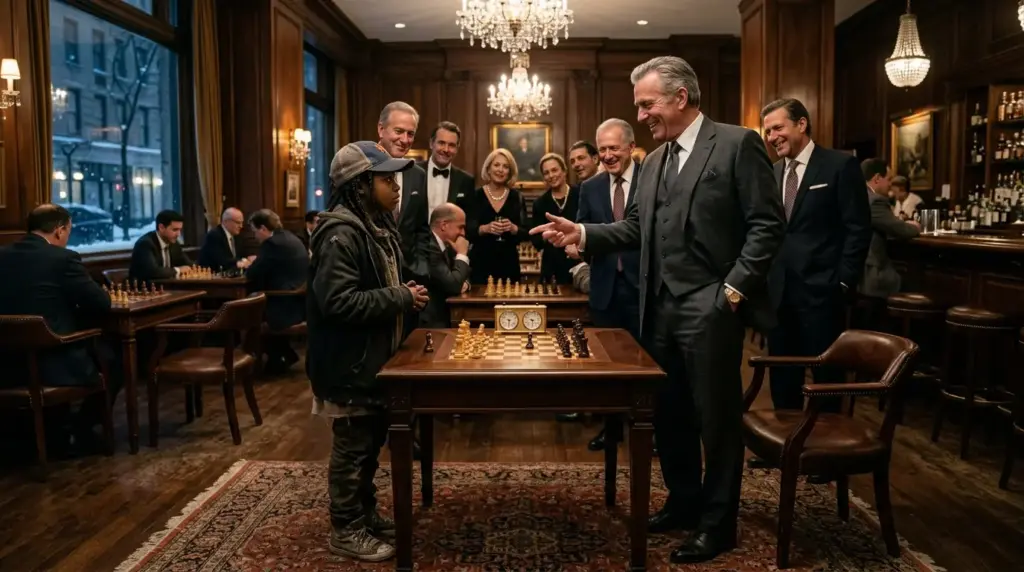
“Sir, Can I Play For Food?” They Laughed At The Homeless Girl — Not Knowing She’s A CHESS PRODIGY!
“She wants to play us for food, as if this is some sort of medieval tavern where peasants gamble for scraps.”
The mocking laughter echoed through the Grand View Elite Chess Club as its wealthy members stared at the twelve-year-old homeless girl standing near the entrance.
Her jacket was torn. Her shoes were soaked from the snow. Her small hands trembled from hunger and cold.
But her eyes were fixed on the chessboard.
“Please, sir,” Maya Thompson whispered. “I haven’t eaten since yesterday. If I win one game, could I have something to eat?”
A wealthy businessman named Richard Sterling leaned back in his leather chair and laughed.
“You? Beat one of us? Little girl, do you even know how the pieces move?”
Maya nodded.
“Yes, sir.”
Richard smiled cruelly.
“Fine. Beat me, and I’ll buy you the biggest dinner you’ve ever seen. Lose, and you walk out that door immediately.”
The room erupted in laughter.
But what none of them knew was that the hungry little girl standing before them had spent years mastering the game they believed belonged only to people like themselves.
And within minutes, their laughter would turn into complete disbelief.
The bitter December wind had cut through Maya’s threadbare jacket as she huddled outside a closed bakery on Madison Avenue.
At twelve years old, she had already learned how cruel the streets could be.
Her stomach growled painfully. She hadn’t eaten since the previous morning, when a stranger had given her half a sandwich near the subway station.
Beside her lay a cardboard sign.
Hungry. Any help appreciated. God bless.
As darkness settled over the city, Maya remembered her grandmother, Rose, the only person who had ever made her feel truly safe.
Two years earlier, they had lived together in a crowded homeless shelter. Every evening, Grandma Rose would bring out an old chessboard with missing paint and teach Maya another lesson.
“The queen is the most powerful piece, baby girl,” her grandmother would say. “But never forget the pawns. Even the smallest piece can become something extraordinary.”
Maya had loved those evenings.
Chess was the only world where she didn’t feel helpless.
Then cancer took Grandma Rose away.
After several unsuccessful foster placements, Maya had ended up alone on the streets. But she never forgot the game her grandmother taught her.
She studied chess books at public libraries, memorized famous matches, and practiced strategies using a tiny magnetic chess set she carried everywhere.
That freezing evening, Maya noticed warm golden lights shining through the windows of an elegant building across the street.
Inside, wealthy men and women sat around polished wooden tables, studying chessboards beneath crystal chandeliers.
A sign beside the entrance read:
GRAND VIEW ELITE CHESS CLUB
Maya watched through the window for nearly an hour.
Then she gathered her courage and pushed open the heavy doors.
The conversations stopped immediately.
A security guard approached.
“Miss, this is a private club.”
“I know, sir,” Maya whispered. “But I was wondering if someone would play chess with me.”
A man in an expensive gray suit looked up.
“For what?”
Maya lowered her eyes.
“For food, sir.”
Laughter spread across the room.
Richard Sterling, a millionaire investor and former regional chess champion, stood from his chair.
“Well, gentlemen, it seems we have ourselves a challenger.”
He gestured toward an empty chessboard.
“Sit down, little girl. Let’s see what you’ve got.”
Maya approached the table and carefully removed her worn baseball cap.
Richard chose the white pieces.
He opened aggressively, moving quickly and confidently, hoping to embarrass her in front of his friends.
Maya studied the board.
Then she made her first move.
Richard smirked.
“Interesting. At least you know an opening.”
Five moves later, his smile began to fade.
Ten moves later, he stopped joking.
By the fifteenth move, several club members had gathered around the table.
Maya’s movements were calm and precise. She barely hesitated, responding to Richard’s attacks with a strategy that seemed almost impossibly mature for someone her age.
Richard leaned forward, suddenly serious.
“Who taught you to play like this?”
“My grandmother, sir.”
He said nothing.
Three moves later, Maya quietly announced:
“Checkmate.”
The room fell silent.
Richard stared at the board.
Then he checked the position again.
It was over.
A twelve-year-old homeless girl had defeated him in less than twenty minutes.
“Impossible,” someone whispered.
Richard’s face reddened.
“Beginner’s luck. Play again.”
Maya looked toward the dining room.
“Sir, could I please have some food first?”
Before Richard could answer, an elderly man rose from a table near the fireplace.
His name was Arthur Bennett, a retired international chess master who had spent forty years competing around the world.
He had watched the entire match without speaking.
“Richard,” Arthur said quietly, “you don’t understand what just happened.”
Richard frowned.
“What are you talking about?”
Arthur approached the board and examined Maya’s final combination.
“This child didn’t simply beat you. She anticipated your entire defensive structure nearly ten moves in advance.”
He turned toward Maya.
“Young lady, what is your name?”
“Maya Thompson, sir.”
Arthur froze.
“Thompson?”
Maya nodded.
“My grandmother was Rose Thompson.”
The old man’s face went pale.
He slowly lowered himself into the chair opposite her.
“Rose Thompson,” he repeated. “Did she ever tell you about a chess tournament in Chicago, thirty years ago?”
Maya shook her head.
Arthur stared at her in disbelief.
“Your grandmother was one of the most extraordinary chess players I ever faced.”
A murmur swept through the club.
Then Arthur reached into his coat pocket and removed a faded photograph.
It showed a much younger Arthur standing beside a smiling Black woman holding a championship trophy.
Maya gasped.
“Grandma?”
Arthur nodded.
“She defeated three grandmasters in one tournament. Then she disappeared from competitive chess.”
Tears filled Maya’s eyes.
“She never told me.”
Arthur gently pushed the chessboard toward her.
“Would you play one game with me, Maya?”





