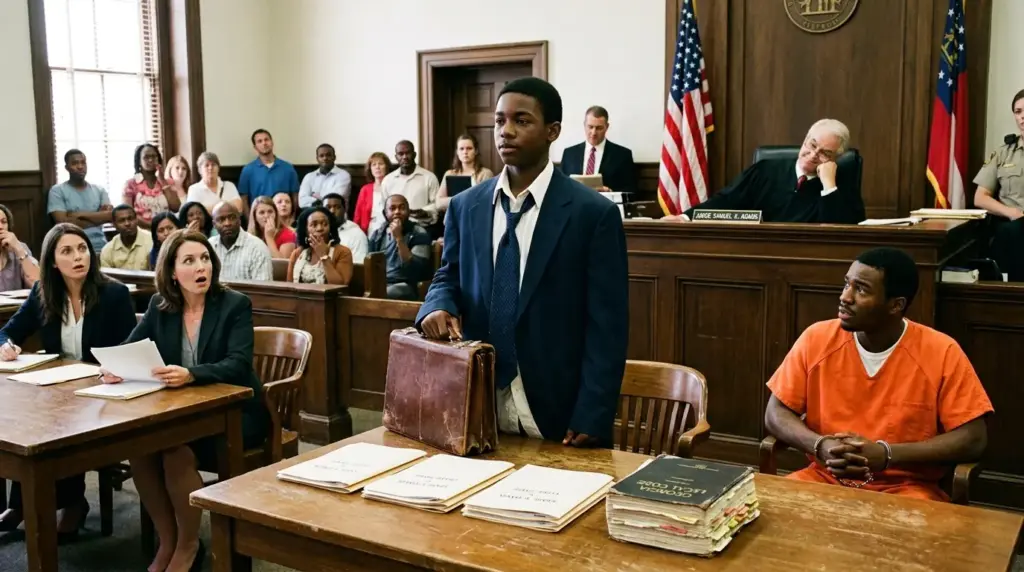
Judge Laughs at Teen in Court — Then Discovers He’s a Genius Attorney!
The judge laughed when he saw the teenager walk into the courtroom wearing his daddy’s oversized suit. But he had no idea that the boy was about to expose a secret that could destroy the prosecution’s entire case.
Nobody expected the kid in the oversized navy suit to speak.
He walked through the double doors of the Miller County Courthouse in Camilla, Georgia, like he’d done it a hundred times before. Only the jacket didn’t quite fit. The sleeves hung past his wrists, nearly hiding his hands. His tie was crooked, and the leather briefcase he carried was scratched and faded, as though it had been passed down through generations.
But the way Elijah Carrington moved told a different story.
He walked calmly, shoulders straight, eyes focused ahead, without the slightest hesitation.
Inside the courtroom, heads turned. Whispers spread across the wooden benches.
“Who’s that boy?”
“Somebody’s assistant?”
“Did a kid seriously just walk into a felony hearing?”
Judge Raymond Tolbert looked up from his bench. His reading glasses rested low on his nose. For several seconds, he simply stared at Elijah before a mocking smile crossed his face.
Elijah didn’t flinch.
He walked directly toward the defense table, opened his battered briefcase, and removed three neatly organized folders alongside a worn copy of the Georgia Code.
He arranged everything carefully, as though preparing for the most important examination of his life.
Judge Tolbert finally spoke.
“You lost, son?”
“No, sir,” Elijah answered steadily. “I’m here to help defend my brother, Isaiah Carrington.”
The courtroom fell silent.
The bailiff blinked. Prosecutor Andrea Lindholm raised an eyebrow. Someone in the third row let out a quiet laugh.
Tolbert leaned back.
“Defend him? You mean you’re here to watch his lawyer?”
“No, Your Honor. I’ve prepared his defense.”
Elijah held up a folder containing his brother’s signed statements and legal research.
“My brother wants to challenge the evidence against him. I’ve spent months preparing the arguments for his attorney.”
The judge chuckled.
“Son, this isn’t a school debate competition. This is a felony case.”
“I understand, sir.”
“You’re seventeen years old.”
“Yes, Your Honor.”
“You have no law license, no degree, and no courtroom experience.”
“No, sir.” Elijah paused. “But I’ve studied the law for two years, and I’ve read every document in my brother’s case at least twice.”
A few spectators laughed again.
Judge Tolbert shook his head.
“Confidence is impressive, young man. But confidence doesn’t make someone an attorney.”
Elijah nodded.
“Neither does a title make someone right, Your Honor.”
The laughter stopped.
For the first time, Judge Tolbert looked genuinely surprised.
The Miller County Courthouse had witnessed countless trials over the decades, but nobody could remember seeing a teenager arrive with such determination.
Elijah’s older brother, Isaiah, was twenty-four years old. He had been accused of stealing nearly $180,000 from a local construction company where he worked as an accounting assistant.
The prosecution claimed that Isaiah had manipulated financial records and transferred company funds into an unauthorized account.
If convicted, he faced years in prison.
But Elijah believed his brother had been framed.
Their father, a former legal researcher who had dreamed of becoming an attorney, had died three years earlier. The oversized navy suit Elijah wore had belonged to him.
So had the briefcase.
After his father’s death, Elijah spent countless evenings reading the legal books left behind in their small family home. He studied criminal procedure, evidence rules, and courtroom transcripts until he understood how cases were built—and how they could fall apart.
When Isaiah was arrested, Elijah began examining every detail of the accusation.
He noticed something strange.
The prosecution’s financial timeline placed Isaiah inside the company’s accounting system at 11:47 p.m. on the night the money disappeared.
But Elijah had found evidence suggesting his brother was somewhere else entirely.
Even more troubling, the electronic records appeared to have been modified after investigators first collected them.
Now, sitting beside his brother’s appointed defense attorney, Elijah quietly passed over a folder marked EXHIBIT C.
The attorney reviewed its contents, then stood.
“Your Honor, the defense requests permission to introduce newly discovered evidence concerning the prosecution’s timeline.”
Andrea Lindholm frowned.
“What evidence?”
The attorney handed the documents to the court clerk.
Elijah watched silently as Judge Tolbert examined the first page.
The judge’s expression changed.
He adjusted his glasses and read the second page.
Then the third.
“Where did you obtain these records?” Tolbert asked.
Elijah leaned toward the defense attorney and whispered an explanation.
The attorney answered, “They were obtained from the company’s original system audit, Your Honor. They show that the transaction records were altered forty-six hours after Mr. Carrington’s arrest.”
The prosecutor stood abruptly.
“That’s impossible.”
Elijah opened another folder.
The defense attorney continued.
“Furthermore, the account receiving the stolen funds was registered using credentials belonging to the company’s chief financial officer.”
A murmur swept through the courtroom.
Judge Tolbert raised his hand for silence.
“Are you suggesting the defendant was framed?”
“We’re suggesting the evidence requires immediate examination before this case proceeds.”
The judge looked toward Elijah.
“Young man, did you discover this discrepancy?”
“Yes, Your Honor.”
“How?”
Elijah swallowed.
“Because everyone was looking at who accessed the account. Nobody checked who changed the records afterward.”
For several seconds, nobody spoke.
Then Judge Tolbert turned toward the prosecutor.
“Ms. Lindholm, I want the original audit logs preserved and independently reviewed.”
Andrea’s face tightened.
“Your Honor, there’s something you should know about those records.”
The judge leaned forward.
“Then I suggest you tell this court immediately.”
She hesitated.
Because the person who had authorized the changes wasn’t Isaiah Carrington.
It was someone connected to the very investigation that had put him behind bars.
And Elijah had one final document in his father’s old briefcase that could reveal exactly who it was.
Chapter 1 – Judge Laughs at Teen in Court — Then Discovers He’s a Genius Attorney! – News